
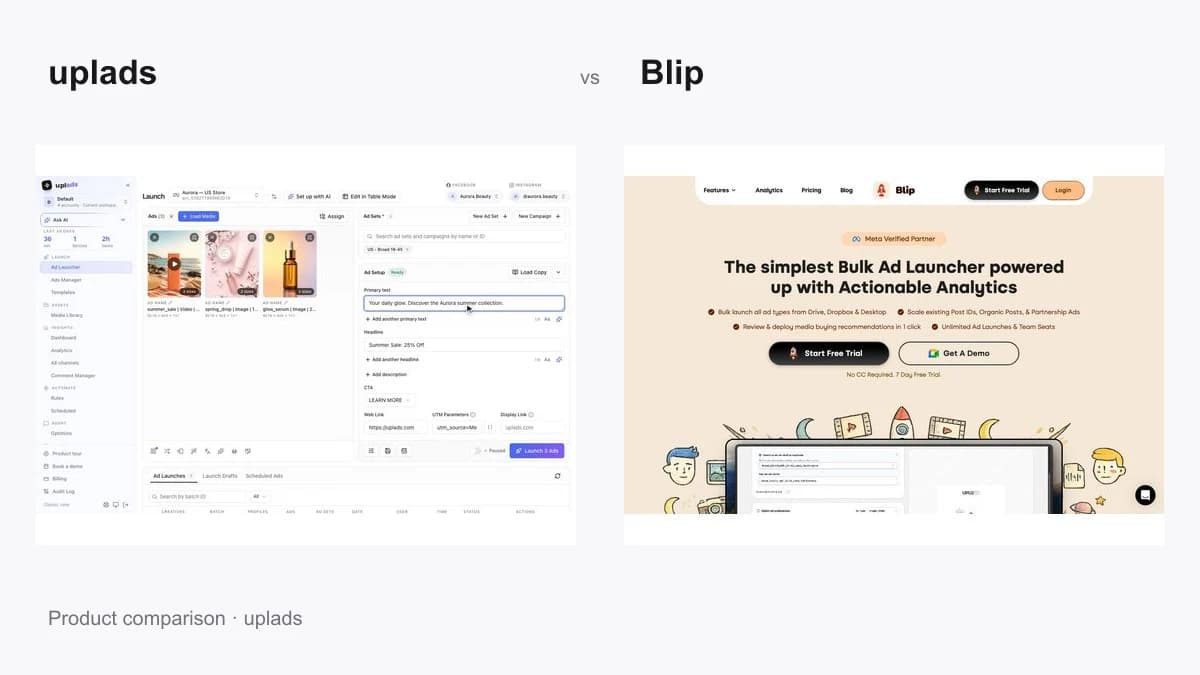
This page compares uplads and Blip (withblip.com) as of November 2026; Blip's prices were re-checked in its homepage pricing data on 9 November 2026. Blip's facts come from its own homepage, documentation, blog and terms of service; where its pages disagree with each other, we say so instead of picking the more convenient version. The feature matrix is factual. The verdict at the end is our opinion, and we are obviously not neutral, so check anything that matters to you in both free trials.
What each tool is, in one paragraph
uplads is a bulk ad launch platform built inside an Austrian performance agency. You load creatives from your computer, the media library, Google Drive, Dropbox, Frame.io or existing posts, pick ad sets (or create new campaigns and ad sets in the same screen), write or generate the copy, and launch. A background worker creates the ads 50 at a time, so one rejected ad never stops the batch.
Meta, TikTok, Google Ads, Snapchat and LinkedIn launch from the same upload. After the launch, uplads keeps going: a reporting table, automated rules on all five networks, an AI Optimizer that proposes changes for approval, creative analytics, and an MCP connector for Claude and ChatGPT. Priced in EUR from 69 EUR per month.
Blip describes itself on its homepage as "the simplest Bulk Ad Launcher powered up with Actionable Analytics". It launches images, videos, carousels, flexible ads, lead forms and call destinations to Meta from desktop, Google Drive and Dropbox (Frame.io is marked "soon"), scales existing post IDs, launches partnership ads and Instagram whitelisting, and groups 1x1 and 9x16 assets into one ad with what it calls AI Placement. Settings such as Page, naming, copy templates with up to five variants, links, UTMs and Advantage+ enhancements are saved per ad account.
The analytics side recommends scaling, reducing or pausing budgets in one click, sends anomaly alerts to Slack and builds reports. The homepage also shows a TikTok launcher and a connection to Claude and ChatGPT that launches ads, checks analytics and applies budget recommendations from the chat. Pricing is in US dollars, monthly, from $49.
Pricing side by side
$49/mo
1 ad account, unlimited launches and seats
$370/mo
Unlimited ad accounts, Meta-first
69€/mo
2 ad accounts, Meta, partnership ads included
199€/mo
5 ad accounts, Meta, TikTok, Google Ads, Snapchat, LinkedIn, rules, AI
Source: withblip.com homepage pricing section and SoftwareApplication schema, 9 November 2026; uplads pricing page, October 2026
Blip publishes three plans in the pricing section of its homepage: Starter at $49 per month for one ad account, Light at $199 for up to five, Pro at $370 for unlimited ad accounts. Every plan includes unlimited ad launches, team seats, post ID scaling, all ad types, Drive and Dropbox import and analytics. There is no yearly price, and Blip's terms state that fees already paid are non-refundable. (Two older Blip blog posts still quote $49, $99 and $149; the homepage and its schema data show the current numbers.)
uplads publishes Starter at 69 EUR per month for two ad accounts on Meta, Growth at 199 EUR for five accounts with TikTok, Google Ads, Snapchat, LinkedIn, automated rules, scheduled launches and the AI Optimizer, and Agency at 499 EUR for 15 accounts. Extra ad accounts cost 39 EUR each, and yearly billing gives two months free. Every plan starts with a 7-day free trial on Growth limits, without a credit card. The full breakdown is on the pricing page.
How it compares in practice:
- One brand, one Meta account: Blip is cheaper ($49 against 69 EUR). The uplads plan includes a second ad account; rules and the other networks start on Growth.
- Five accounts: the same number on both price tags. Blip's $199 covers Meta (plus its TikTok launcher). uplads' 199 EUR covers five networks, rules, scheduled launches and the AI Optimizer.
- Dozens of Meta-only accounts: Blip's flat $370 for unlimited accounts beats uplads Agency on price. That is the one profile where Blip's pricing structure wins clearly, and we say so in the verdict.
Pros and cons
uplads
Pros
- Meta, TikTok, Google Ads (Performance Max, Demand Gen, YouTube, App), Snapchat and LinkedIn from one upload
- Meta ads that lead to a website, a phone call, a Facebook event, Messenger, Instagram Direct or WhatsApp, picked per ad when launching or editing
- Partnership ads with both Meta mechanisms: co-branding on your own creatives and promoting a creator's post by code, on every plan
- Automated rules on Meta, TikTok, Google Ads, Snapchat and LinkedIn with budget floors and ceilings, alerts by email, Slack or ClickUp
- AI Optimizer: a Meta account audit whose findings you apply in one click and can undo, with audits on all five networks through the MCP connector
- AI ad copy per platform, with a saved brand voice per ad account
- MCP connector for Claude and ChatGPT, with paused-by-default building, launch drafts and a daily spending ceiling
- Per-member permissions and an audit log of every change
- Preview link for batches on all five networks: clients comment on each ad without a login, and the batch waits as a launch draft
- Scheduled go-live in the ad account's own time zone, catalog product sets on bulk launches
- EUR pricing from an EU company, yearly billing with two months free
Cons
- Seats are tiered (1, 5 and 15) where Blip includes unlimited seats
- Preview links do not export to PDF, where Blip's previews do
Blip
Pros
- $49 entry plan for a single Meta ad account
- Unlimited launches and unlimited team seats on every plan
- Unlimited ad accounts on the $370 Pro plan
- Client preview links for approval before launch: clients comment without an account, previews export as PDF
- Slack-native anomaly alerts and reports
- Claude and ChatGPT connection that launches ads, reads analytics and applies budget recommendations
Cons
- No Google Ads or Snapchat, and TikTok described as live on the homepage but "coming soon" on other Blip pages
- No automated rules engine; recommendations wait for a click
- No AI ad copy listed and no public API; the homepage describes no spending limit or approval step for the Claude and ChatGPT connection
- No audit log of account changes ("not the focus", per Blip's own Kitchn comparison)
- No Advantage+ catalogue ads or WhatsApp destinations, per Blip's own roundup
- USD only, monthly only, fees non-refundable per its terms
Feature matrix
| Capability | uplads | Blip |
|---|---|---|
| Bulk upload from desktop, Google Drive, Dropbox | ||
| Frame.io import | announced as "soon" | |
| Group 1x1 / 4x5 / 9x16 variants into one ad | AI Placement | |
| Saved copy, naming, link and UTM templates per account | ||
| Advantage+ creative enhancements off by default | per account | saved per account |
| Carousel, flexible ads, lead forms | ||
| Relaunch existing ads by post ID | ||
| Ad destinations beyond a website | call, event, Messenger, Instagram Direct, WhatsApp | call destinations; no WhatsApp (Blip's roundup) |
| Partnership ads: co-branding on own creatives | ||
| Partnership ads: creator post via ad code | ||
| Catalog product set on a bulk launch | no Advantage+ catalogue ads (Blip's roundup) | |
| Create new campaigns and ad sets while launching | duplicates existing shells | |
| Scheduled go-live at a set time | Meta | not listed |
| Automatic boosting of new organic posts | yes (Post Boosts) | Instagram organic boosting |
| TikTok launching | Growth and up | homepage yes, other pages "coming soon" |
| Google Ads: PMax, Demand Gen, YouTube, App | ||
| Snapchat launching | ||
| LinkedIn launching | ||
| AI ad copy per platform | not listed | |
| Reporting table | 60+ columns, Meta | analytics dashboards |
| One-click budget recommendations | ||
| Automated rules (pause, scale, alert) | all five networks | not listed |
| Alerts in Slack | rules | anomalies, reports |
| Creative analytics by format, hook and angle | Meta | creative hit rate |
| Client preview links for approval, with comments | ||
| Team seats | 1 / 5 / 15 by plan | unlimited |
| Per-member permissions and audit log | audit log "not the focus" (Blip's Kitchn page) | |
| AI assistant connector (MCP) | ||
| Public API | ||
| Free trial | 7 days, no card | 7 days, no card |
| Price and currency | 69 / 199 / 499 EUR, monthly or yearly | $49 / $199 / $370, monthly |
The launch rows are close. Everything from "TikTok launching" downwards is where the two products part ways, and most of those rows sit on the uplads side.
Where uplads wins
Every network from one upload. A creative batch rarely stays on Meta. uplads sends the same upload to Meta, TikTok, Google Ads, Snapchat and LinkedIn, with each network's own rules handled for you: TikTok's 9x16 padding, Google's asset groups and text limits, Snapchat's vertical Snap Ads. The multi-platform page shows how that works per network. Blip's homepage shows a TikTok launcher and nothing beyond it.
Partnership ads on every plan, both kinds. Blip markets bulk partnership ads, and it is a fair highlight. uplads covers both Meta mechanisms in one dialog: name a creator on a whole batch of your own creatives without any ad code, or promote creators' posts by pasting many codes at once, each checked against Meta before launch. The dialog reads your approved creators from Meta and sends permission requests. Details on the partnership ads page.
Automation with a ceiling. Blip's analytics recommend budget moves and wait for a click. uplads offers the same one-click step through the AI Optimizer, with undo, and adds automated rules that run on their own on all five networks: conditions on the numbers each network reports (25 metrics on Meta), AND or OR logic, lookbacks up to 30 days, actions that pause, reactivate, raise or lower budget, and a floor and ceiling a rule can never cross. Every run is logged with the numbers it saw.
An AI assistant you can actually let in. Blip's blog argues that wiring Claude Code to the Meta API is risky, and for a raw script that is true. Both tools now answer that with a connector of their own: Blip's homepage shows Claude and ChatGPT launching ads, scheduled or live, checking analytics and applying budget recommendations. The difference is what is written down about the limits.
Through the uplads MCP connector, Claude or ChatGPT can import creatives from a Dropbox link, read your brand context, write the copy, build campaigns and ad sets paused, and stage the launch as a draft that a person reviews and launches. Publishing directly, switching ads on or raising spend needs a workspace switch, a daily spending ceiling and an explicit yes in the chat, and every action lands in the audit log. Blip's homepage describes no spending limit or approval step for its connection, and Blip offers no public API.
Teams with accountability. Blip includes unlimited seats, and uplads tiers them. The trade is control: in uplads every member gets their own ad accounts, Pages, edit rights and spend visibility, a read-only analyst really cannot change budgets, and every write action lands in an audit trail. Blip's own comparison with Kitchn lists the audit log as "not the focus".
Run a real launch through uplads
The 7-day trial runs on Growth limits without a credit card: launch one batch to Meta and TikTok, set up a co-branded partnership ad and a rule, and compare it with the week you have now.
When the answer is honestly "Blip"
There is a real profile for Blip. You run a large number of Meta ad accounts, ideally more than 15, all spend stays on Meta, you want every freelancer and client contact to have a seat without counting, and nobody on the team wants automated rules running on the accounts. Then Blip's flat $370 for unlimited accounts and seats is the better deal, and choosing it is the right call. If one of those conditions breaks, for example the first TikTok or Google test, or a client who asks who changed a budget on Friday, the profile points to uplads.
When the answer is "uplads"
uplads is the better fit when at least one of these is true: the same creatives go to Meta and at least one other network; the week after the launch involves rules, budget changes or an optimization pass that someone does by hand today; several people work in client accounts and you need to know who changed what; partnership ads are part of the plan and you want the co-branded and creator-code paths in the same launch; or you want Claude or ChatGPT to do the setup work while a person keeps the launch button. That is most agencies and most brands that spend on more than one network.
What uplads does not do, said plainly
uplads does not include unlimited seats; Starter is one seat, Growth five and Agency 15. Clients see a batch through a preview link: one link per batch, no login, a comment on any ad and an optional approval per ad. It does not export previews as PDF, as Blip does. The Optimize tab in the app and creative analytics are Meta only; rules run on all five networks, and Optimize audits reach the other four through the MCP connector. And the Starter plan is Meta only; TikTok, Google Ads, Snapchat and LinkedIn start on Growth.
Verdict
Pick uplads. Blip only wins for a large, Meta-only agency that needs unlimited accounts and seats on one flat plan.
Both launch to Meta fast, both handle partnership ads and both now connect to Claude and ChatGPT. Every network beyond Meta and TikTok, every rule that runs without a click, the AI copy and a published daily spending ceiling for the assistant exist only on the uplads side.
Blip has built a fast and friendly Meta launcher, and its flat pricing for unlimited accounts is genuinely attractive for very large Meta shops. uplads does the same launch job and then covers the rest of the week: the batch goes to TikTok, Google, Snapchat and LinkedIn from the same upload, partnership ads run on every plan, rules with hard budget limits watch the account, the Optimizer proposes the next move, and Claude or ChatGPT can prepare the whole launch while a person keeps the final click. For a team whose work does not end at the launch screen, uplads is the stronger choice.