
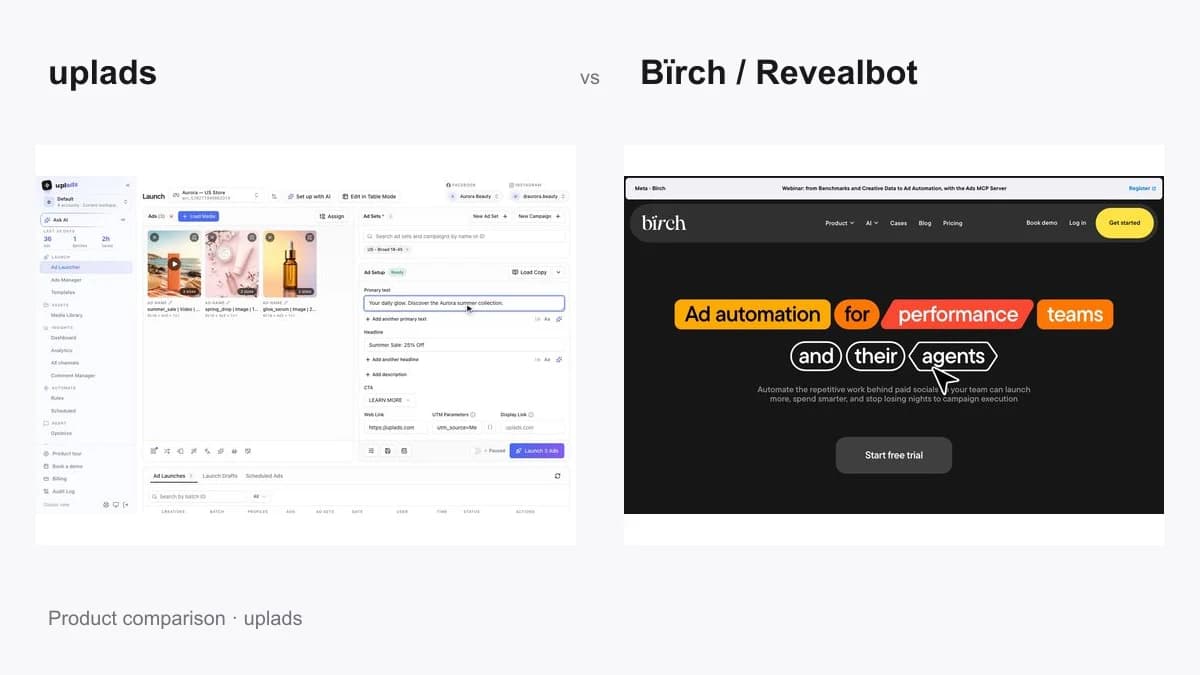
This page is the practical, side-by-side read on uplads versus Revealbot (now Bïrch) for performance marketers, agencies, and ecommerce teams deciding which tool fits which part of their workflow in 2026. The two tools share an audience but a different center of gravity. The verdict at the bottom is opinionated; the matrix in the middle is not.
A note on the rebrand
Revealbot is now Bïrch. The rename happened in October 2024 and is announced on the Bïrch company blog, where the team frames the move as a refocus on blending automation with creative testing. The product, the team, and the API are continuous; only the brand name changed. G2 still lists the product as "Bïrch (ex. Revealbot)", most search traffic still uses the legacy "Revealbot" name, and the new one is usually typed without the diaeresis, as Birch. This page treats the two as the same product and uses both names depending on what makes the sentence cleaner.
What each tool is, in one paragraph
uplads is a bulk ad launch platform. The product loop is: drag in 50 to 200 creatives, pick ad sets across one or many ad accounts, pick a naming template, click launch. A background worker creates the ads in batches of fifty against the Meta Marketing API, with per-ad failure isolation and multi-placement grouping handled automatically.
Once the ads are live, an in-app Ads Manager covers bulk actions on them - pause, activate and budget changes on every network, plus find-and-replace text edits across selected Meta ads. Automated rules run on Meta and TikTok, and Post Boosts turns new organic posts into ads on its own. Meta, TikTok, Google Ads and Snapchat are the production networks. uplads was built inside an Austrian performance marketing agency where the daily reality is shipping dozens of ad variants per client per week.
Revealbot (now Bïrch) is a multi-network ad automation platform. The product center is the automation rules engine: pause ads if a metric crosses a threshold, scale budgets when ROAS clears a target, alert in Slack the moment a campaign changes state. On top of that the platform layers Launcher for bulk ad creation, Stage for creative testing, Explorer for analytics, an audience builder, and integrations with Slack, Google Sheets, AppsFlyer, and Hyros. Networks supported per the Bïrch pricing page are Meta, Google, TikTok, and Snapchat, and the product carries a 4.6 out of 5 rating on G2.
Pricing at a glance
$49/mo
Up to $10K monthly ad spend
$99/mo
Adds automation rules, scales with spend
69€/mo
2 ad accounts, no spend cap
499€/mo
15 ad accounts, 15 seats
Source: Bïrch pricing page (bir.ch/pricing), checked 7 October 2026, and uplads pricing page, October 2026
The pricing models are structurally different, which matters more than the numbers. Bïrch prices by the ad spend the team pushes through the platform. The Essential plan at $49 per month covers up to $10,000 in monthly ad spend; above that, the price rises with spend across all ad accounts. Pro at $99 per month is the popular tier - it unlocks automated rules, Launcher, Explorer, Stage, the audience tools and the third-party integrations - and it scales with spend the same way. Enterprise is custom and adds onboarding plus premium support. The 14-day free trial includes every feature and needs no credit card. The model fits a tool whose value scales with the size of the budget it is automating.
uplads prices by ad account count. Every plan starts with a 7-day free trial on Growth limits, no credit card up front. Paid tiers start at 69€ per month for Starter (two ad accounts, one seat, Meta only), 199€ per month for Growth (five ad accounts, five seats, Meta, TikTok, Google Ads and Snapchat plus the AI Optimizer, automated rules and Post Boosts), and 499€ per month for Agency (15 ad accounts, 15 seats). Extra ad accounts cost 39€ each, yearly billing gives two months free, and an Enterprise tier covers teams past 15 accounts.
There is no ad spend cap on any tier - the spend that flows through uplads is between you and the network you are launching on. See the uplads pricing page for the full breakdown.
The practical difference: if you scale monthly ad spend, Bïrch scales in price with you and uplads does not. If you scale ad accounts (agency mode), uplads scales in price and Bïrch does not. A solo brand running $30,000 a month in Meta spend on one ad account pays uplads 69€ and pays Bïrch whatever the spend-based pricing bracket says. An agency running $30,000 a month spread across fifteen client accounts pays uplads 499€ for all fifteen and pays Bïrch per managed-spend bracket on each account it automates.
The honest pros and cons
uplads
Pros
- Drag-drop bulk upload, 50 to 200 files per session, deduplicated automatically
- Multi-placement auto-grouping (4×5 + 9×16 of the same creative collapsed into one ad)
- Per-ad failure isolation on batches of 50, so one bad ad does not kill the launch
- Token-based naming template applied at launch, not as a post-launch cleanup pass
- Pricing by ad accounts and storage, no managed ad spend cap
- Catalog enhancement attaches a product set once and rides on every ad in the batch
- Meta, TikTok, Google Ads and Snapchat live in production
- Automated rules engine for Meta and TikTok on Growth and Agency: 25 metrics, pause, activate, budget up or down or notify, budget moves clamped to a floor and ceiling, alerts to email, Slack or ClickUp
- In-app Meta Ads Manager with bulk actions on live ads, including find-and-replace text editing across selected ads
- Creative analytics classifies every creative along six traits (format, hook, angle, emotion, awareness stage, tone) and reports which ones carry the spend
- AI Optimizer audits the Meta account and proposes changes for one-click approval, never acting on its own
- Scheduled launches (Growth and Agency), per-person team permissions, full audit log
- Post Boosts: new organic posts from Facebook, Instagram or TikTok become ads in your own campaign, with a run time, a spend cap per post and an optional approval step
- MCP connector (Beta, every plan): Claude or ChatGPT build campaigns paused and stage launch drafts a person reviews, with a daily budget ceiling on anything that raises spend
Cons
- Meta, TikTok, Google Ads and Snapchat by design; no Pinterest, no CTV
- Rules run on Meta and TikTok, the AI Optimizer and creative analytics on Meta only; Bïrch's rule layer also covers Google and Snapchat
- Post Boosts fires on every new post; there are no engagement or keyword conditions yet
- No third-party attribution integrations (AppsFlyer, Hyros) - the numbers come straight from Meta
Revealbot (Bïrch)
Pros
- Mature rules-based automation engine for Meta, Google, TikTok, and Snapchat
- Slack alerts when a rule fires or a campaign changes state
- Launcher, Stage (creative testing), Explorer (analytics), and audience builder
- Integrations with Google Sheets, AppsFlyer, Hyros for warehouse-led attribution
- 4.6 out of 5 on the G2 listing for Bïrch (ex. Revealbot)
- 14-day free trial with every feature, no credit card
- Long track record on Meta optimization specifically
- Post boosting rules that wait for organic proof: reactions, comments, shares, engagement rate, video views, post age or a keyword in the post text, combined with AND or OR
Cons
- Pricing scales with monthly ad spend, which gets expensive at scale
- The bulk Launcher is real, but not built for shipping 100+ variants from a creative library in a single pass
- No multi-placement auto-grouping for 4×5 + 9×16 variants of the same creative
- The rebrand from Revealbot to Bïrch in October 2024 caused real confusion in support docs and SEO surfaces
- Rules engine has a learning curve - teams that under-use the automation pay for value they do not capture
- Post boosting covers Facebook and Instagram, not TikTok
Feature matrix
| Capability | uplads | Revealbot (Bïrch) |
|---|---|---|
| Drag-drop bulk upload, 50-200 files per session | Partial (Launcher) | |
| Multi-placement auto-grouping (4×5 + 9×16 collapsed into one ad) | ||
| Per-ad failure isolation on a 50-ad batch | n/a | |
| Token-based naming template applied at launch | Partial | |
| Automation rules engine (pause / scale / alert) | yes, Meta and TikTok (Growth, Agency) | yes, four networks |
| Slack alerts on rule firing | ||
| AI optimization layer | yes, proposes changes for approval | |
| Creative trait analytics (format, hook, angle, emotion) | ||
| Reporting surface | yes, 60+ columns on Meta, all plans | yes (Explorer) |
| Catalog enhancement on every ad in a batch | ||
| Facebook + Instagram support | ||
| Google Ads (Performance Max, Demand Gen, YouTube, App) | ||
| TikTok ads | ||
| Snapchat ads | ||
| Auto-boost new organic posts | yes (Facebook, Instagram, TikTok) | yes (Facebook, Instagram) |
| Boost only after engagement or keyword conditions | ||
| Approval step before a post is boosted | not documented | |
| AI assistant connector (MCP) for Claude / ChatGPT | yes (Beta, every plan) | not publicly documented |
| Pricing scales by | Ad accounts and storage | Managed ad spend |
| Free trial | 7 days on Growth limits, no card | 14 days, no card |
| Starting paid price | 69€/month | $49/month (up to $10K ad spend) |
The two columns describe two product centers of gravity. uplads is green where the launch-day workflow lives - grouping, naming, failure isolation, catalog, drag-drop bulk - and holds its own on the post-launch rows, with rules on Meta and TikTok, post boosting, AI optimization, trait analytics and live-ad bulk editing. Bïrch is green where cross-network automation lives - rules and alerts spanning Meta, Google, TikTok and Snapchat - and where a post has to earn its boost before money moves.
Where uplads wins
High-volume creative testing weeks. A common paid-ads testing motion in 2026 is five product angles, three audience cuts, two aspect ratios per creative - fifty ads per launch, often two launches per week. The uplads loop (drop files, pick ad sets, pick template, launch) collapses that into a fifteen-minute pass against the Meta API - in internal timings, 87% faster than building the same launch by hand in Ads Manager. Bïrch has a Launcher surface, but the wedge of the product is what happens after the ads go live. Shipping 100 to 200 ad variations from a single upload, deduplicated by hash, is the uplads job.
Multi-placement reality. The 4×5 Feed creative and the 9×16 Story or Reel creative for the same concept are one ad in uplads (see the multi-placement product page), with placement-level asset customization handling which ratio serves where. Bïrch does not collapse aspect-ratio variants into a single ad - you either bring both as separate ads, or you launch one ratio and let it look wrong on the wrong placement. For agencies producing Reels and Feed posts from the same shoot, the uplads grouping compresses the ad count meaningfully and makes frequency management cleaner.
Pricing without a spend-based ramp. A growing ecommerce brand that crosses from $10,000 to $100,000 a month in Meta ad spend keeps paying uplads the same flat 69€ or 199€. Bïrch pricing is bracketed against monthly ad spend, so that same growth curve pushes the brand up Bïrch tiers as it scales. Whether the trade is fair depends on how much ROI the automation rules deliver against the bigger budget - but the ramp is real, and it punishes media buyers who are already scaling well on their own.
The naming engine, applied at launch. uplads applies the template at launch time as part of the API call, so the ad name is correct before the ad exists. Bïrch's Launcher can apply a naming convention as well, but Bïrch's daily job is automating live ads - the template enforcement at launch is not its center. For teams whose attribution dashboards depend on parsing ad names, "right at launch" beats "fixed afterwards" every Monday morning.
Per-ad failure isolation. When uplads creates 50 ads in a batch, one bad asset, one rejected creative, or one ad set permission issue fails that one ad and lets the other 49 ship. Most Excel-style bulk import paths fail the whole batch on the first error. The uplads behavior is the practical difference between a clean Monday morning and a four-hour cleanup pass.
Hands-on bulk editing of live ads. Bïrch changes live ads by rule; uplads adds the hands-on layer. The in-app Meta Ads Manager runs bulk actions on live ads - select fifty ads and pause, activate or rewrite them in one pass, with find-and-replace text editing across every selected ad. Rules handle the predictable cases; the bulk editor handles the Tuesday case where legal wants one claim changed in every running ad.
Use uplads for the launch, then automate wherever you want
Every uplads plan starts with a 7-day free trial on Growth limits, no credit card up front - enough to push a real bulk launch through uplads and decide whether the time saving holds up against the way the team ships ads today.
Post boosting: same idea, different trigger
Both tools automate the oldest chore in paid social: an organic post goes up, and somebody has to remember to put money behind it. Both turn the post into a real ad with your own targeting rather than the Boost Post button's cut-down form, and both cap how many boosted posts run at once, switching off the oldest when a new one arrives. The difference is the question each one asks before it spends.
Bïrch asks whether the post has earned it. A Bïrch post boosting rule watches Facebook Pages and Instagram accounts and checks each post against conditions: organic impressions, reach, engagement rate, reactions, comments, shares, negative feedback, video views, click rate, how many hours ago it was published, and whether the text contains or excludes a keyword, combined with AND or OR. "Boost videos with 100 views and 10 shares in the first four hours" is the kind of rule it is built for. The campaign, ad set, targeting, placements and budget are configured inside the rule, and every boosted post becomes a new ad set in one campaign. Alerts go to email or Slack.
uplads asks whether the post is new. Post Boosts watches up to ten Facebook Pages, Instagram accounts or TikTok identities and checks every 3, 6, 12 or 24 hours. Every post that appeared since the last check is a candidate, filtered by format if you want (images, videos, carousels). The ad lands where you point it: one more ad in an existing ad set, a copy of a template ad set inside your campaign, or a copy of a whole template campaign.
You set a budget per day or for the whole run, a run time, and a cap on what one boosted post may spend in total. New rules start on ask-first, so each detected post waits for a human until you switch the rule to boost on its own. On TikTok the boost becomes a Spark Ad on the original video.
| Post boosting | uplads Post Boosts | Bïrch post boosting |
|---|---|---|
| Sources | Facebook, Instagram, TikTok | Facebook, Instagram |
| Trigger | Every new post, filtered by format | Engagement, reach, views, post age, keywords |
| Approval step before money moves | not documented | |
| Where the ad lands | Existing ad set, new ad set in your campaign, or a campaign copy | New ad set in one campaign |
| Spend cap per boosted post | Via a lifetime budget per ad set | |
| Switches off the oldest boost | ||
| Alerts | Email, Slack |
If a client publishes a handful of posts a week and every one of them deserves budget, the uplads shape is the shorter path, and it reaches TikTok as well. If a page publishes twenty posts a day and only the ones that take off organically should get money, Bïrch's conditions do something uplads does not do today.
When the answer is honestly "use both"
The joint stack fits one narrow profile: the brand or agency running mid five figures and up monthly across several networks, whose pause and scale logic must span Meta, Google, TikTok and Snapchat at once - the one job uplads' rules, which run on Meta and TikTok, do not cover. That team lets uplads ship the Monday batch and handle the Meta and TikTok share of the week while Bïrch runs the cross-network automation; both tools write the same network objects, so nothing has to migrate. Every narrower setup - Meta-and-TikTok spend, rules that live on those two networks, creative volume as the real bottleneck - lands on uplads alone, and the answer only changes if the cross-network automation need actually materializes.
What uplads does not do, said plainly
In the spirit of the truth rule on this site, the things uplads does not do that Bïrch (Revealbot) does:
- Rules on Google and Snapchat. uplads' rules run on Meta and TikTok, its AI Optimizer and creative analytics on Meta; Bïrch's rules span all four networks. uplads launches to all four as well, but does not automate Google or Snapchat.
- Conditional post boosting. Bïrch can hold a post back until it earns a set number of reactions, comments, shares or views, or until its text contains a keyword. uplads boosts every new post, filtered by format if you want, and offers an approval step instead of engagement conditions.
- Third-party attribution integrations (AppsFlyer, Hyros). uplads reads its numbers straight from Meta; warehouse-led measurement teams will want Bïrch's integrations.
If one of those is non-negotiable for the team's week, Bïrch (or another tool in this space - AdEspresso for A/B-test generation, Smartly.io for enterprise multi-channel creative production) is the right call and this page does not pretend otherwise. See the Revealbot alternatives page for the broader market.
Verdict
Pick uplads for high-volume launch plus rules on Meta and TikTok, post boosting, reporting and creative analysis. Pick Bïrch (Revealbot) when pause/scale logic genuinely has to span Google and Snapchat too, or when posts should only be boosted once they perform organically.
uplads combines bulk launch on four networks with rules on Meta and TikTok, automatic post boosting, live-ad bulk editing, reporting and creative analytics. Bïrch is a cross-network rules engine whose launch surface is an attachment, not the wedge.
For the agency or in-house team whose Monday morning is "fifty new ads across Meta and TikTok, fifteen ad sets, one naming convention," and whose optimization is Meta and TikTok heavy, uplads is the more direct fit - and is flat-priced against ad accounts rather than ad spend. Bïrch is the more direct fit for the team whose week genuinely depends on one pause/scale layer running across Meta, Google, TikTok and Snapchat at once. Network scope is the deciding axis, and it is a narrower one than it looks: if Meta and TikTok are where the budget actually sits, uplads covers launch, rules, post boosting, live-ad bulk editing, reporting and creative analysis in a single tool, while Bïrch covers the rules layer across more logos.