
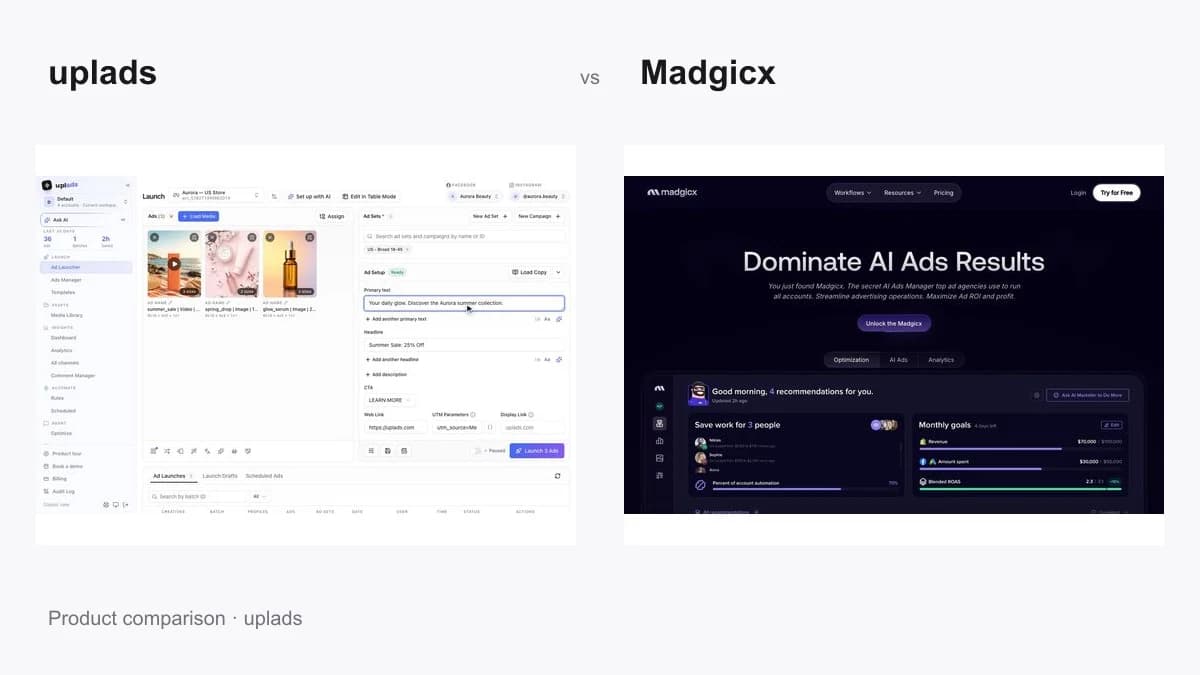
This page is the practical, side-by-side read on uplads versus Madgicx for performance marketers, agencies, and ecommerce teams deciding which tool fits which part of their workflow in 2026. The two products sit in the same Meta ads ecosystem but they solve different jobs. The verdict at the bottom is opinionated; the matrix in the middle is not.
What each tool is, in one paragraph
uplads is a bulk ad launch platform. The product loop is: drag in 50 to 200 creatives, pick ad sets across one or many ad accounts, pick a naming template, click launch. A background worker creates the ads in batches of fifty against the Meta Marketing API, with per-ad failure isolation and multi-placement grouping handled automatically.
After launch, an in-app Meta Ads Manager covers the live side - bulk actions on running ads, including bulk text editing with find-and-replace - alongside automated rules and an AI Optimizer that proposes changes for one-click approval. Meta, TikTok, Google Ads and Snapchat are the production networks. uplads was built inside an Austrian performance marketing agency where the daily reality is shipping dozens of ad variants per client per week.
Madgicx describes itself on madgicx.com as an "Agentic Meta Ads Management AI Platform". The product is organized into three workflows: Optimization, pitched as a personal AI media buyer that audits the account and surfaces opportunities; AI Ads, an end-to-end generative creative workflow; and Analytics. The daily job is improving the performance of ads that are already running on Meta, not bulk-launching new ones. On the pricing page the Pro Complete with AI plan is priced by monthly ad-spend bracket, with the number shown inside the app; Tracking Pro adds tracking and attribution for $49 per month per connected account.
Pricing at a glance
In-app price
Set by monthly Meta ad-spend bracket
$49/mo
Per connected ad account
69€/mo
2 ad accounts, no spend cap
499€/mo
15 ad accounts, 15 seats
Source: madgicx.com/pricing, checked 7 October 2026; uplads pricing page, October 2026
The pricing models are structurally different, which matters more than the numbers. Madgicx prices by the ad spend you push through Meta. Its pricing page asks for a monthly spend bracket (less than $1K, then steps up to $30K and more) and shows the actual price inside the app, with discounts for quarterly and annual billing. That model fits a tool whose value scales with the size of the budget it is optimizing: more spend means more decisions, more bid adjustments, more audience signal to chew on.
uplads prices by ad account count. Every plan starts with a 7-day free trial on Growth limits, no credit card up front. Paid tiers start at 69€ per month for Starter (two ad accounts, one seat, Meta only), 199€ per month for Growth (five ad accounts, five seats, Meta, TikTok, Google Ads and Snapchat plus the AI Optimizer and automated rules), and 499€ per month for Agency (15 ad accounts, 15 seats). Extra ad accounts cost 39€ each, yearly billing gives two months free, and an Enterprise tier covers teams past 15 accounts.
There is no ad spend cap on any tier - the spend you push through uplads is between you and the network you are launching on. See the uplads pricing page for the full breakdown.
The practical difference: if you scale ad spend, Madgicx scales in price with you and uplads does not. If you scale ad accounts (agency mode), uplads scales in price and Madgicx does not. A solo brand running $20,000 a month in Meta spend on one ad account pays uplads 69€ and pays Madgicx whatever the ad-spend bracket says. An agency running $20,000 a month total across fifteen client accounts pays Madgicx per-spend on each account and pays uplads 499€ for the whole stack.
The honest pros and cons
uplads
Pros
- Drag-drop bulk upload, 50 to 200 files per session, deduplicated automatically
- Multi-placement auto-grouping (4×5 + 9×16 collapsed into a single ad)
- Per-ad failure isolation in batches of 50, so one bad ad does not kill the launch
- Token-based naming template applied at launch, not post-launch cleanup
- Pricing by ad account, no managed spend cap
- Catalog enhancement attaches a product set once and rides on every ad in the batch
- Meta, TikTok, Google Ads and Snapchat live for customers
- Partnership ads (co-branding and creator post codes) on every plan
- Automated rules on Meta and TikTok (Growth and Agency): 25 metrics plus name and date conditions, budget moves clamped to a floor and ceiling
- AI Optimizer audits the Meta account and proposes changes for approval, with one-click apply
- In-app Meta Ads Manager with bulk actions on live ads, including bulk text editing with find-and-replace
- Creative analytics classifies every creative along six traits and shows which of them carry the spend
- AI ad copy per platform in your brand voice, up to five variants per field
- MCP connector (Beta, every plan): Claude or ChatGPT build campaigns paused and stage launch drafts a person reviews, with a daily budget ceiling on anything that raises spend
Cons
- Optimization stays human-approved by design - the AI Optimizer proposes cost caps and changes, it never bids autonomously
- No generative-AI image or video production - visual creatives come from your own pipeline
- No attribution layer - use Meta CAPI directly or a third-party tracking tool
Madgicx
Pros
- AI bidding and budget optimization on Meta
- Audience AI for prospecting, retargeting, and lookalike alternatives
- Creative scoring and generative-AI ad production
- Analytics and reporting dashboards for Meta
- Tracking Pro add-on for tracking and attribution per connected account
- 4.6/5 rating on G2 from 219 reviews (G2 listing)
- Long track record on Meta optimization specifically
Cons
- Meta only - no Google Ads, no TikTok, no Performance Max
- Pricing scales with monthly Meta ad spend, which gets expensive at scale
- 1.7/5 rating on Trustpilot from 271 reviews (Trustpilot page), with recurring trial-to-billing complaints
- No price on the public pricing page; you see it inside the app
- Not built for high-volume bulk launching of new creative variants
- Tracking Pro is a separate $49/month line item per connected account
Feature matrix
| Capability | uplads | Madgicx |
|---|---|---|
| Drag-drop bulk upload, 200 files per session | ||
| Multi-placement auto-grouping (4×5 + 9×16 collapsed into one ad) | ||
| Per-ad failure isolation on a 50-ad batch | n/a | |
| Token-based naming template applied at launch | ||
| Automated rules engine (pause / activate / budget / notify) | yes (Growth, Agency) | Partial |
| In-app ads manager with bulk edits on live ads | yes (Meta, incl. find-and-replace) | |
| AI optimization layer | yes, proposes changes for approval | |
| AI bidding automation on Meta | Partial (proposes cost caps) | |
| Audience AI / lookalike alternatives | ||
| Generative-AI ad copy | yes - brand voice, Claude or GPT | |
| Generative-AI image / video production | ||
| Reporting inside the tool | yes, 60+ columns, all plans, Meta only | |
| Creative performance scoring | yes - six-trait creative classification | |
| Catalog enhancement on every ad in a batch | Partial | |
| Facebook + Instagram support | ||
| Google Ads / Performance Max | ||
| TikTok ads | ||
| Snapchat ads | ||
| Tracking and attribution layer | yes (Tracking Pro add-on) | |
| AI assistant connector (MCP) for Claude / ChatGPT | yes (Beta, every plan) | not publicly documented |
| Pricing scales by | Ad accounts and storage | Managed Meta ad spend |
| Free trial on entry plan | 7 days on Growth limits | 7-day trial |
| Starting paid price | 69€/month | shown in the app, by ad-spend bracket |
| G2 rating | not yet listed | 4.6 / 5 (219 reviews) |
| Trustpilot rating | not yet listed | 1.7 / 5 (271 reviews) |
The two columns describe two different product centers of gravity. uplads is mostly green where the launch-day workflow lives - grouping, naming, failure isolation, catalog, multi-network reach - and increasingly on the day-two rows as well: rules, live-ad bulk edits, reporting and creative classification. Madgicx stays green where autonomous optimization lives - AI bidding, audience discovery, generative creative, tracking.
Where uplads wins
High-volume creative testing weeks. A typical paid-ads testing motion in 2026 is five product angles, three audience cuts, two aspect ratios per creative - fifty ads per launch, often two launches per week. The uplads loop (drop files, pick ad sets, pick template, launch) collapses that into a fifteen-minute pass against the Meta API - 87% faster than launching the same batch manually, per internal timings. Shipping fifty new variants on Monday morning is not what Madgicx is built for; its launch surface is a thinner part of the product, and the wedge is what happens after the ads go live.
Multi-placement reality. The 4×5 Feed creative and the 9×16 Story or Reel creative for the same concept are one ad in uplads (see the multi-placement product page), with placement-level asset customisation handling which ratio serves where. Collapsing aspect-ratio variants into a single ad is not part of the Madgicx workflow - you either bring two ads, or you launch one ratio and let it look worse on the wrong placement. For agencies producing Reels and Feed posts from the same shoot, the uplads grouping compresses the ad count meaningfully and makes frequency management cleaner.
Pricing without a spend-based ramp. A growing ecommerce brand that crosses from $10,000 to $100,000 a month in Meta ad spend keeps paying uplads the same flat 69€ or 199€. On Madgicx the price is bracketed against monthly Meta spend, so the same growth curve moves the brand up the brackets as it scales. Whether that is a fair trade depends on how much ROAS the optimization layer delivered against that bigger budget allocation - but it is a real ramp, and one that punishes media buyers who are already scaling well on their own.
The post-launch week, without a second tool. uplads ships an in-app Meta Ads Manager with bulk actions on live ads - including bulk text editing with find-and-replace across selected ads - plus the automated rules engine on Growth and Agency and an AI Optimizer that audits the account and proposes changes for one-click approval.
Reporting is built in on every plan: over 60 metric columns with campaign-to-ad drilldown, breakdowns by age, gender, country, placement or device, and CSV export, plus a creative analytics layer that classifies every creative that has run along six traits (visual format, hook, angle, emotion, awareness stage, tone) and reports which of them carry the account's spend. A large share of what teams shop for in the optimization aisle is already in the flat tier.
The naming engine, applied at launch. uplads applies the template at launch time as part of the API call, so the ad name is correct before the ad exists. As an optimization platform first, Madgicx does not treat naming-template enforcement at launch as its job. For teams whose attribution dashboards depend on parsing ad names, "right at launch" beats "fixed afterwards" every Monday morning.
Multi-network on one upload screen. Performance teams in 2026 increasingly run Meta, Google Performance Max, and TikTok in parallel. uplads is designed for that direction: one creative library, one upload, with Meta, TikTok, Google Ads and Snapchat live today. With Meta as its only network, Madgicx covers a smaller fraction of the weekly job by definition once TikTok or Google is in the stack.
Use uplads for the launch, then optimize wherever you want
Every uplads plan starts with a 7-day free trial on Growth limits, no credit card up front - enough to push a real bulk launch through uplads and see whether the time saving holds up against the way you ship ads today.
When the answer is honestly "use both"
The joint stack makes sense for exactly one profile: the ecommerce brand or agency running mid five figures and up in monthly Meta spend, shipping a high volume of new variants each week, that has crossed the threshold where autonomous AI bidding is worth a per-spend invoice. Both tools read and write the same Meta object graph, so that team can run uplads for the Monday-morning launch and Madgicx for the rest of the week without migrating anything. Every account below that spend bracket - which is most accounts - already gets the launch, the bulk edits, the rules and the optimizer from uplads alone, and a second invoice adds nothing.
What uplads does not do, said plainly
In the spirit of the truth rule on this site, the things uplads does not yet do that Madgicx does:
- Autonomous AI bidding. The AI Optimizer proposes cost caps and budget moves and a human approves them with one click; by design it never moves a bid on its own.
- Audience AI and lookalike alternatives. uplads does not build audiences; targeting comes from wherever the team builds it.
- Generative-AI images and video. Copy generation is in; visual creative comes from your own pipeline.
- Server-side tracking layer. Use Meta CAPI directly, or a third-party tool.
If any of those is non-negotiable for your week, Madgicx (or another tool in the optimization layer like Revealbot for rules-based automation, Cometly for attribution, or Smartly.io for enterprise multi-channel creative production) is the right call and this page should not pretend otherwise. See the Madgicx alternatives space for the broader market.
Verdict
Pick uplads for launching creatives and understanding which ones work. Pick Madgicx when six-figure monthly Meta spend justifies a dedicated AI bidding layer on top.
uplads covers bulk launch, live-ad bulk editing, Meta reporting, automated rules and creative analysis at a flat price. Madgicx is a Meta-only optimization platform priced against ad spend.
For the agency or in-house team whose Monday morning is "fifty new ads across Meta and TikTok, fifteen ad sets, one naming convention," uplads is the more direct fit - and is flat-priced against ad accounts rather than ad spend. Madgicx earns its place at one particular scale: $30,000 to $300,000 a month on Meta, where a dedicated AI bidding layer has enough budget underneath it to move the number. Below that, spend-based pricing works against you - and the creative intelligence most teams actually buy Madgicx for, knowing which formats, hooks and angles are carrying the account, is included in uplads on every plan. For the majority of teams the honest read is that uplads covers the whole week and Madgicx covers an edge case at the top of it.