
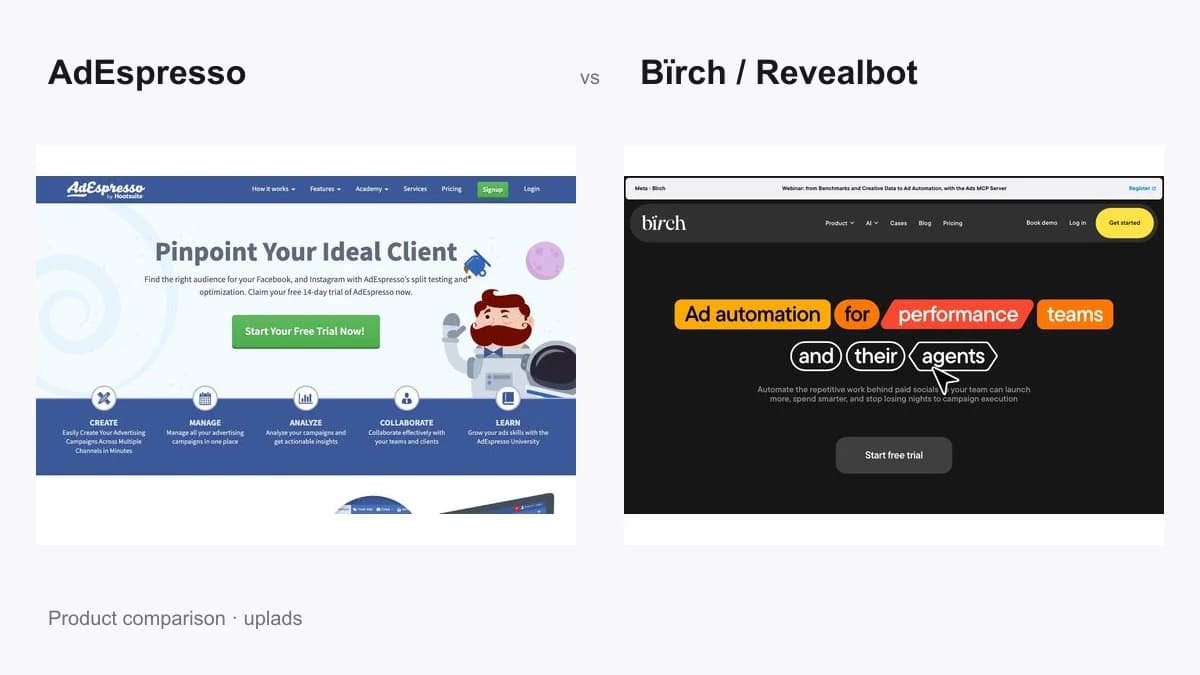
This page is an honest, side-by-side read on AdEspresso versus Revealbot (now Bïrch) for performance marketers, agencies, and ecommerce teams choosing between the two in 2026. Both tools are well-known in the Meta-ads ecosystem and both come up repeatedly in the same vendor evaluations - "revealbot vs adespresso" is the search query most teams type when the shortlist is down to these two. The matrix in the middle is factual. The verdict at the bottom is opinionated, and includes a third option neither tool centers on.
A note on the rebrand
Revealbot is now Bïrch. The rename happened in October 2024 and is announced on the Bïrch company blog, where the team frames the move as a refocus on blending automation with creative testing. The product, the team, and the API are continuous; only the brand name moved. G2 lists the product as "Bïrch (ex. Revealbot)" and most search traffic still uses the legacy "Revealbot" name. This page treats the two names as one product and uses whichever makes the sentence cleaner.
What each tool is, in one paragraph
AdEspresso is an ad creation and split testing platform for Facebook and Instagram, owned by Hootsuite since 2017 (Hootsuite acquisition press release). The product has been on the market since 2014. The product loop is: pick an audience matrix, pick a creative matrix, AdEspresso permutes the combinations into ads and runs them as a structured A/B test. The bulk creation surface, post-launch analytics and optimization, customised performance triggers, white-label reporting, and a public API have been layered on top of that split testing foundation across the Starter, Plus, and Enterprise tiers.
Revealbot (now Bïrch) is a multi-network ad automation platform that has been on the market since 2016. The product center is the rules engine: pause ads if a metric crosses a threshold, scale budgets when ROAS clears a target, alert in Slack the moment a campaign changes state. On top of that the platform layers Launcher for bulk ad creation, Stage for creative testing, Explorer for analytics, an audience builder, and integrations with Slack, Google Sheets, AppsFlyer, and Hyros. Networks supported per the Bïrch pricing page are Meta (Facebook + Instagram), Google, TikTok, and Snapchat. G2 reviews carry a 4.6 out of 5 rating.
Pricing at a glance
$49/mo
$1,000 ad spend cap
$99/mo
Unlimited spend, 15 seats
$49/mo
Up to $10K monthly ad spend
$99/mo
Adds automated rules, scales with spend
Source: AdEspresso pricing page (adespresso.com/pricing) and Bïrch pricing page (bir.ch/pricing), checked 12 October 2026
The pricing models are structurally similar, which is the point that matters more than the dollar number. Both tools price by managed ad spend, not by ad accounts or storage. AdEspresso Starter at $49 per month is locked at $1,000 in monthly ad spend, which is enough for a single small advertiser and not enough for an agency running paid budgets for clients. To uncap spend you move to AdEspresso Plus at $99 per month (up to 15 seats, campaign approval, white-label reports) or Enterprise starting at $259 for API access and Salesforce contacts sync.
Bïrch Essential at $49 per month is priced for up to $10,000 in monthly ad spend on the Bïrch pricing page and already includes reports, post boosting and the Slack integration. Pro at $99 per month at the same bracket is the popular tier: it adds automated rules and strategies, Launcher, Explorer, the free version of Stage, the custom and lookalike audience builder, and integrations with Google Sheets, AppsFlyer and Hyros. Both tiers rise in price with spend. Enterprise is custom and adds onboarding plus premium support. The 14-day free trial includes every feature and needs no credit card; yearly billing is listed at 20% off.
The practical difference between the two pricing pages: AdEspresso's $1,000 Starter cap is aggressive enough that most working users move to Plus immediately. Bïrch's $10,000 Essential cap is enough that a small advertiser can stay on the entry tier for a while. Above either cap, both products scale in price as your ad spend scales.
The honest pros and cons
AdEspresso
Pros
- Mature A/B test generation - the wedge feature since 2014
- Multi-page bulk creation on Plus and Enterprise tiers
- White-label reporting and approval workflows for client-facing agencies
- Owned by Hootsuite, so social and ad workflows can sit on the same stack
- Public API on Enterprise for custom integrations
- Customised performance triggers on every plan (cross-campaign on Plus) overlap with simple automation
Cons
- The pricing page lists Facebook and Instagram features only; no Google Ads launching is listed
- No TikTok or Snapchat support
- $1,000 ad spend cap on Starter forces an immediate upgrade for most working users
- No rules-based automation engine at the depth Bïrch offers
- Product roadmap pace under Hootsuite ownership is widely seen as slow
- No multi-placement auto-grouping for 4×5 and 9×16 variants of the same creative
Revealbot (Bïrch)
Pros
- Mature rules-based automation engine for Meta, Google, TikTok, and Snapchat
- Slack alerts when a rule fires or a campaign changes state
- Launcher, Stage (creative testing), Explorer (analytics), and audience builder
- Integrations with Google Sheets, AppsFlyer, and Hyros for warehouse-led attribution
- 4.6 out of 5 on the G2 listing for Bïrch (ex. Revealbot)
- 14-day free trial with every feature and no credit card
- Long track record on Meta optimization specifically
Cons
- Pricing scales with monthly ad spend, which gets expensive at scale
- The bulk Launcher is real, but not built for shipping 100+ variants from a creative library in a single pass
- No multi-placement auto-grouping for 4×5 and 9×16 variants of the same creative
- The rebrand from Revealbot to Bïrch in October 2024 caused real confusion in support docs and SEO surfaces
- Rules engine has a learning curve - teams that under-use the automation pay for value they do not capture
Feature matrix
| Capability | AdEspresso | Revealbot (Bïrch) | uplads |
|---|---|---|---|
| A/B test generation across audience and creative matrices | Partial (Stage) | ||
| Rules-based automation engine (pause / scale / alert) | Partial (performance triggers) | yes (Pro+) | yes (Meta and TikTok, Growth and Agency) |
| Slack alerts | yes (Essential+) | ||
| Bulk ad creation as a core wedge | Partial | Partial (Launcher) | |
| Multi-placement auto-grouping (4×5 + 9×16 collapsed into one ad) | |||
| Per-ad failure isolation on a 50-ad batch | n/a | ||
| Token-based naming template applied at launch | Partial | Partial | |
| Catalog enhancement on every ad in a batch | |||
| Analytics dashboard | yes (Explorer) | yes (60+ columns, Meta) | |
| Creative testing surface with lift tracking | yes (Stage) | ||
| White-label client reporting | yes (Plus+) | ||
| Facebook + Instagram support | |||
| Google Ads | not listed on the pricing page | yes (Performance Max, Demand Gen, YouTube video, App) | |
| TikTok ads | |||
| Snapchat ads | |||
| Third-party integrations (GSheets, AppsFlyer, Hyros) | Limited | yes (Pro+) | |
| Pricing scales by | Managed ad spend | Managed ad spend | Ad accounts and storage |
| Starting paid price | $49/mo ($1K spend cap) | $49/mo (up to $10K spend) | 69€/mo (2 ad accounts, Meta) |
| G2 rating | 4.4 / 5 | 4.6 / 5 | n/a |
Three columns, three centers of gravity. AdEspresso is mostly green on the split testing and client-reporting axes. Bïrch is mostly green on the post-launch automation and multi-network axes. uplads is green where the launch-day workflow lives - grouping, naming, failure isolation, catalog, drag-drop bulk - which is not the wedge of either AdEspresso or Bïrch, and on Meta its column stays green downstream too: automated rules, Slack alerts and a 60+ column reporting surface ride along with the launch.
Where AdEspresso wins
Split testing as a structured surface. This is AdEspresso's wedge and the reason the product exists. Define the audiences, define the creatives, define the placements, and AdEspresso permutes the combinations into ads and tracks lift. Bïrch's Stage surface covers creative testing but the rest of the platform is rules-based optimization, not split-test generation. If the team's week is dominated by "we are testing this hook against that hook against three audiences," AdEspresso is the more direct fit.
Client reporting and approval workflow. AdEspresso Plus and Enterprise include white-label reporting and ad approval cycles that are mature for client-facing agencies. Bïrch can produce performance reports through Explorer but does not center on client-facing deliverables the same way. For an agency whose week is dominated by review meetings and client report PDFs, the AdEspresso path is more direct.
The Hootsuite bundle. AdEspresso is owned by Hootsuite. For a team already running social publishing on Hootsuite, keeping the ad workflow on the same platform reduces vendor count and centralises billing. Bïrch is a standalone purchase.
Where Revealbot (Bïrch) wins
The automation rules engine. This is the Bïrch wedge and there is no honest comparison on this axis. The platform lets a media buyer compose rules like "pause any ad with CPA > $X over the last 3 days" or "scale budget +20% on any ad set with ROAS > 2.5x over 7 days" and run them across Meta, Google, TikTok, and Snapchat in one place. AdEspresso has customised performance triggers, but the depth and breadth of the Bïrch rules engine is in a different category.
Multi-network coverage. Bïrch supports Meta, Google, TikTok, and Snapchat on the same platform. AdEspresso's pricing page lists Facebook and Instagram features only, with no Google Ads, TikTok or Snapchat management on any plan (checked 12 October 2026). For a brand running real budget across more than Meta, Bïrch is the practical choice.
Slack alerts and ops-grade monitoring. Bïrch fires Slack notifications when rules trigger, when budgets change, when something breaks. Performance teams that run paid ads as an operational surface (not a weekly cron job) lean on those alerts. AdEspresso does not push notifications to Slack in the same operational way.
Third-party integrations. Bïrch Pro and above integrate with Google Sheets for data export, AppsFlyer for mobile attribution, and Hyros for server-side attribution. Teams running warehouse-led measurement strategies use those integrations as part of the daily flow. AdEspresso has API access on Enterprise but does not match the same integration surface out of the box.
The gap both tools leave
Both AdEspresso and Bïrch include bulk creation, and both are honest about its existence. Neither has bulk creation as the wedge of the product. AdEspresso's wedge is split test generation; Bïrch's wedge is rules-based automation; bulk creation is the surface attached to either of those wedges.
The agencies and in-house teams that show up in the r/PPC thread on third-party ad managers describe a different weekly pain: shipping 30 to 200 new ad variants cleanly across one or more networks, every Monday, with a naming convention enforced at launch. That pain is upstream of both A/B test generation and automation rules. The split test is what you do once the ads are live. The pause-and-scale rule is what you do once the ads have data. The launch is the prior step, and it is the step both AdEspresso and Bïrch treat as an attachment to the main job.
This is the wedge uplads was built inside. Drag in 50 to 200 creatives, pick ad sets across one or many ad accounts, pick a naming template, click launch. A background worker creates the ads in batches of fifty against the Meta Marketing API, with per-ad failure isolation and multi-placement grouping handled automatically (see the multi-placement product page). Meta, TikTok, Google Ads and Snapchat are in production today.
Pricing is by ad account count and storage, not by managed ad spend. And launch is no longer where uplads stops: an in-app Meta Ads Manager carries bulk actions on live ads (including find-and-replace text edits across selected ads), an automated rules engine covers the pause-and-scale cases on Meta and TikTok with capped budget moves (25 metrics, checks as often as every 30 minutes), and creative analytics classifies every creative that has run along six traits to show which ones carry the spend.
Try the launch step that AdEspresso and Bïrch both treat as a feature
Every uplads plan starts with a 7-day free trial - full feature access, no credit card up front - enough to push a real bulk launch and decide whether the time saving holds up against the way the team ships ads today.
When to use which
Pick AdEspresso when: the weekly motion is structured A/B testing on Facebook and Instagram, the team needs white-label client reporting, and the existing stack already includes Hootsuite. Plus at $99 per month is the realistic working tier.
Pick Revealbot (Bïrch) when: the weekly motion is running automation rules across live spend on Meta, Google, TikTok, or Snapchat, the team needs Slack alerts on rule firing, and warehouse-led measurement (AppsFlyer, Hyros) is part of the attribution stack. Pro at $99 per month is the realistic working tier.
Pick uplads when: the weekly motion is shipping 30 to 200 new ad variants cleanly, multi-placement grouping (4×5 + 9×16) and a token-based naming convention are non-negotiable at launch, and pricing by ad account count beats pricing by managed spend for the team's growth curve. On Meta, uplads then covers the downstream jobs too - automated rules, bulk editing of live ads, creative analytics. The free trial is 7 days with no credit card.
Use them together when: budget is mid five figures or more monthly across networks, weekly creative volume is high enough that bulk launch savings dominate, and cross-network rules-based automation is non-negotiable. uplads launches the weekly batch and can carry the Meta rules itself; Bïrch automates what runs beyond Meta; AdEspresso runs structured A/B tests on the Meta subset. All three tools read and write the same Meta ad object graph through the Marketing API, so the ads launched in uplads on Monday morning are visible to Bïrch and AdEspresso by Monday afternoon.
Verdict
AdEspresso for a formal split-test matrix on Meta, Revealbot (Bïrch) for rules across four networks - but both act on ads someone else still has to launch. uplads closes that gap, and covers Meta rules and creative analysis with it.
AdEspresso and Revealbot sit at two different points of the downstream week. Neither owns the launch step, and for a Meta-led team uplads covers that step plus most of what each is bought for.
For a team whose week is a structured A/B test matrix on Facebook and Instagram ending in a client PDF, AdEspresso is the more direct fit. For a team whose week is automated pause and scale logic across Meta, Google, TikTok, and Snapchat, Revealbot (Bïrch) is the more direct fit. Both start from ads that already exist, though - and launching dozens of new variants cleanly is what produces the results either tool then tests or automates. uplads owns that step, and on Meta it carries the automated rules Revealbot is bought for plus reporting and creative analysis that tell you which kind of creative wins, rather than only which variant won one test. For a Meta-led team, that combination beats either tool on its own. See uplads vs AdEspresso and uplads vs Revealbot for the head-to-heads, or AdEspresso alternatives and Revealbot alternatives for the wider market.