
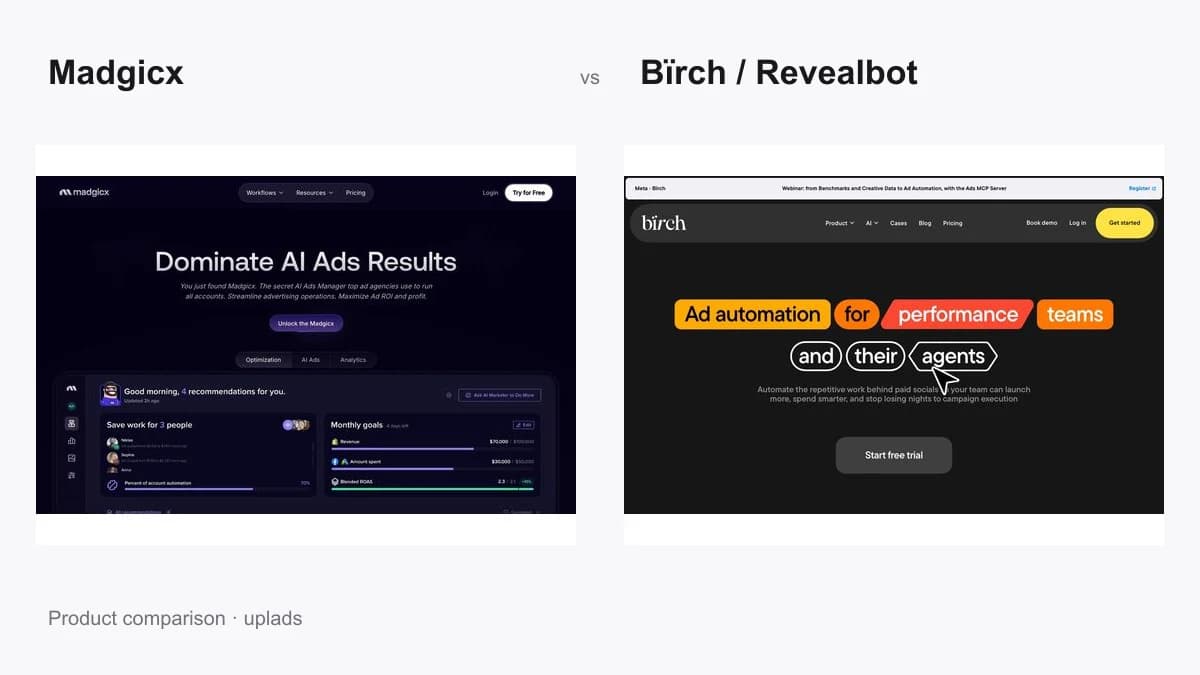
This page is an honest, side-by-side read on Madgicx versus Revealbot (now Bïrch) for performance marketers, agencies, and ecommerce teams choosing between the two in 2026. Both tools are well-known in the Meta-ads ecosystem and both come up repeatedly in the same vendor evaluations - "madgicx vs revealbot" is one of the search queries most teams type when the shortlist is down to these two. The matrix in the middle is factual. The verdict at the bottom is opinionated, and includes a third option neither tool centers on.
A note on the rebrand
Revealbot is now Bïrch. The rename happened in October 2024 and is announced on the Bïrch company blog, where the team frames the move as a refocus on blending automation with creative testing. The product, the team, and the API are continuous; only the brand name moved. G2 lists the product as "Bïrch (ex. Revealbot)" and most search traffic still uses the legacy "Revealbot" name. This page treats the two names as one product and uses whichever makes the sentence cleaner. Madgicx, for its part, is unchanged - same brand, same Meta-ads positioning since launch.
What each tool is, in one paragraph
Madgicx is an AI-powered optimization platform for Meta ads. It now describes itself on madgicx.com as an "Agentic Meta Ads Management AI Platform" with three workflows: Optimization (an AI media buyer that audits the account), AI Ads (generative creative production) and Analytics. The daily job is improving the performance of ads that are already running on Meta, not bulk-launching new ones. The Madgicx pricing page asks for a monthly Meta spend bracket and shows the Pro Complete price inside the app; Tracking Pro costs $49 per month. The product is Facebook and Instagram only; Google Ads, TikTok, and Snapchat are not in scope.
Revealbot (now Bïrch) is a multi-network ad automation platform that has been on the market since 2016. The product center is the rules engine: pause ads if a metric crosses a threshold, scale budgets when ROAS clears a target, alert in Slack the moment a campaign changes state. On top of that the platform layers Launcher for bulk ad creation, Stage for creative testing, Explorer for analytics, an audience builder, and integrations with Slack, Google Sheets, AppsFlyer, and Hyros. Networks supported per the Bïrch pricing page are Meta (Facebook + Instagram), Google, TikTok, and Snapchat. G2 reviews carry a 4.6 out of 5 rating.
Pricing at a glance
In-app
Priced by Meta spend bracket, 7 brackets
$49/mo
Server-side tracking add-on
$49/mo
Up to $10K monthly ad spend
$99/mo
Adds automated rules, scales with spend
Source: Madgicx pricing page (madgicx.com/pricing) and Bïrch pricing page (bir.ch/pricing), checked 12 October 2026
The pricing models are structurally similar, which is the point that matters more than the dollar number. Both tools price by ad spend, not by ad accounts or storage.
Madgicx asks for the monthly Meta spend at signup, in seven brackets from under $1K through $1K to $2.5K, $2.5K to $5K, $5K to $10K, $10K to $20K and $20K to $30K up to $30K and more, and shows the Pro Complete price inside the app. Monthly, quarterly and annual billing are offered, with the longer terms discounted. The model fits a tool whose value scales with the size of the budget it is optimizing. Tracking Pro at $49 per month is a separate line item for server-side tracking, used by some teams as a Meta Conversions API layer.
Bïrch Essential at $49 per month is priced for up to $10,000 in monthly ad spend on the Bïrch pricing page and already includes reports, post boosting and the Slack integration. Pro at $99 per month at the same bracket is the popular tier: it adds automated rules and strategies, Launcher, Explorer, the free version of Stage, the audience builder and the Google Sheets, AppsFlyer and Hyros integrations. Both tiers rise in price with spend. Enterprise is custom and adds onboarding plus premium support. The 14-day free trial includes every feature and needs no credit card.
The practical difference between the two pricing pages: Bïrch prints its entry price for the first $10,000 of monthly spend, while Madgicx shows no number until you are inside the app. Invoices climb against ad spend in either case. A solo brand running $20,000 a month in Meta spend pays Madgicx whatever the $10K to $20K bracket shows (plus an optional $49 for Tracking Pro) and pays Bïrch whatever its own bracket says above $10,000. Above either cap, both products scale in price as the team's ad spend scales.
The honest pros and cons
Madgicx
Pros
- AI bidding and budget optimization on Meta
- Audience AI for prospecting, retargeting, and lookalike alternatives
- Creative scoring and generative-AI ad production
- One-Click Report for client and internal reporting
- Tracking Pro add-on for server-side, post-iOS-14 attribution
- 4.6 out of 5 on G2 from 219 reviews in October 2026 (G2 listing)
- Long track record on Meta optimization specifically
Cons
- Meta only - no Google Ads, no TikTok, no Snapchat
- Pricing scales with monthly Meta ad spend, which gets expensive at scale
- 1.7 out of 5 on Trustpilot from 271 reviews in October 2026 (Trustpilot page), with recurring trial-to-billing complaints
- No price on the public pricing page; the number appears inside the app
- Not built for high-volume bulk launching of new creative variants
- Tracking Pro is a separate $49/month line item
- No multi-placement auto-grouping for 4×5 and 9×16 variants of the same creative
Revealbot (Bïrch)
Pros
- Mature rules-based automation engine for Meta, Google, TikTok, and Snapchat
- Slack alerts when a rule fires or a campaign changes state
- Launcher, Stage (creative testing), Explorer (analytics), and audience builder
- Integrations with Google Sheets, AppsFlyer, and Hyros for warehouse-led attribution
- 4.6 out of 5 on the G2 listing for Bïrch (ex. Revealbot)
- 14-day free trial with every feature and no credit card
- Long track record on multi-network ad automation
Cons
- Pricing scales with monthly ad spend, which gets expensive at scale
- The bulk Launcher is real, but not built for shipping 100+ variants from a creative library in a single pass
- No multi-placement auto-grouping for 4×5 and 9×16 variants of the same creative
- The rebrand from Revealbot to Bïrch in October 2024 caused real confusion in support docs and SEO surfaces
- Rules engine has a learning curve - teams that under-use the automation pay for value they do not capture
- Less generative-AI creative tooling than Madgicx
Feature matrix
| Capability | Madgicx | Revealbot (Bïrch) | uplads |
|---|---|---|---|
| AI bidding and budget optimization on Meta | Partial (rules-based) | Partial (AI Optimizer proposes, human approves) | |
| Audience AI / lookalike alternatives | Partial (audience builder) | ||
| Generative-AI creative production | |||
| Creative performance scoring | Partial (Stage) | yes (six-trait classification) | |
| Rules-based automation engine (pause / scale / alert) | Partial | yes (Pro+) | yes (Meta and TikTok, Growth and Agency) |
| Slack alerts | yes (Essential+) | ||
| Bulk ad creation as a core wedge | Partial (Launcher) | ||
| Multi-placement auto-grouping (4×5 + 9×16 collapsed into one ad) | |||
| Per-ad failure isolation on a 50-ad batch | n/a | n/a | |
| Token-based naming template applied at launch | Partial | ||
| Catalog enhancement on every ad in a batch | Partial | ||
| Analytics dashboard | yes (Explorer) | yes (Meta, 60+ columns) | |
| Creative testing surface with lift tracking | yes (Stage) | ||
| White-label client reporting | yes (One-Click Report) | ||
| Facebook + Instagram support | |||
| Google Ads | yes (Performance Max, Demand Gen, YouTube video, App) | ||
| TikTok ads | |||
| Snapchat ads | |||
| Server-side tracking layer | yes (Tracking Pro add-on) | Partial (via Hyros) | |
| Third-party integrations (GSheets, AppsFlyer, Hyros) | Limited | yes (Pro+) | |
| Pricing scales by | Monthly Meta ad spend bracket | Monthly ad spend | Ad accounts and storage |
| Starting paid price | Shown in the app only | $49/mo (up to $10K spend) | 69€/mo (2 ad accounts, Meta) |
| Free trial | 7 days | 14 days, no card | 7 days, no card |
| G2 rating | 4.6 / 5 (219 reviews) | 4.6 / 5 | not yet listed |
Three columns, three centers of gravity. Madgicx is mostly green on the AI optimization, generative creative, and Meta-only depth axes. Bïrch is mostly green on the post-launch automation, multi-network, and integration axes. uplads is mostly green where the launch-day workflow lives - grouping, naming, failure isolation, catalog, drag-drop bulk - which is not the wedge of either Madgicx or Bïrch, and it has turned green on the Meta rules, alerting and creative-analytics rows as well.
Where Madgicx wins
AI bidding and budget optimization on Meta. This is the Madgicx wedge. The platform automatically adjusts budgets, applies bid logic against live Meta campaigns, and uses machine learning to lift ROAS. Bïrch's automation engine is rule-based - the team writes the conditions; Bïrch executes them. Madgicx's automation is AI-first - the team sets the goal; Madgicx decides the moves. For media buyers who would rather state intent than draft fifteen if-then conditions, Madgicx is the more direct fit on Meta.
Audience AI. Madgicx Audience Studio surfaces audience suggestions, lookalike alternatives, and retargeting segments based on the account's performance signal. Bïrch has an audience builder, but the depth of automated audience discovery is a Madgicx strength specifically. Teams whose weekly pain is "we have run out of audience ideas" lean on the Madgicx side here.
Generative-AI creative production. Madgicx includes generative-AI ad creation - prompt-driven static and video creative made for Meta ad placements. Bïrch does not include generative-AI creative tooling at the same depth. For teams that are short on a designer and short on production capacity, the Madgicx generative surface is a real lever.
Creative scoring and One-Click Report. Madgicx's Creative Insights scores live creatives on performance dimensions, and the One-Click Report ships a client- or internal-friendly performance summary. Bïrch's Stage covers creative testing and Explorer covers analytics, but client-facing reporting is more polished on the Madgicx side.
Server-side tracking add-on. Post-iOS-14 attribution is a real pain on Meta. Madgicx Tracking Pro at $49 per month is a server-side tracking layer some teams use as their Meta Conversions API setup. Bïrch covers part of this story through its Hyros integration on Pro, but the path is "buy and integrate Hyros" rather than "add the Madgicx add-on."
Where Revealbot (Bïrch) wins
The automation rules engine. This is the Bïrch wedge and there is no honest comparison on this axis. The platform lets a media buyer compose rules like "pause any ad with CPA > $X over the last 3 days" or "scale budget +20% on any ad set with ROAS > 2.5x over 7 days" and run them across Meta, Google, TikTok, and Snapchat in one place. Madgicx has automation surfaces, but the depth and breadth of the Bïrch rules engine is in a different category. If the team's week depends on automated pause and scale logic, Bïrch is the right tool.
Multi-network coverage. Bïrch supports Meta, Google, TikTok, and Snapchat on the same platform. Madgicx supports Facebook and Instagram and stops there. For a brand running real budget across more than Meta - which describes most ecommerce teams in 2026 - Bïrch covers a larger fraction of the weekly job by definition.
Slack alerts and ops-grade monitoring. Bïrch fires Slack notifications when rules trigger, when budgets change, when something breaks. Performance teams that run paid ads as an operational surface (not a weekly cron job) lean on those alerts. Madgicx does not push notifications to Slack in the same operational way.
Third-party integrations. Bïrch Pro and above integrate with Google Sheets for data export, AppsFlyer for mobile attribution, and Hyros for server-side attribution. Teams running warehouse-led measurement strategies use those integrations as part of the daily flow. Madgicx has its own tracking add-on but does not match the same integration breadth.
Cleaner free trial economics. Bïrch gives 14 days with every feature and no credit card; Madgicx gives 7 days. Bïrch prints $49 and $99 for the first $10,000 of monthly spend, so the entry-tier math is legible before signup. Madgicx shows its price only inside the app, and its Trustpilot complaint cluster (271 reviews, 1.7 stars in October 2026) is mostly about trial-to-billing surprise, the kind of friction that costs a team time even when the underlying tool is good.
The gap both tools leave
Both Madgicx and Bïrch include some bulk creation surfaces, and both are honest about its existence. Neither has bulk creation as the wedge of the product. Madgicx's wedge is AI-driven optimization; Bïrch's wedge is rules-based automation; the launch surface is attached to either of those wedges, not the center of either.
The agencies and in-house teams that show up in the r/marketing thread on Madgicx vs Revealbot describe a different weekly pain on top of the optimization decision: shipping 30 to 200 new ad variants cleanly across one or more networks, every Monday, with a naming convention enforced at launch. That pain is upstream of both AI optimization and automation rules. The AI bid adjustment is what happens once the ads have spend data. The pause-and-scale rule is what happens once the ads have a few days of signal. The launch is the prior step, and it is the step both Madgicx and Bïrch treat as an attachment to the main job.
This is the wedge uplads was built inside. Drag in 50 to 200 creatives, pick ad sets across one or many ad accounts, pick a naming template, click launch. A background worker creates the ads in batches of fifty against the Meta Marketing API, with per-ad failure isolation and multi-placement grouping handled automatically (see the multi-placement product page). Meta, TikTok, Google Ads and Snapchat are in production today.
Pricing is by ad account count and storage, not by managed ad spend - and internal timings put the loop at 87% faster than launching the same batch manually. The wedge has also widened past launch day on Meta: an in-app Ads Manager with bulk edits on live ads, an automated rules engine with alerts to email, Slack or ClickUp, six-trait creative analytics and an AI Optimizer that proposes changes for one-click approval all ship in the same flat tiers.
When we evaluated the existing tools on the market while building uplads, the recurring shape was this: the Meta-ads automation category is mature on the optimization side - Madgicx for AI, Bïrch for rules - and underbuilt on the launch side. Both downstream tools optimize beautifully against ads that already exist. The work of getting clean ads onto the network in the first place was where teams kept leaning on spreadsheets, Notion macros, and the manual Ads Manager flow.
Try the launch step that Madgicx and Bïrch both treat as a feature
Every uplads plan starts with a 7-day free trial - full feature access, no credit card up front - enough to push a real bulk launch and decide whether the time saving holds up against the way the team ships ads today.
When to use which
Pick Madgicx when: the weekly motion is AI-driven optimization on Facebook and Instagram specifically, the team needs generative-AI creative production and creative scoring, and Meta is the only network that matters for the budget. Pro Complete is the plan; its price follows the monthly spend bracket, plus $49 for Tracking Pro if the attribution stack needs it.
Pick Revealbot (Bïrch) when: the weekly motion is running automation rules across live spend on Meta, Google, TikTok, or Snapchat, the team needs Slack alerts on rule firing, and warehouse-led measurement (AppsFlyer, Hyros) is part of the attribution stack. Pro at $99 per month is the realistic working tier.
Pick uplads when: the weekly motion is shipping 30 to 200 new ad variants cleanly, multi-placement grouping (4×5 + 9×16) and a token-based naming convention are non-negotiable at launch, and pricing by ad account count beats pricing by managed spend for the team's growth curve. uplads also covers the automated rules layer with Slack alerts on Meta and TikTok, plus creative analytics on Meta, so a Meta-led team often stops at one subscription. The free trial is 7 days with no credit card.
Use them together when: budget is mid five figures or more monthly, weekly creative volume is high enough that bulk launch savings dominate, and either AI optimization (Madgicx) or rules-based automation (Bïrch) is non-negotiable. uplads launches the weekly batch; Madgicx optimizes Meta with AI; Bïrch automates the broader network mix with rules. All three tools read and write the same network ad object graphs through the platform APIs, so the ads launched in uplads on Monday morning are visible to Madgicx and Bïrch by Monday afternoon.
What uplads does not do, said plainly
In the spirit of the truth rule on this site, the things uplads does not do that Madgicx or Bïrch do:
- Autonomous AI bidding. The uplads AI Optimizer audits the account and proposes changes for one-click approval; by design it never moves a bid on its own.
- Audience AI and lookalike alternatives. uplads does not build audiences.
- Generative-AI creative production. Bring your own creative; uplads handles the launch.
- Third-party integrations (Google Sheets, AppsFlyer, Hyros). Not in uplads today.
If any of those is non-negotiable for the week, Madgicx or Bïrch (or another tool in this space - AdEspresso for split test generation, Smartly.io for enterprise multi-channel creative production) is the right call and this page does not pretend otherwise. See the Madgicx alternatives and Revealbot alternatives pages for the broader market.
Verdict
Madgicx for AI optimization on Meta, Revealbot (Bïrch) for rules across four networks - but both optimize ads someone else still has to launch. uplads is the tool that closes that gap, and covers rules and creative analysis on Meta as well.
Madgicx and Revealbot are two philosophies (AI vs rules) applied to the same downstream half of the week. Neither owns the launch step, and for a Meta-led team uplads covers both halves.
For a team whose week is AI-driven optimization on Facebook and Instagram with generative creative production and one-click client reporting, Madgicx is the more direct fit. For a team whose week is automated pause and scale logic across Meta, Google, TikTok, and Snapchat with Slack alerts and warehouse-led integrations, Revealbot (Bïrch) is the more direct fit. Both assumptions are worth testing, though, because both tools start from ads that already exist - and getting dozens of new variants live cleanly every week is the step that produces the performance either engine then optimizes. uplads owns that step, and on Meta it also covers the automated rules Revealbot is bought for and the creative intelligence Madgicx is bought for, at a published flat price instead of a percentage of spend. For a Meta-led team the shortest path is not choosing between these two - it is starting where the week actually starts. See uplads vs Madgicx and uplads vs Revealbot for the head-to-heads, adespresso vs revealbot for the third common pairing in this space, or Madgicx alternatives and Revealbot alternatives for the wider market.