
MarketerX alternatives are unusually easy to compare badly. One list mixes AI chatbots, copywriting suites, creative generators, and ad managers as if they solve the same job. They do not.
MarketerX sits upstream: build durable brand context, diagnose the campaign, then create on-strategy marketing assets. Some buyers want a deeper version of that idea. Others discover that their real bottleneck starts one step later - getting approved creative into ad platforms quickly and operating it after launch.
This guide sorts the alternatives by that missing job.
What MarketerX actually does
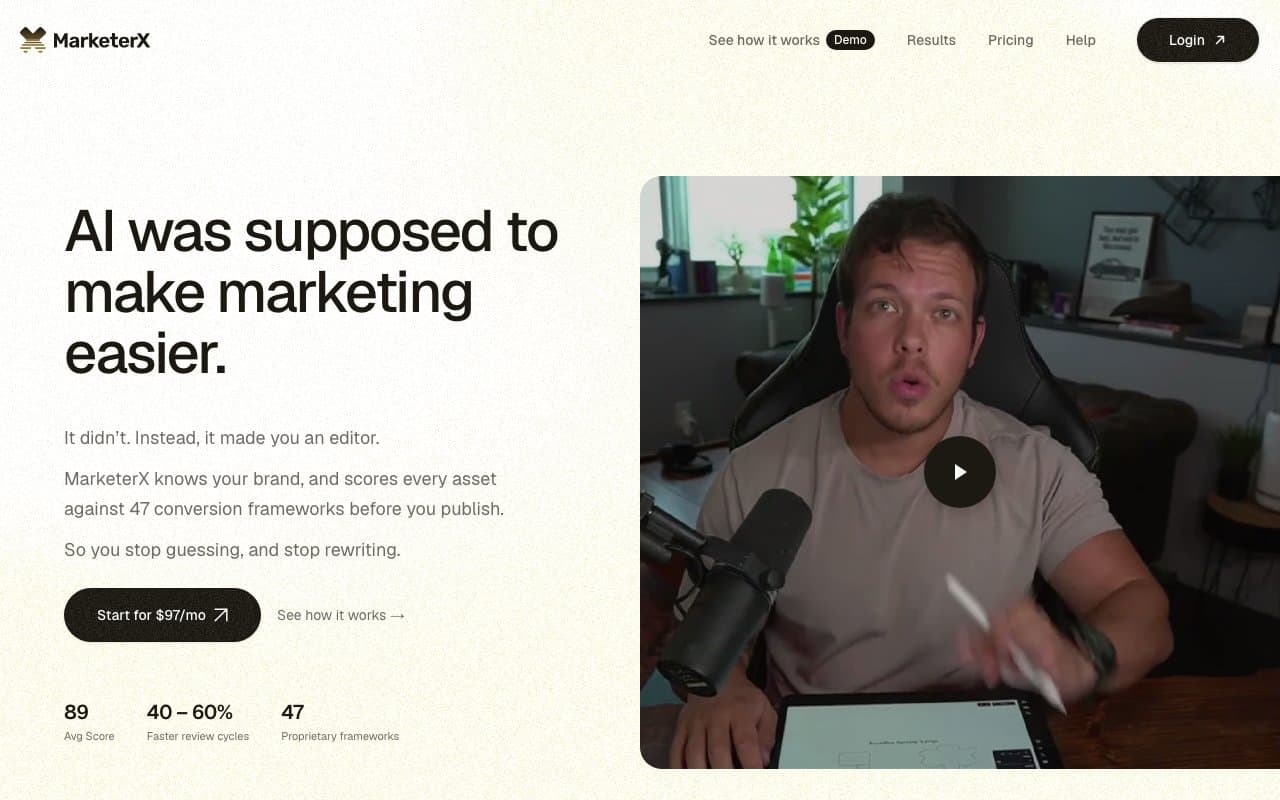
MarketerX presents itself as an AI marketing system built around a Brand Brain: a one-time setup that captures the business, buyer psychology, offer architecture, voice patterns and case study data, so prompts do not start from zero. Per marketerx.com in October 2026, the system scores every asset against 47 conversion frameworks before you publish, automatically revises flagged sections, and produces email, Meta ads, landing pages and offer strategy.
The public site emphasizes that quality gate. That matters: the product promise is not merely “generate more words.” It is to keep outputs anchored to a reusable strategy and improve weak sections without rebuilding everything. When you report how an asset performed, MarketerX adjusts its scoring weights for your brand.
Public pricing in October 2026 is $97/month at the founding rate, or $970/year with two months free; extra team members cost $72.75/month each, with no setup fees and cancellation any time. Direct publishing into Meta or Google is not documented publicly, so teams that need it should verify that capability before buying.
Why teams look for a MarketerX alternative
Most searches come from one of five gaps:
- Execution: the copy and creative exist, but launching dozens of ads is still manual.
- Governance: a larger organization needs approvals and strong brand controls across many users.
- Prediction: the team wants a score or performance signal before it spends media budget.
- Visual production: the missing asset is the image or video, not the copy.
- Flexibility or cost: the team would rather assemble its own process around a general AI model.
That produces a better shortlist than asking which product has the most AI features.
1. uplads - best for AI-assisted copy plus direct ad launch
Best for: Performance teams and agencies with finished image/video creative that need copy, bulk launching, consistent naming, and post-launch Meta operations.
uplads is the execution-first alternative. It stores a brand voice per ad account and a reusable website brief with the product, audience, pains, and value propositions. With included AI credits or the customer's own OpenAI or Anthropic API key, it writes up to five variants per field, shaped per network: Meta primary texts, headlines and descriptions, TikTok captions, Snapchat headlines and the text sets each Google channel needs. Images can be analyzed visually; video copy currently uses the brief and filename rather than frame analysis.
The key difference starts after approval. The same workflow can upload files or folders, reconcile duplicates, group placement variants, apply an ad-naming template, and launch directly to Meta, TikTok, Google Ads or Snapchat. Meta launches are created in batches, with each ad request recorded independently. Ads are paused by default unless the user explicitly chooses active.
After launch, uplads keeps working. It includes live Meta reporting with a 60+ column report, an in-app Ads Manager with bulk actions on live ads - including bulk text find-and-replace - creative analytics that classifies every creative along six traits, human-approved optimization recommendations, scheduled launches, and automated rules on Growth and Agency. Those post-launch capabilities are Meta-first today, with rules also running on TikTok; Google Ads, TikTok and Snapchat each have an Ads Manager of their own.
uplads
Pros
- AI copy per network (Meta, TikTok, Snapchat, LinkedIn, each Google channel) using included credits or your own API key
- Per-account brand voice plus a saved website brief that pre-fills generation
- Direct launch to Meta, TikTok, Google Ads, Snapchat and LinkedIn for existing image and video creatives
- Bulk file/folder upload, up to 250 MB per asset, with duplicate reconciliation
- Multi-placement grouping, naming templates, Meta reporting, automated rules, and an AI Optimizer with one-click approval
- In-app Meta Ads Manager with bulk actions on live ads, including bulk text find-and-replace
- Creative analytics: six-trait classification of every creative, spend-weighted findings
- Transparent EUR pricing and a 7-day no-card trial with the Growth feature set
- MCP connector (Beta, every plan): Claude or ChatGPT build campaigns paused and stage launch drafts a person reviews, with a daily budget ceiling on anything that raises spend
Cons
- Focused on ad copy by design - email sequences and landing pages stay out of scope
- Launches the creatives you produce; it does not generate images or videos
- Post-launch reporting, rules, and optimization are Meta-first today; Google Ads has its own native Ads Manager
The honest choice is simple: pick uplads if strategy and creative production are already covered and the expensive part is turning the output into live, consistently named ads. Pick MarketerX if creating the strategy and cross-channel message system is the job.
See bulk upload, multi-placement ads, and uplads pricing.
2. Jasper - best for enterprise brand governance
Best for: Marketing organizations that need reusable brand context and consistency across many users and content types.
Jasper is the closest alternative when “Brand Brain” means governance at organizational scale. Its Brand Voice product focuses on learning a company's tone and style, while its pricing separates a self-serve Pro plan from a custom Business tier with broader governance and knowledge capabilities.
Jasper is broader than an ad-copy tool and more mature as an enterprise content layer. The trade-off is that content governance is its center of gravity - not bulk deployment into named campaigns and ad sets. A larger content team may choose Jasper; a performance team with an ad-ops bottleneck may still need a launcher beside it.
3. Anyword - best for predictive copy scoring
Best for: Teams that want a performance prediction attached to copy before publishing.
Anyword's differentiator is predictive scoring. Its current plans connect copy generation with performance prediction, while higher tiers extend the relationship with actual marketing data. This is a stronger fit than MarketerX when the buying question is, “Which message is most likely to perform?”
Prediction is not deployment, though. A score can help select a variant; it does not remove the operational work of uploading assets, mapping them to ad sets, applying names, handling placements, and resolving platform errors.
4. Copy.ai - best for broader GTM workflows
Best for: Companies that want repeatable workflows across marketing, sales, enablement, and operations.
Copy.ai has moved beyond a copy generator into a broad GTM workflow platform. Its pricing reflects that range, from a smaller chat product to high-value workflow plans. It can be the better alternative when MarketerX feels too marketing-asset-specific and the organization wants to automate multi-step processes across departments.
That breadth brings setup and cost. A team that only needs a durable campaign brief and disciplined ad copy may prefer MarketerX's narrower mental model. A team that only needs to ship existing creatives may prefer uplads' narrower operational loop.
5. AdCreative.ai - best for visual ad generation
Best for: Small teams whose missing input is the visual creative itself.
AdCreative.ai combines brand inputs, ad text, and AI-generated visual creatives. It is the clearest alternative when “we cannot launch” really means “we do not have enough banners and variations.” It covers a part of production that neither MarketerX's public positioning nor uplads' launch workflow is designed to replace.
Its public pricing can vary with promotions and plan configuration, so use the live page rather than a comparison article's frozen number. Also separate creative generation from ad operations during evaluation: generating 40 variants is useful, but someone still needs to approve, name, map, launch, and learn from them.
6. ChatGPT or Claude plus a structured brief - best flexible baseline
Best for: Small teams willing to own the process in exchange for flexibility and a low starting commitment.
A well-maintained document can approximate the first layer of a Brand Brain: positioning, customer segments, pains, offer, proof, voice, prohibited claims, and example copy. Attach it to a general-purpose AI assistant, use a consistent campaign brief, and require a human review before publishing.
The advantage is control. The cost is process debt. The team has to maintain context, version prompts, stop unsupported claims, store approved outputs, and move them into ad platforms manually. The moment that manual glue becomes the weekly bottleneck, a specialist system earns its fee.
Feature matrix
| Capability | uplads | MarketerX | Jasper | Anyword | Copy.ai | AdCreative.ai | ChatGPT / Claude + brief |
|---|---|---|---|---|---|---|---|
| Persistent brand context | Per-account voice + website brief | Brand Brain | Brand controls | Manual | |||
| Strategy-first campaign diagnostic | Partial | Partial | Partial | Workflow-dependent | Manual | ||
| Meta ad-copy generation | yes, included credits or own key | ||||||
| Email / landing page outputs | Limited | ||||||
| AI image or video generation | not the core public claim | Model/tool-dependent | |||||
| Direct bulk ad launch | Meta + TikTok + Google + Snapchat + LinkedIn | not publicly documented | Account connections; verify workflow | ||||
| Multi-placement grouping and launch naming | not publicly documented | not the primary loop | |||||
| Native post-launch operating surface | Ads Manager per network; Meta reporting and AI Optimizer; rules on Meta and TikTok | learns from performance you report | Performance-data features | Workflow-dependent | Performance insights | ||
| Best fit | Ad execution | Strategy + cross-channel copy | Brand governance | Predictive copy | GTM workflows | Visual production | Flexible DIY setup |
| AI assistant connector (MCP) | yes (Beta, every plan) | not publicly documented | not publicly documented | not publicly documented | not publicly documented | not publicly documented | no; the chat can write copy but cannot reach the ad account |
“Not publicly documented” is intentional. It means the capability was not described on the vendor's public pages during this review - not that it cannot exist inside the product.
Choose by the bottleneck
- Choose uplads when approved creative needs AI-assisted ad copy, direct and repeatable deployment to Meta, TikTok, Google Ads, Snapchat or LinkedIn, and a post-launch surface to operate what went live.
- Choose MarketerX when positioning, audience thinking, offer strategy, and consistent cross-channel copy are the missing system.
- Choose Jasper when many people need governed, on-brand content across an enterprise.
- Choose Anyword when predictive copy performance is the deciding layer.
- Choose Copy.ai when marketing is one part of a larger GTM automation program.
- Choose AdCreative.ai when visual asset production is blocking campaign volume.
- Choose a general AI assistant when flexibility matters more than a dedicated workflow and the team will maintain the process itself.
For many teams, the real architecture is two tools: an upstream strategy or creative system and a downstream launcher. That is not duplication if each owns a clear stage. And when only one seat gets budget, the launcher tends to win it - strategy can live in a document, but launching cannot.
Turn approved creative into live ads
uplads includes a 7-day no-credit-card trial with the Growth feature set. Bring real image or video creatives, generate or add the copy, and measure the launch workflow against Ads Manager.
Verdict
For performance teams, uplads: AI-assisted ad copy plus direct launching to Meta, TikTok, Google Ads and Snapchat, with reporting, bulk editing, rules and an AI Optimizer covering the ads once they are live. Choose MarketerX only when building the upstream strategy and cross-channel copy system is itself the job.
These products overlap at AI copy, but the stage that consumes most teams' week is execution - and that is the stage uplads owns end to end.
MarketerX owns the upstream question: what should this campaign say, to whom, and why should they believe it? uplads owns everything after: turning approved creative and copy into many correctly structured ads, then reporting on them, bulk-editing them, and optimizing them without rebuilding the work inside Ads Manager. If the strategy layer is genuinely missing, MarketerX is a coherent answer to it. For every team whose strategy already lives in a document or a founder's head, the fastest improvement is downstream - and that is uplads' home ground. Start with the 7-day trial and measure the launch workflow against your current one.