
Most guides on how to scale Facebook ad creatives are really about one thing: turning the budget up. Raise the daily spend, duplicate the campaign, push the winner harder. That advice is not wrong, but it answers the wrong question, because the budget is almost never the thing that runs out first. The creative is.
I build the launch tooling for an Austrian performance marketing agency where a normal week is dozens of new ad variants across several client accounts, and the pattern is consistent: accounts do not stall because the team forgot to increase a budget. They stall because the winning creative fatigued and there was no fresh winner queued to absorb the spend. Scaling on Meta in 2026 is a creative-supply problem wearing a budget-strategy costume. This guide covers the budget mechanics properly, because you do need them, and then it covers the part the other guides skip: the output cadence that decides whether any of it compounds.
What does "scaling Facebook ad creatives" actually mean?
Scaling Facebook ad creatives means two distinct things, and conflating them is the root cause of most stalled accounts: scaling spend behind a creative that already works, and scaling the supply of new creatives that work.
The first is the one everyone talks about. You have a winning ad. You want it to spend more and still hit your return on ad spend. That is a budget and structure problem, and it splits into vertical scaling (more budget on the same ad set) and horizontal scaling (the same creative duplicated into more ad sets and audiences). It is real, it matters, and it has a hard ceiling, because every creative has a finite audience that responds to its specific hook.
The second is the one that actually determines your trajectory. A creative is a depreciating asset. The day you find a winner is the day it starts dying, slowly at first, then all at once when frequency climbs and the delivery system has shown it to everyone who was ever going to respond. A frequency cap can slow that on the few objectives that offer one, but it does not replace the next creative. Scaling the account, as opposed to scaling one ad, means having the next winner ready before the current one decays. That is a creative strategy and a throughput problem, not a budget setting.
Hold both definitions in your head for the rest of this guide. Every tactic below is either "get more out of a creative you have" or "make sure you always have the next one." The accounts that scale profitably are disciplined about the first and relentless about the second. The accounts that plateau are good at the first and treat the second as something they will get to when the launch process is less painful, which is never.
Vertical vs horizontal scaling on Meta
Vertical scaling increases the budget on an existing winning ad set; horizontal scaling duplicates the winning creative into new ad sets, audiences, or placements. You will use both, but they answer different questions and fail in different ways.
Vertical scaling is the fast lever. You have an ad set converting at target, you increase its daily budget, the same creative reaches more of the same kind of person. The appeal is obvious: one edit, more volume, no new setup. The cost is just as predictable. The delivery system has to find incremental audience for a creative whose best-responding pocket it has already mined, so cost per acquisition tends to rise as you push, and a large budget jump risks throwing the ad set back into the learning phase, where the cost per result is volatile and the data is least trustworthy. Vertical scaling is correct in small, spaced steps on a clear winner. It is not a growth strategy on its own.
Horizontal scaling is the durable lever. You take the winning creative and duplicate it across new ad sets: a new lookalike audience, a broad audience, a different interest stack, a separate placement strategy, or a fresh campaign with its own budget. Each duplicate gets its own learning phase and its own pocket of demand, so the original winner is never overheated and the risk is spread across several bets instead of concentrated in one. The trade is that it is more setup and it introduces audience overlap if you are careless, which you manage with broad targeting and consolidation, not with ever-narrower interests. For most accounts, horizontal scaling is where durable, profitable growth comes from, with vertical steps reserved for the unambiguous winners.
A practical way to think about the split: vertical scaling asks "can this exact ad spend more against this exact audience?" and the answer is usually "a little, then no." Horizontal scaling asks "where else does this winning creative work?" and the answer is usually "more places than you think, if you stop narrowing the audience." Neither question has an answer that lasts forever, because both are still scaling one creative, and one creative always fatigues.
How to scale a winning creative's budget safely
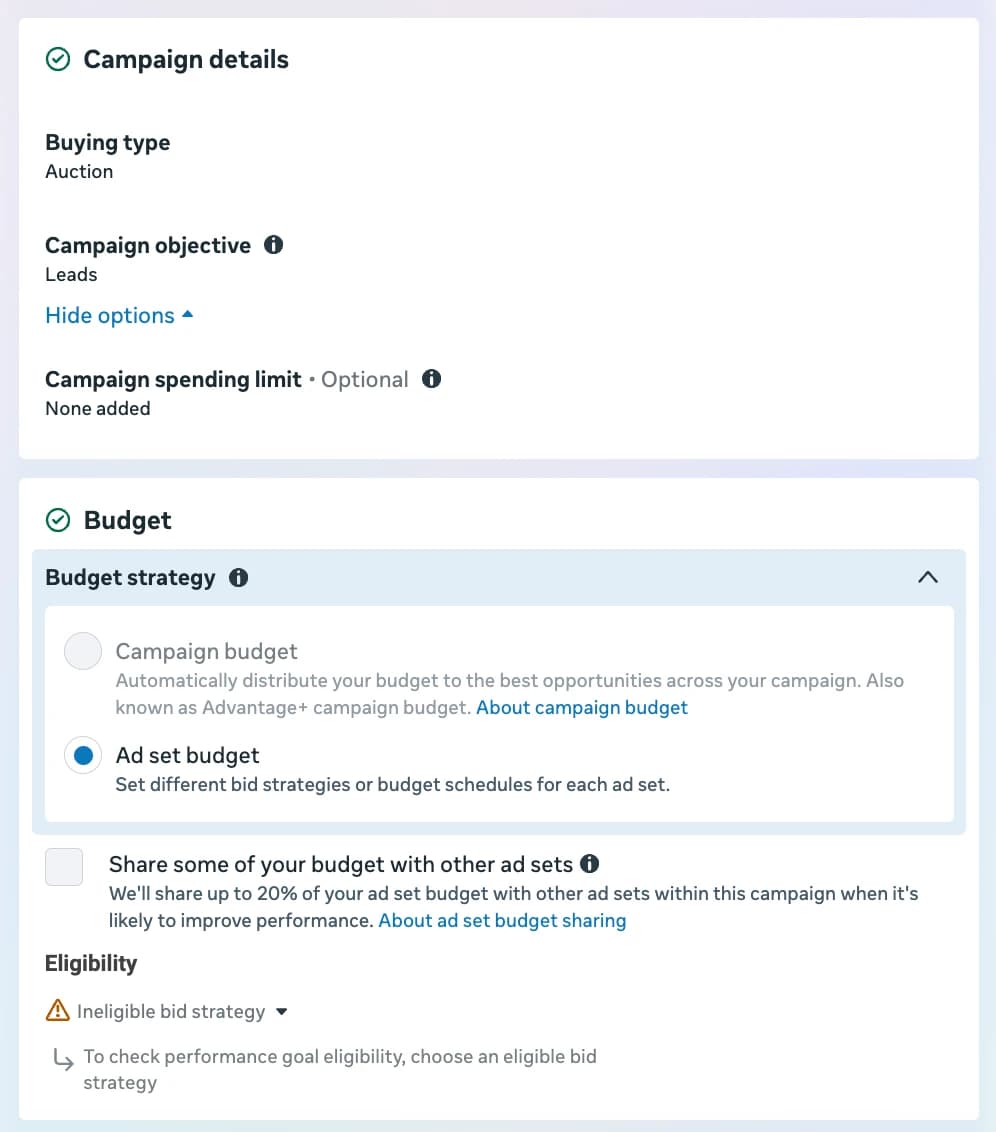
Scale a winning ad set's budget in small, spaced increases - a common working rule is around 20 percent every two to three days - rather than large jumps, so the delivery system keeps its learnings instead of restarting them.
The reason is mechanical. Meta's delivery system stabilizes an ad set after it gathers enough optimization events, and until it does, the ad set is in the learning phase, where cost per result swings widely and the numbers are the least representative the system will ever produce. Meta's own About the learning phase documentation is explicit that significant edits can send an ad set back into learning, and a large budget change is one of those edits. Restarting learning on a proven ad set means re-paying, in volatile spend, for stability you already had. A modest increase the system can absorb without re-entering learning keeps the equity you have built.
So the rule of thumb is not superstition, it is a way of staying inside the budget change the system tolerates without a reset. Roughly 20 percent every couple of days is the commonly cited figure. The exact tolerance varies by account, spend level, and event volume, so treat the number as a starting discipline, not a law. Two corollaries matter more than the precise percentage:
First, if you need a step change in volume, duplicate, do not force it. Trying to take a winner from 50 to 200 a day in one edit is the textbook way to lose a good ad set. Duplicate the winning creative into a new ad set at the higher budget and let it find its own footing while the original keeps delivering. You get the volume without gambling the proven ad set.
Second, budget changes are not free even when they work. Each increment asks the system to find more people for a creative whose strongest audience it has already reached, so efficiency erodes as you climb regardless of how gently you do it. The gentle cadence protects the learning phase; it does not repeal diminishing returns. That erosion is the entire reason the next two sections exist.
Here is what that erosion looks like, and why the answer is rarely "more budget on the same ad."
Illustrative, and the exact slopes vary by account, but the shape is what every scaling account eventually sees: budget on one creative climbs the cost curve; fresh winners flatten it.
How to scale horizontally without audience overlap
Horizontal scaling means duplicating a proven creative into new ad sets and audiences so it finds fresh demand without overheating the original ad set.
The mechanics are simple and the discipline is everything. You take the winning creative and stand it up against new audience after new audience: a fresh lookalike audience built off a higher-intent event, a broad audience that lets the system find people you would not have targeted by hand, a separate prospecting campaign with its own budget so it cannot starve or be starved by the original. Each duplicate runs its own learning phase, so a duplicate that does not work fails on its own without touching the proven ad set, and a duplicate that works adds genuinely incremental volume rather than cannibalizing the original.
Two failure modes show up the moment you scale this way. The first is audience overlap: stacking many narrow interest audiences that contain the same people means your own ad sets bid against each other in the auction and you pay more to reach a person you were already reaching. The 2026 answer is the opposite of the 2019 instinct - go broader, not narrower, and let the delivery system de-duplicate, rather than hand-building a dozen overlapping interest segments. The second is structure sprawl: forty ad sets nobody can read. This is where the structured frames help.
The 3-2-2 method is the most common of these frames: three creatives, two audiences, and two objectives or placements, run together so you can read which combination earns its budget before you commit. It is useful because it forces variable discipline and gives the system enough variety to find a pocket without spreading spend so thin nothing clears learning. Treat it as a clean starting structure for horizontal scaling, not a sacred ratio - the right counts are whatever your budget can fund to a readable sample. The deeper mechanics of building those test cells cleanly live in the Facebook ads creative testing guide; this one assumes you already have a winner and are deciding how to spread it.
Notice what horizontal scaling actually demands operationally: the same creative, or the same small set of creatives, launched into many ad sets at once. Not duplicated by hand forty times with the names cleaned up afterward. That operational detail is exactly where most horizontal-scaling plans quietly die, and it is the subject of the second half of this guide.
The real ceiling: creative diversity, not budget
Every scaling tactic above still scales one creative, and one creative always fatigues, so the binding constraint on a Meta account is not budget - it is the rate at which you produce new winners.
Walk the logic to its end. Vertical scaling erodes as the creative's best audience is exhausted. Horizontal scaling spreads the same creative across more audiences, which delays fatigue but does not prevent it, because the creative still reaches a finite set of people who respond to that specific hook and message. Frequency climbs, the response thins, cost per acquisition rises. This is not a structure problem you can solve with a better campaign tree. It is a supply problem: the only durable answer to a fatigued winner is a new winner.
That reframes the entire question. "How do I scale this creative" has a ceiling. "How do I make sure I always have a fresh winner ready" does not, as long as the pipeline keeps running. The accounts that scale for years are not the ones with a clever budget rule. They are the ones that turned creative production and launch into a weekly machine, so there is always a new batch entering test while the current winners scale and the previous winners retire. Budget tactics manage the decline of any one creative. Creative supply is the only thing that compounds.
Here is the operational reality of running that machine, drawn from the agency the tool I build came out of.
30
Angles x formats x ratios to keep the queue full
1
Rough share of tests that earn scale budget
4
30 variants x 3 ad sets, by hand in Ads Manager
12
Same batch, dropped and configured once
Source: Doppel N Marketing internal benchmark, May 2026 - illustrative, varies by account
If roughly one in eight tested creatives earns real scale budget, then scaling the account is arithmetic: to have two fresh winners ready next month you have to test on the order of sixteen this month, every month, on top of iterating the ones already working. That cadence is trivial to write and brutal to sustain by hand, which is precisely why most accounts do not sustain it.
How to scale your creative output without it eating the week
To scale creative output you have to remove the launch from the critical path, because producing variants is creative work and launching them is repetitive work, and only the second one is automatable.
This is the thread the budget-focused guides never pull. Producing thirty raw variants a week is a real creative effort, but it is the effort the team should be spending its time on. The part that actually blocks the cadence is what happens after the files exist: building the ad sets, attaching each creative, duplicating across audiences, applying a naming scheme so the results are readable, doing it again next week. Before the tool I build existed, the agency kept a document full of "duplicate this ad set ten times, swap the creative, rename" macros for client accounts. The macros were the symptom. The work was too repetitive to do well by hand and too important to do inconsistently, which is the exact profile of work that should not be manual.
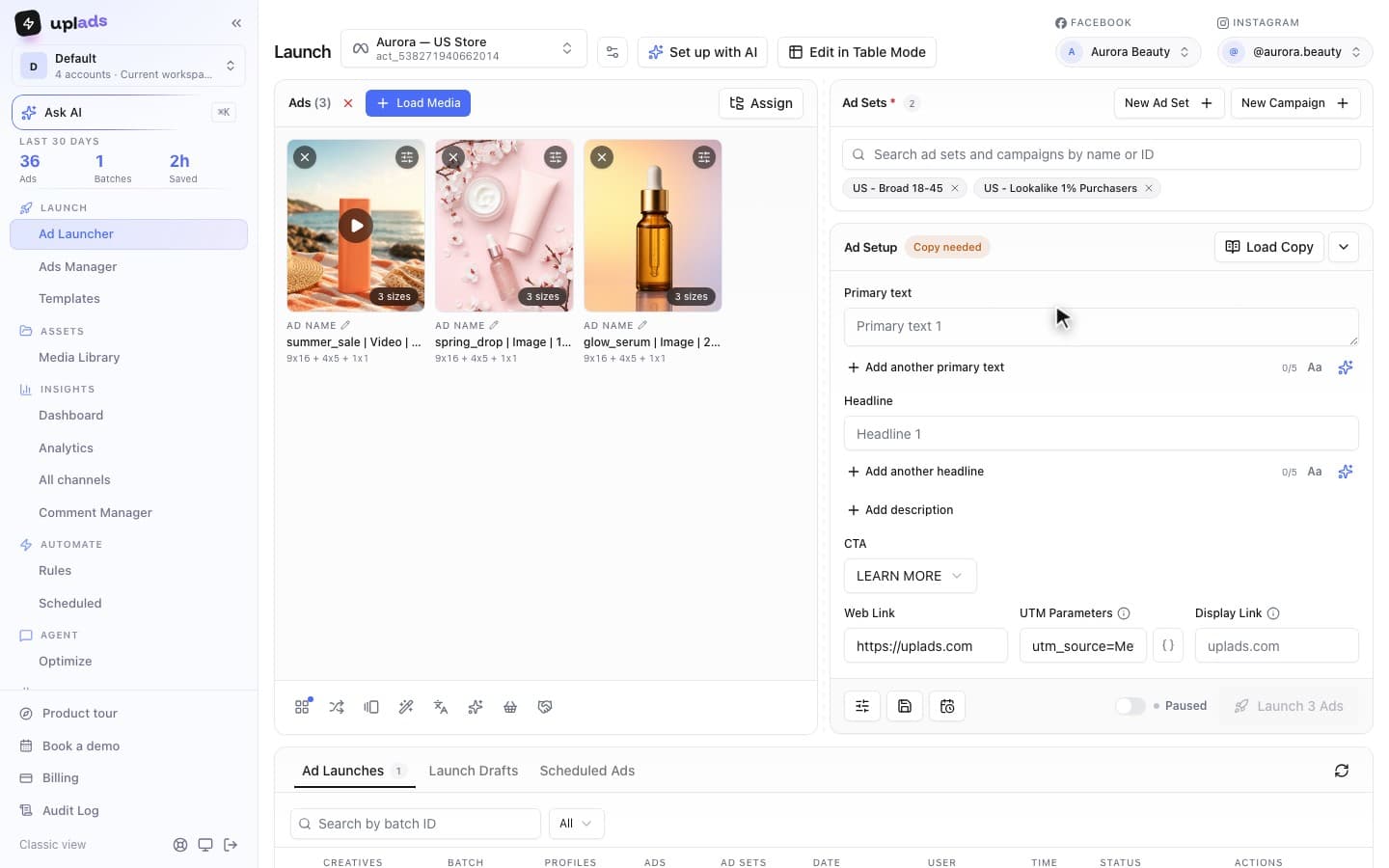
What unblocks the cadence is a launch step that scales flat instead of linearly with the number of ads. Concretely, that means a few capabilities the scaling framework quietly assumes you can do for free:
- One creative into many ad sets in a single launch. Horizontal scaling is, operationally, exactly this: take a winner, fan it across many ad sets at once instead of duplicating by hand. A direct-upload bulk launch tool does the fan-out as one action, so "duplicate the winner into eight audiences" is one selection, not eight rebuilds.
- A naming scheme applied at launch, not reconciled after. A scaled account with inconsistent ad names is an account you cannot read, and an account you cannot read is one where scaling decisions become guesses. A naming convention applied automatically as each ad is created means the variant, format, and angle are encoded from the first impression and the reporting parses itself.
- Both aspect ratios as one ad, not two. Scaling doubles every structural sloppiness. Shipping a 4×5 and a 9×16 of the same concept as two separate ads splits the data and inflates the account at exactly the moment you can least afford the noise. Multi-placement grouping keeps each concept as one ad that serves the right ratio per placement, so volume goes up without the readability going down.
- Re-launching a proven creative is instant. A winner you want in three more campaigns should not be three more uploads. Files are recognised and reused, so spreading a proven creative across new structures is a configuration step, not a re-upload.
None of this changes the scaling strategy. It changes whether you can run the strategy every week without the launch consuming the week. One honest scope note: this is a Meta, Facebook and Instagram, workflow, which is the network this guide is about. TikTok, Google Ads and Snapchat run on the same upload flow in production. If your scaling is on Meta, the loop in the next section is the loop.
Scaling fails at the launch step, not the strategy step
uplads takes a week's worth of raw creatives, groups the aspect ratios into single ads, applies your naming scheme, and launches the whole batch into every ad set you select in one pass - so the weekly scaling cadence is a short configuration job, not a four-hour rebuild.
A weekly creative-scaling system
The system that compounds is a weekly loop with three pipelines running at once: discovery feeding scale, scale feeding decline, and decline feeding the next discovery round.
The mistake is treating scaling as an event - find a winner, scale it, wait, repeat. That serializes work that should run in parallel and guarantees dead weeks where the account is coasting on a fatiguing ad. The accounts that compound run all three stages every week, so there is never a gap.
The weekly scaling loop
- 1
Read last week
Pull the results by the naming scheme. Which creatives earned scale budget, which fatigued, which are borderline. This is a five-minute read if the names were applied at launch, a weekend job if they were not.
- 2
Scale the proven
Raise budget on clear winners in small spaced steps, and duplicate the strongest into new audiences for horizontal volume. Small vertical steps, deliberate horizontal spread.
- 3
Retire the fatigued
Anything past its frequency ceiling with rising cost per acquisition comes off. Holding a dying creative because it once worked is how accounts bleed quietly.
- 4
Launch the next batch
The new variants for this week go live into their test cells in one launch, fan-out and naming and aspect-ratio grouping applied automatically, so discovery never stalls behind operations.
- 5
Bank the learnings
What won and why becomes the brief for next week's variants. The winner is not the end of the loop, it is the input to the next one.
The cadence is the strategy. A mediocre scaling framework run cleanly every week beats a perfect one run when there is time, because the weekly version always has a fresh winner ready and the occasional version is always one fatigue cycle from a flat month. The only thing standing between a team and the weekly version is almost always the launch cost of step four, which is the entire reason to make that step cheap. The mechanics of getting a batch live three different ways are covered in the bulk upload Facebook ads guide.
Common mistakes when scaling Facebook ad creatives
The recurring failures are predictable, and they cluster at the seam between budget tactics and creative supply.
Scaling budget faster than the creative can carry it. Doubling a winner's budget overnight, watching cost per acquisition spike, concluding the ad "stopped working." It did not stop working; it was asked to reach people it was never going to convert. Small spaced steps, and a duplicate when you need a step change.
Treating vertical scaling as a growth strategy. More budget on one ad set is a lever, not a plan. An account whose only scaling motion is "increase the budget" plateaus the moment its one creative fatigues, which it always does.
Narrowing audiences while scaling horizontally. Stacking overlapping interest segments so your own ad sets bid against each other. In 2026 the move is broader, not more granular; let the system de-duplicate instead of hand-building the overlap.
Scaling on data you cannot read. Forty ad sets with inconsistent names is not a scaled account, it is a mess with a high budget. The naming scheme has to be applied at launch, because nobody reconciles forty ad names by hand on a Friday, which means the scaling decisions get made on vibes.
Confusing one winner with a pipeline. The most expensive mistake. Finding a winner, scaling it, and not having the next one in test means the account is one fatigue cycle from a flat month. Scaling is a supply discipline, not a one-time event.
Testing too rarely because the launch is too painful. The quiet root cause under most of the above. A correct loop run monthly loses to an adequate loop run weekly, and the only thing usually keeping a team off the weekly cadence is the manual launch cost - not the strategy, the clicking.
The cheapest version of that launch cost in 2026 is not a faster screen but no screen: an MCP connector, in beta at uplads, lets Claude or ChatGPT assemble the next batch from a brief and stage it for review, so the supply side of the pipeline keeps moving even on the weeks nobody has a spare morning. MCP for advertisers covers what to check before connecting one.
Most of these disappear the moment the workflow stops being "build the ads by hand and tidy the names later" and becomes "decide the batch, drop the files, let the rules apply themselves." Get the budget mechanics right so you do not waste the winners you have, then make the launch cheap enough that you always have new ones. If you want the test-side discipline in depth, the Facebook ads creative testing guide covers finding winners cleanly, the bulk upload Facebook ads guide covers getting a batch live three ways, and uplads pricing is the no-spend-cap version of the direct-upload path that makes the weekly cadence sustainable.