
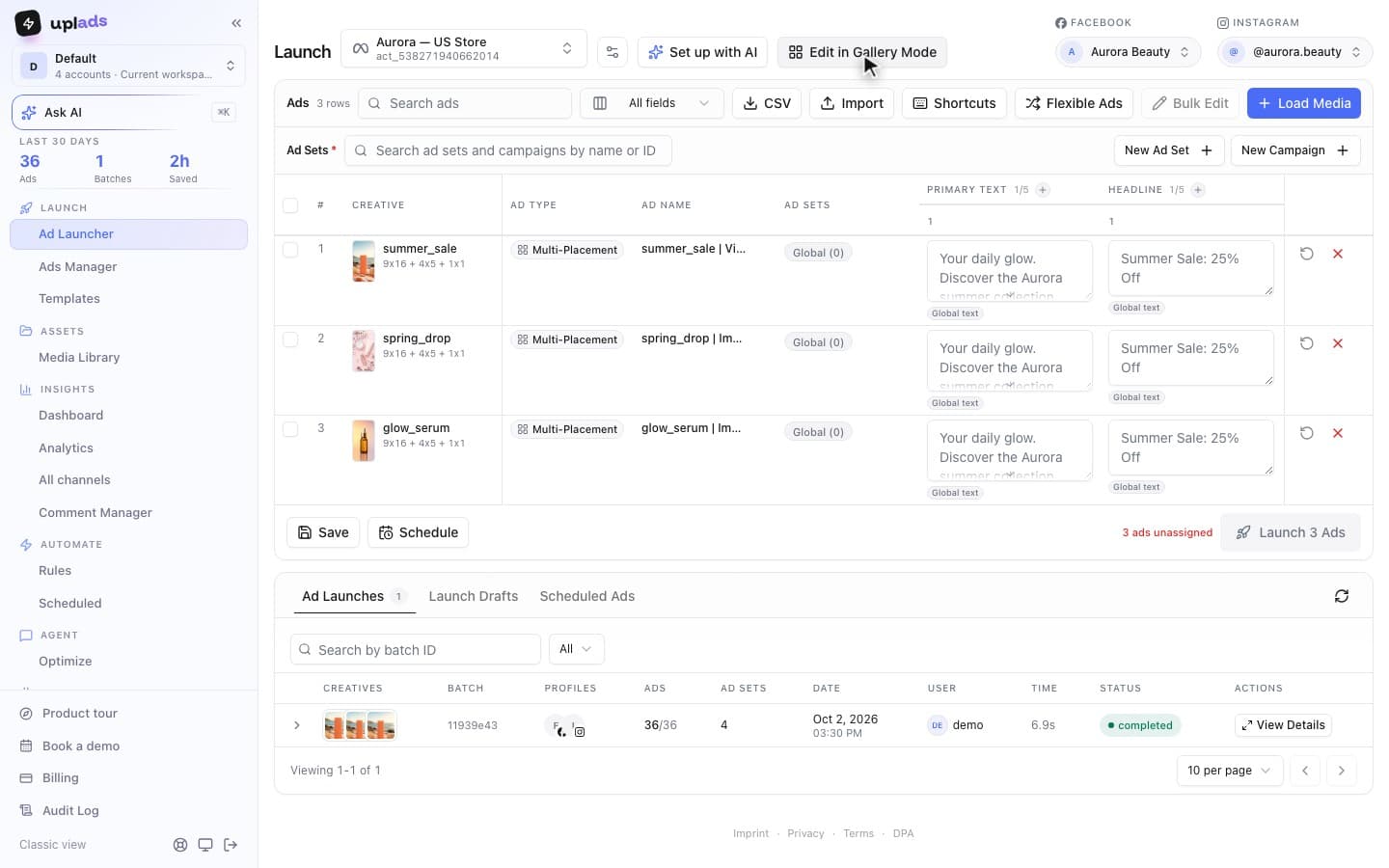
Targeting on Meta is mostly automated now. Bidding is automated. The one input the delivery system cannot generate for you is the creative, which is why creative testing is no longer one task among many in a paid social week. It is the job. If you systematically find and scale better ads faster than the account next to you, you win, almost regardless of what you do with audiences and budgets.
I build the tooling for an Austrian performance marketing agency where a normal week is dozens of new ad variants per client, and the recurring lesson is blunt: the teams that struggle with creative testing rarely have a methodology problem. They have a throughput problem. They know they should test more creatives, more often, and isolate variables cleanly, and they cannot, because shipping the volume the method demands is a four-hour clicking job nobody wants to do twice a week. This guide is the full framework, and it is also honest about that bottleneck, because the framework does not work without solving it.
What is Facebook ads creative testing?
Facebook ads creative testing is the practice of running multiple ad creatives against the same audience and the same objective to learn which ones the delivery system and your customers actually respond to.
That is the whole definition, but two words inside it carry the weight. "Same audience and same objective" is what makes it a test rather than a vibe: if the creative changes and the audience changes and the budget changes, you have learned nothing you can reuse. "Respond to" means the answer is a number, not an opinion: a creative test ends in a decision backed by conversions, click-through rate, and cost per acquisition, not in a meeting about which ad looked best.
Creative testing matters more in 2026 than it did even two years ago because of where Meta moved the optimization. The delivery system increasingly decides who sees what, when, and at what bid. The advertiser's remaining real lever is the set of creatives fed into that system. Meta's own About Creative Testing documentation frames it the same way: testing exists so you can introduce new creative into a working campaign and find better performers without throwing away the delivery learnings you have already paid for.
There is a volume reality underneath this that the methodology guides skip. A single clean test of five angles, two formats, and two aspect ratios is already 20 ads. Run that weekly, across two or three audiences, and you are launching 40 to 60 new ads a week per account before you have iterated on a single winner. The framework below is correct. It is also unworkable if producing and launching that volume is a manual grind, which is the thread running through the rest of this guide.
The three creative testing methods on Meta
There are three legitimate ways to structure a creative test on Meta in 2026, and they answer different questions.
Each method trades control for realism. The more isolated the test, the cleaner the read and the less it resembles how the ad will actually be delivered at scale. Pick the method by the question you are asking, not by which one a YouTube video told you to use.
Isolated ABO test cells
One ad set per creative (or a small set of creatives), ad-set budget optimization, budgets fixed and equal. Cleanest read of which creative wins on its own merit. Best for finding new winners from scratch.
Compete inside CBO / Advantage+
Drop new creatives into a campaign with campaign-level budget and let the system allocate. Most realistic, least clean: the system can pick a favorite early. Best once you trust the creatives and want survival of the fittest.
Meta native Creative Testing
Dedicate a slice of a running campaign's budget to new creative without disturbing proven ads or losing delivery learnings. Best for incremental testing inside a winner, not for volume discovery.
Isolated ABO test cells. This is the workhorse for discovery. You build one ad set per creative (or per small group of creatives you genuinely want isolated), set ad-set budget optimization with equal budgets, and point every cell at the same audience and objective. Because the budget cannot slosh toward an early favorite, each creative gets a fair sample. The downside is honest: it costs more (you are funding several cells in parallel) and it does not match how the creative will be delivered once it graduates into a budget-optimized campaign. Use it when the question is "which of these new concepts deserves to live."
Compete inside a CBO or Advantage+ campaign. Here you put new creatives into an existing campaign with campaign budget optimization and let Meta allocate spend toward whatever performs. This is the most realistic test because it is not a test, it is production. It is also the least clean: the system frequently commits to one creative before the others have a fair sample, which is the single most common complaint performance marketers raise about testing in CBO. It is the right method once you already trust the creatives and you want the market, not a contrived split, to pick the winner.
Meta's native Creative Testing feature. Rolled out across 2025 and 2026, this lets you ring-fence a portion of a live campaign's budget specifically for new creative, so the proven ads keep delivering and the campaign does not re-enter the learning phase. It is a genuinely useful addition for incremental testing, and it is what most of the recent coverage (Jon Loomer's walkthrough, the wave of 2026 YouTube explainers) is reacting to. Treat it as a precise tool for "test new creative without disturbing a winner," not as a replacement for a structured weekly discovery matrix. It tests inside one campaign; it does not solve testing at portfolio volume.
One note on Dynamic Creative: turning on Meta's dynamic creative option (the system permuting your headlines, texts, and media) is not a fourth testing method. It is an asset-permutation setting on a single ad. It can surface a strong combination, but it does not give you a clean per-creative read, because you cannot fully isolate which asset drove the result. Use it to squeeze a known concept, not to decide between concepts.
What to test, and in what order
Test the variable that moves the most money first, and only one variable at a time.
The single most common methodology mistake is changing the whole ad: new visual, new hook, new copy, new offer, all at once. When that ad wins or loses you have learned nothing reusable, because you cannot attribute the result to a cause. The discipline is boring and it is the entire game: hold everything constant except the one thing you are testing.
The order matters because the variables do not move results equally. Test them roughly in this sequence:
- The hook (first 3 seconds, or the scroll-stopping frame). Test this first. Most of the spread between a winning ad and a losing one is decided before the second 3 of the video. Test the same offer and body with three to five radically different openings.
- The format and creative type. Static versus video, talking-head UGC versus product-demo versus founder-to-camera, carousel versus single. Different formats reach different people and Meta delivers them differently.
- The angle or message. Same product, different reason to buy: price, speed, status, problem-agitation, social proof. This is where you find the headroom once the format question is settled.
- The polish. Editing pace, captions, music, on-screen text, thumbnail. Real but small. Testing polish before hook is rearranging deck chairs.
Meta's own research backs the sequencing. Their Facebook IQ work on creative pre-testing found that lightweight, early creative tests are a reliable predictor of in-market performance, which is the whole reason you front-load the cheap, high-impact variables (hook, format) before spending on the expensive ones (polish).
A practical metric note that comes up constantly in practitioner threads: hook rate (often measured as 3-second video views over impressions, sometimes called thumb-stop rate) is the leading indicator that tells you the test is working at the top of the funnel before you have enough conversions to read the bottom. It is a diagnostic, not the verdict. The verdict is always the conversion metric at your target. A creative with a great hook rate and a bad cost per acquisition is a great trailer for a film nobody buys a ticket to.
How to set up a creative test in Meta Ads Manager
To set up a clean creative test in Meta Ads Manager, build one campaign, one audience, and one isolated ad set per creative you want a clean read on, with equal fixed budgets.
This is the isolated-ABO method, step by step, because it is the one worth getting exactly right. The other two methods are variations on "put creatives in a campaign and watch."
Set up an isolated creative test in Meta Ads Manager
- 1
Define the hypothesis
Write one sentence: "Hook B will beat the current hook on cost per acquisition for the cold prospecting audience." If you cannot write that sentence, you are not ready to launch a test.
- 2
Build one campaign, one objective
Use your real optimization event (purchase, lead). Testing on a proxy event teaches you about the proxy, not the business.
- 3
Create the test ad sets
One ad set per isolated creative, ad-set budget optimization on, identical budgets, identical audience, identical placements. The only thing that differs between ad sets is the creative variable.
- 4
Include a control
One of the cells is your current best ad, unchanged. Without a control you can measure which new creative is least bad, not whether any of them beats what you already run.
- 5
Hold placements constant
Use the same placement set across every cell, and supply both a 4×5 and a 9×16 of each creative so placement is never the hidden variable.
- 6
Fund each cell to a readable sample
Set budgets so every creative can reach roughly 50 optimization events, or at least 1 to 3 times your target cost per acquisition in spend, before you judge it.
- 7
Launch all cells at once
Stagger nothing. Same start time, same conditions, or the test has a time confound baked in.
The step people skip is the control. A test without a control answers "which of these new ads is best" but not "is the best new ad better than what we already run," and the second question is the only one that should change your account.
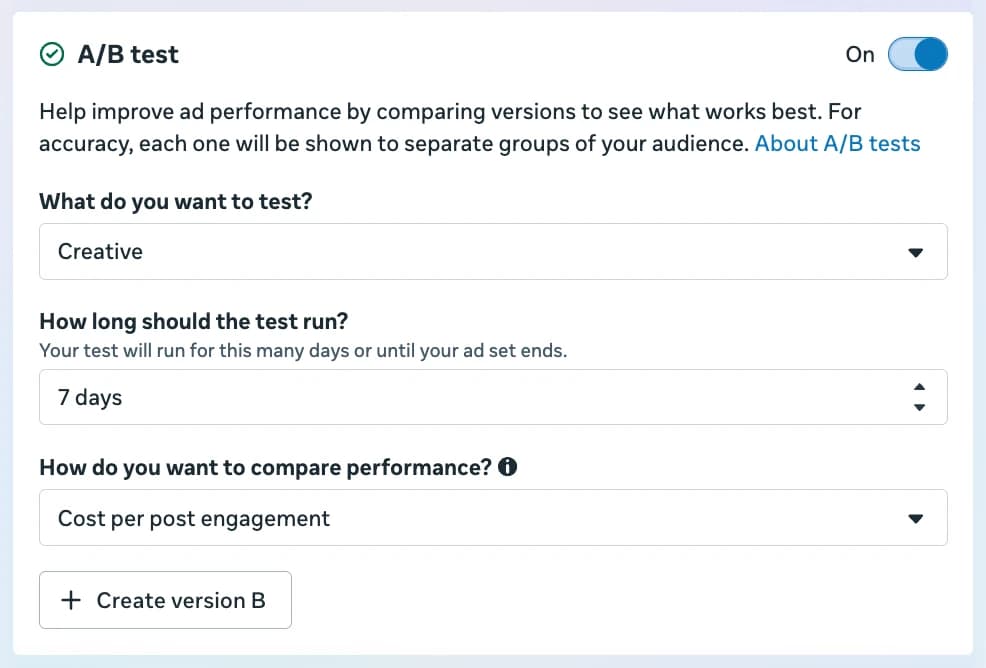
Budget and duration: how much, and how long
Fund each creative enough to exit the learning phase and run the test at least three to four full days before you read it.
These two failure modes, underfunding and judging early, account for most creative tests that produce noise instead of a decision. They are worth being precise about.
Budget per creative, not per test. The unit of funding is the individual creative, because each one has to gather its own evidence. Meta's delivery system stabilizes a new ad after roughly 50 optimization events; below that you are reading the learning phase, which is the least representative data the system produces.
Practically: take your target cost per acquisition, multiply by something like 50 (or by a smaller 1 to 3x floor if your CPA is high and 50 events is unrealistic for a test), and that is the spend each creative needs before its number means anything. Five creatives is five times that. This is why "how many creatives can I test" is really "what is my test budget divided by the spend each one needs" - it is arithmetic, not a rule of thumb.
Duration: three to seven days, learning phase excluded. Three to four full days is the floor: enough to clear learning and gather a readable sample across different days of the week. Seven days is a common ceiling for a discovery test, because past that, creative fatigue and external noise (a sale, a competitor, a news cycle) start contaminating the read. Inside that window, decide on the conversion metric at your target, with hook rate and click-through rate as the explanation for why a creative landed where it did.
If two creatives are statistically too close to call after a fair run, treat them as a tie and keep both - a forced winner between two equivalent ads is a coin flip dressed as a decision.
How to read the results and pick a winner
Read creative test metrics as a funnel: attention, then interest, then profitable conversion, with the conversion metric as the only decider.
The mistake is reading the metrics flat, as a row of numbers where the best CTR or the cheapest CPM wins. They are a sequence. Each one explains the next.
- Hook rate / 3-second views over impressions - did the creative earn attention at all? A low hook rate caps everything downstream; the test is over for that creative before the click even matters.
- Click-through rate - of the people it stopped, did enough find the promise compelling enough to act? CTR isolates the message and the offer from the visual hook.
- Cost per acquisition and ROAS at your target - of the people who clicked, did enough convert profitably? This is the verdict. Everything above it is the diagnosis.
Here is the same five-creative test read through that funnel. The point is not the exact numbers; it is that the winner on the bottom metric is not the winner on the top one, which is exactly why you read top to bottom and decide on the bottom.
Creative C earns the most attention; Creative E converts the most profitably. E wins the test. C goes back into the next round as a hook to graft onto E's offer.
Two cautions when you read the table. First, the Meta-favoritism effect: in non-isolated tests the system often over-feeds one creative early, so a "winner" in CBO can be an artifact of allocation, not merit - which is the whole reason isolated cells exist for discovery. Second, statistical significance is real but do not turn it into an excuse for paralysis: at small-business spend you will rarely hit textbook significance, so use a consistent decision rule (clear leader on the target metric after a fair, learning-cleared run) and apply it the same way every week.
How to scale and iterate a winning creative
Scaling a winning creative means iterating on what made it win, not just duplicating it into more ad sets at higher budget.
This is where most accounts leave the majority of the money on the table. They find a winner, push its budget, watch performance decay as it fatigues, and call creative testing a treadmill. The teams that compound treat a winner as a research finding, not a finished asset:
- Bank the winner, then interrogate it. Why did E win? Was it the hook, the proof, the pacing? The post-test analysis is where the next round's hypotheses come from.
- Spin variants off the winning element, not the whole ad. If E won on a specific hook, the next test is five new bodies and offers under that hook. You are climbing, not restarting.
- Graft winning parts together. C had the best hook, E had the best offer. The obvious next creative is C's hook on E's offer. Cross-pollination of proven parts is the highest-yield idea in iterative testing and it costs almost nothing to produce.
- Consolidate, then scale budget. Move proven winners into the budget-optimized campaign and scale there, while the isolated test cells keep running fresh discovery in parallel. Discovery and scaling are two pipelines, not one campaign you keep poking.
The structural insight: a creative test does not end with a winner, it ends with the inputs to the next test. An account that runs this loop weekly compounds; an account that runs a test, scales, and waits for the winner to die does not. Which makes the loop's cadence - how often you can actually run it - the thing that determines whether you compound at all.
The real bottleneck: creative volume
The framework above is well understood. The reason most teams still lose at creative testing is not that they do not know it - it is that running it at the required cadence is an operational job they cannot sustain.
Walk the numbers. A disciplined weekly discovery test is 5 angles by 2 formats by 2 aspect ratios, which is 20 creatives, across 2 to 3 audiences, plus the iteration round on last week's winner, plus the control. That is comfortably 40 to 60 new ads a week, per account. For an agency that is several accounts. Built one by one in Ads Manager, that is the four-hour Monday that gets quietly skipped under client pressure - and a skipped test week is a week the account stops compounding.
This is the thread the methodology guides never pull, and it is the entire reason the tool I build exists. Before it, the agency kept a document full of "duplicate this ad set ten times, rename, swap the creative" macros for client accounts. The macros were the tell: the work was too repetitive to do by hand and too important to do inconsistently. The fix is not a better spreadsheet, it is removing the per-ad clicking from the launch entirely.
20
5 angles x 2 formats x 2 ratios, before iteration
50
Across audiences and accounts, per the framework
4
30 variants x 3 ad sets, by hand in Ads Manager
12
Same launch, files dropped and configured once
Source: Doppel N Marketing internal benchmark, May 2026 - illustrative, varies by account
What removes the bottleneck is a launch step that scales flat instead of linearly. Practically, that means three things the framework quietly assumes you can do cheaply:
- One creative into many ad sets in one launch. The framework says "same creative, isolated cells, same conditions." That is one creative fanned across many ad sets - one selection, not fifty duplications. A direct-upload bulk launch tool does the fan-out as a single action.
- Naming applied at launch, not cleaned up after. A test you cannot read is a test you did not run. A token-based naming convention applied to every ad as it is created means the variant, format, and angle are encoded in the ad name from the first impression, so the results table parses itself instead of becoming a weekend reconciliation job.
- Both aspect ratios as one ad, not two. The 4×5 and the 9×16 of the same concept are one ad with placement-level customization, not two ads that split your data. Multi-placement grouping keeps the test honest by making placement a constant, not an accidental extra variable that doubles your ad count.
None of this changes the methodology. It changes whether you can actually run the methodology every week without it costing the week. The honest scope note: this is a Meta (Facebook and Instagram) creative-testing workflow, which is what this guide covers. TikTok, Google Ads and Snapchat run on the same upload flow in production. If your testing is Meta, the loop above is the loop.
The framework only works if you can ship the volume
uplads ingests your raw creatives, groups the aspect ratios into one ad, applies your naming template, and launches the whole test matrix against Meta in one pass - so the weekly creative test is a 12-minute job, not a 4-hour one.
Common creative testing mistakes
The recurring failures are not exotic. They are the same handful, in roughly this order of frequency.
Changing more than one variable at a time. New visual, new hook, new copy, new offer, all in one ad. The ad wins or loses and you have learned nothing transferable. One variable per test, always.
Killing creatives during the learning phase. A high cost per acquisition on day one is the learning phase, not a verdict. Decisions made before a fair, learning-cleared sample are the most expensive mistake in this entire process, because you are discarding ads that were never given the chance to work.
No control in the test. Without your current best ad in the test, you can rank the new creatives against each other but you cannot tell whether the best of them beats what you already run, which is the only result that should change the account.
Reading metrics flat instead of as a funnel. Picking the winner on CTR or CPM instead of the conversion metric at your target. The upper-funnel metrics explain the result; they do not decide it.
Splitting one creative into two ads for two ratios. The 4×5 and the 9×16 of one concept are one ad. Doubling the ad count to cover placements splits the data, inflates the account, and makes the test harder to read - the opposite of what a test is for.
Testing too rarely because the launch is too painful. The quietest and most expensive mistake. A correct framework run once a month loses to an adequate framework run every week, and the only thing standing between a team and a weekly cadence is usually the manual launch cost, not the strategy.
Most of these disappear the moment the workflow stops being "build fifty ads by hand and tidy the names later" and becomes "decide the matrix, drop the files, let the rule apply itself." Get the methodology right, then make the cadence cheap enough to actually keep. If you want the launch-mechanics side in depth, the bulk upload Facebook ads guide walks the three ways to get a test matrix live, the Meta Ads Manager alternatives breakdown covers when the native tools stop being enough, and uplads pricing lists the flat monthly plans for the direct-upload path, none of which takes a share of ad spend.