
Every agency has a strategy deck. Almost none have a written ad operations playbook, and the gap between those two documents is where agency margin leaks out. Strategy is the glamorous half of paid media: the angles, the audiences, the creative bets. Ad operations is the unglamorous half: building the ads, naming them so the reports parse, QA-ing them before spend, and doing it again next week across every client account. The agencies that scale profitably are not the ones with better strategy. They are the ones whose operations do not get more expensive every time they sign a client.
I build the launch tooling for an Austrian performance marketing agency where a normal week is dozens of new ad variants per client across a portfolio of accounts. The recurring lesson is blunt: the constraint on an agency is almost never strategy capacity. It is operations capacity. The team knows what to launch. Getting it live, named correctly, and QA'd, across eight or fifteen client accounts, every Monday, is the part that breaks. This guide is the playbook for that half of the job.
What is agency ad operations?
Agency ad operations is the repeatable execution layer that turns a media plan into live, correctly-named, correctly-targeted ads across client accounts, week after week, without errors and on schedule.
It is deliberately not strategy. Strategy decides what to run and why. Ad operations is the discipline that gets it live cleanly, at the cadence the strategy demands, at the volume the client roster demands. In practice it covers a narrow but high-frequency set of tasks: building the ads, applying the naming convention, structuring the account, QA-ing before spend, launching, and handing clean data to whoever does reporting. None of it requires judgment in the way strategy does. All of it requires consistency, because it happens every week on every account and a single inconsistency contaminates a client's entire reporting history.
The reason this matters more in 2026 than it did a few years ago is where the platforms moved the work. Targeting on Meta is largely automated through Advantage+ audience. Bidding is automated. The advertiser's real remaining lever is the volume and quality of creative fed into the system, which means the modern paid-media account is a creative-throughput machine. More creative throughput means more ads to build, name, QA, and launch every week. The strategic surface shrank and the operational surface grew. An agency that did not notice this is now spending its most expensive people on its lowest-value work.
Here is the thesis the rest of this playbook is built on: agency ad operations is the hidden margin. Strategy hours are roughly fixed per client. Operations hours scale with creative volume times client count, and that product grows fast. If the launch step is a four-hour manual job, signing the fifth client does not add a fifth of your operations load, it adds a full week of someone's time you did not budget for. The playbook exists to break that linear scaling.
What belongs in an agency ad operations playbook
A complete agency ad operations playbook documents five components: the weekly launch ritual, the naming convention, the pre-flight QA checklist, the per-client account-structure standard, and the build-vs-buy decision for the launch tooling.
It is a standard operating procedure, not a strategy framework. The test of a good playbook is simple: a competent operator who has never touched a given client account should be able to run that client's weekly launch correctly using only the playbook, and produce a result identical to what your most senior person would produce. If the answer depends on tribal knowledge in one person's head, you do not have a playbook, you have a key-person risk. These are the five components every agency playbook needs to define.
The launch ritual
A fixed weekly cadence, a named owner per client, and a definition of done. Launches happen on a schedule, not when someone gets to them.
The naming spine
One token-based convention applied identically across every client account, enforced at launch, never cleaned up afterward.
The pre-flight QA
A written checklist run before spend on every launch. The same checks, every time, regardless of who launches.
Account-structure standard
A repeatable campaign and ad-set skeleton per client so accounts are legible to any operator on the team.
Build-vs-buy call
An explicit decision on which parts of the launch are tooling problems versus headcount problems, reviewed as the roster grows.
The reporting handoff
A defined boundary where operations ends and reporting begins, made clean by the naming spine doing its job.
Most agency playbooks that exist at all stop at the account-structure standard and call it done. The two components that actually decide whether operations scales, the naming spine and the build-vs-buy call, are the ones that get hand-waved, because they feel like infrastructure rather than work. They are the work. The rest of this guide goes deep on each.
The weekly client launch ritual
The launch ritual is a fixed weekly cadence with a named owner per client and a written definition of done, so launches happen on schedule rather than whenever someone gets to them.
The single biggest operational failure in agencies is not a bad launch. It is a skipped one. A client's account stops compounding the week its creative test does not ship, and tests get skipped when the launch is an undefined, unowned, multi-hour job that competes with everything else on a Monday. A ritual removes the decision. The launch is not a thing the team chooses to do when there is time; it is a scheduled event with an owner and a checklist, the same way payroll is. A fixed day also suits how Meta delivers: every new ad set starts in the learning phase, and a steady weekly rhythm is easier to read than sporadic large batches.
The weekly per-client launch ritual
- 1
Lock the matrix
Strategy and creative decide the week's test: the angles, formats, and audiences. Operations does not start until the matrix is a fixed list, not a conversation.
- 2
Stage the creatives
Collect the week's files for the client. Both aspect ratios of each concept are present and named to the convention from the moment they are saved.
- 3
Select targets in the client account
One client account per launch run. Choose the ad sets the matrix calls for. The account-structure standard means the skeleton already exists.
- 4
Apply the naming template
The token template is selected once for the run. Every ad inherits it at launch. Nothing is renamed afterward.
- 5
Pre-flight QA
Run the written checklist below before anything spends. This is the step that is never skipped, even under deadline.
- 6
Launch and walk away
The batch processes in the background. The operator moves to the next client while it runs.
- 7
Confirm and hand off
Verify the launch completed, note any per-ad failures, and the reporting handoff is now clean because the names already parse.
The ritual is per client account, and that word "per" is doing honest work. There is no single button that fans one launch across every client account at once, and any playbook that promises that is selling you a compliance problem. Each client account is its own run. The win is not eliminating the per-client loop; it is making each iteration of that loop minutes instead of hours, so running it fifteen times on a Monday is a morning, not a week.
Naming conventions: the spine of multi-account reporting
A naming convention is the spine of agency ad operations because it is the only thing that makes reporting possible across many client accounts without a human reconciling names by hand.
In a single in-house account you can get away with messy names because one person holds the context. In an agency running ten or twenty client accounts, the names are the data model. If the campaign, ad set, and ad names do not encode the client, product, audience, creative, and date in a fixed, parseable structure, then every cross-client report, every client-facing dashboard, and every "which angle is working across the portfolio" question becomes a manual archaeology project. The naming convention is not housekeeping. It is the difference between reporting being a query and reporting being a weekend.
Two rules make a convention real, and both are about enforcement, not format. First, the template is identical across every client account. The tokens can be whatever your reporting needs, in our agency the shape is brand, then offer, then audience, then creative identifier, then date, but the order and separators never vary by client, because the moment they do, cross-client analysis breaks. Second, and this is the rule that is almost always violated, the names are applied at launch time, not cleaned up afterward. A convention that relies on an operator remembering to rename forty ads after they go live is not a convention. It is a wish that survives exactly until the first busy week.
This is why a token-based naming convention that is applied as the ads are created is worth more to an agency than the most elaborate naming document nobody follows under pressure. The full design of a portfolio-grade convention, the tokens, the separators, the cross-client structure, is its own deep topic; the Facebook ads naming convention guide walks the whole thing. For the playbook, the rule is one sentence: enforced at launch, identical across clients, never retroactive.
The pre-flight QA checklist every launch needs
The pre-flight QA checklist is a fixed, written set of checks run before any spend on every launch, identical regardless of who is launching, because the cost of catching an error after spend is the spend.
QA in ad operations is not optional polish. A wrong audience on a client launch, a creative that did not upload, a budget that is ten times what was briefed: these are not embarrassing, they are billable damage on someone else's money. The defining property of a good QA step is that it is the same checklist every time. Ad-hoc "I'll just eyeball it" QA fails precisely when it matters most, on the busy week with the deadline, which is also the week the expensive mistake happens.
A minimum pre-flight checklist for an agency launch: the correct client account is selected, not the previous client's, which is the single most common multi-account error; the budget matches the brief at the campaign and ad-set level; the audience is the briefed audience, not a leftover from last week; every creative actually rendered and is not a broken upload; both aspect ratios are present for each concept so placement is not a hidden variable; the naming template resolved correctly on a sample ad; and the objective and optimization event are the ones the strategy specified, not a platform default.
Seven checks, two minutes, run before spend, every time. The agencies that get burned are not the ones without QA knowledge. They are the ones whose QA was a habit instead of a list, and habits do not survive deadlines.
The multi-account reality, and the honest scope
The honest operational reality of an agency is one client account per launch run, and the playbook is built around iterating that loop fast rather than pretending it away.
It is worth being precise here, because a lot of tooling marketing is not. An agency does not launch into all client accounts simultaneously from one button. Each client account is a separate, isolated launch: its own creatives, its own targets, its own run, its own QA. This is correct, not a limitation, because client accounts must stay isolated for billing, access, and blast-radius reasons. You do not want a workflow where one misconfigured run can touch every client at once. The right design is strict per-account isolation where each operator only ever sees and touches the accounts they are responsible for.
So the multi-account playbook is not "launch everywhere at once." It is "make a single client launch so cheap that running it fifteen times is a morning." The savings come from the per-run cost, not from collapsing the runs. A workflow built for teams managing many accounts gives each team member a clean view of only the ad accounts they have been given access to, and the speed-up comes from the launch step inside one account taking minutes. Multiply a 15-minute job by 15 clients and you have a Monday morning, under 4 hours. Multiply a 4-hour job by 15 clients and you have 60 hours, a problem no amount of strategy talent can fix.
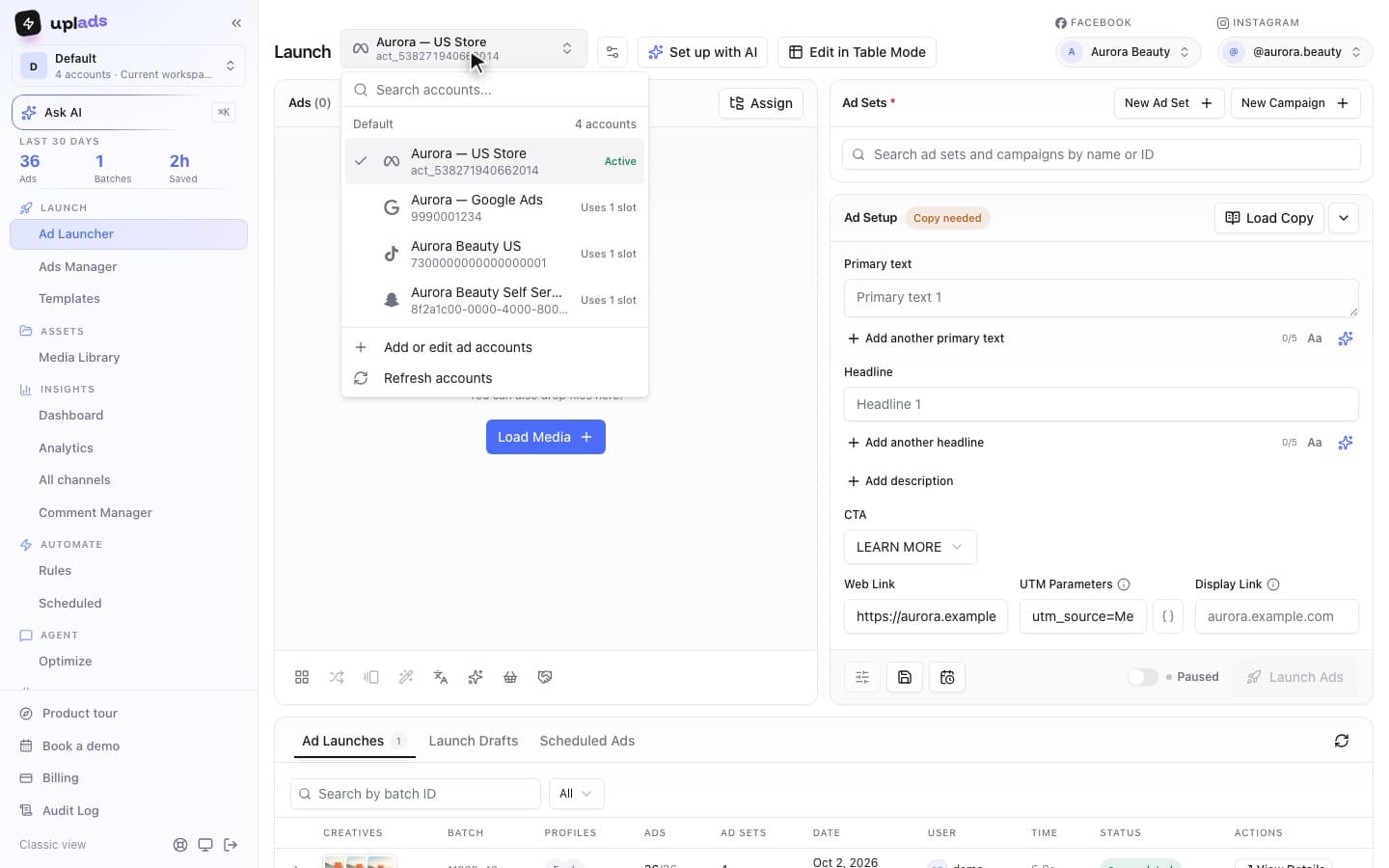
The ceilings of a single run are worth knowing before you plan the week around them. In uplads one launch takes up to 500 creatives into up to 50 ad sets across up to 20 campaigns, always inside one ad account; Snapchat launches cap at 50 creatives. A weekly matrix for one client fits inside one run with room to spare, which is the point: the loop is per client, and each pass of it is one launch.
One scope note, stated plainly because the truth rule in this playbook applies to the playbook itself: the bulk-launch workflow described here is a Meta workflow, Facebook and Instagram, which is where the agency volume problem is most acute. TikTok, Google Ads (Performance Max, Demand Gen, YouTube video and App campaigns) and Snapchat run on the same upload approach in production, on the Growth and Agency plans. If your agency's weekly grind is any of those four, this is the loop.
Where the playbook breaks: the manual-launch tax
The agency ad operations playbook breaks at exactly one point: the launch step, where building and naming ads by hand turns a five-component system into a four-hour manual job that does not survive client growth.
Everything above, the ritual, the naming spine, the QA checklist, is cheap to write and free to follow if the launch itself is fast. The entire system collapses on the one component that scales linearly with creative volume times client count. Walk the arithmetic. A disciplined weekly test for one client is 5 angles by 2 formats by 2 aspect ratios, 20 creatives, across 2 or 3 audiences. That is 40 to 60 ads for one client.
Built one by one in the native ads manager, that is the multi-hour block. Now multiply by a client roster. The playbook did not fail because the strategy was wrong or the team was lazy. It failed because the launch mechanics made following it unaffordable.
Before the tool I build existed, the agency it was built inside kept a document full of "duplicate this ad set ten times, rename each one, swap the creative" macros for client accounts. That document was the diagnosis. The work was too repetitive to do by hand reliably and too important to do inconsistently, which is the exact signature of a task that is a tooling problem, not a headcount problem. You do not solve it by hiring a junior to click faster. You solve it by removing the per-ad clicking from the launch entirely.
The strategy line is roughly flat per client. The manual-operations line is not. The whole playbook is about flattening the orange bars.
What flattens that line is a launch step that scales sub-linearly: one creative selected once and fanned into many ad sets in a single run instead of duplicated by hand, both aspect ratios of a concept grouped into one ad instead of two that split the data, the naming template resolved as the ads are created, and the whole batch processed in the background so one rejected ad does not kill the launch and the operator can move to the next client while it runs.
That is the difference between the orange bars and the blue ones. The methodology in this playbook does not change at all; what changes is whether an agency can afford to follow it past the third client.
The playbook only works if the launch is cheap
uplads takes the week's creatives, groups the aspect ratios into one ad, applies your naming template at launch, and pushes the matrix into a client account in one pass, so the per-client launch is a minutes job and the playbook survives the fifteenth client.
Where automation actually fits, and where it does not
Automation belongs on the high-volume, low-judgment, identical-across-clients parts of ad operations: bulk launching, naming enforcement, aspect-ratio grouping. It does not belong on the strategy, the creative, or the QA judgment.
The 2026 discourse wants to automate everything with an AI agent, and the playbook view is more disciplined than that. The test for whether a task should be automated is not "can a model do it." It is "is this task high-frequency, low-judgment, and identical across every client." Bulk launching is the textbook case: it is the same mechanical action fifty times, the judgment was already spent deciding the matrix, and the output is identical in shape across every client account. That is a tooling problem with a clean answer.
The inverse is just as important. The angle selection, the creative concept, the read on whether a test result is real or noise, the decision to keep or kill a client strategy: these are low-frequency and high-judgment, and automating them produces confident garbage. The QA checklist is the interesting middle. The checklist itself should be enforced by tooling so it cannot be skipped, but the judgment inside a check, is this really the right audience for this client, stays human. A good agency ad operations playbook automates the clicking and protects the thinking. The failure mode of the automate-everything era is doing the opposite: leaving the fifty manual ad builds in place while pointing an AI agent at the strategy.
Build vs buy your ad operations layer
Build the parts of ad operations that are your competitive edge; buy or systematize the parts that are pure repetition and identical across every agency on earth.
The decision rule is one line: if a task is high-volume, low-judgment, and the same at every agency, it is not where your team should be spending hours, because there is no edge in it, only cost. Your account structure, your creative process, your strategic frameworks, those are differentiated and worth owning. Bulk launching, naming enforcement, and aspect-ratio grouping are not differentiated. Every competent agency does them the same way. Hours spent there are pure overhead that scales with your client count, which is the worst kind of cost: it grows exactly as fast as your revenue, so it caps your margin no matter how many clients you add.
Most agencies under-invest here for a revealing reason: the work feels too mundane to systematize. Strategy gets the investment because it feels important. The launch grind gets tolerated because admitting it is a real, expensive problem feels like admitting the team is doing low-value work, even though that is precisely the point, the team should not be doing it. The agencies that break the linear-cost trap are the ones that looked at the manual launch honestly, classified it as the commodity it is, and bought a tool instead of hiring more hands to absorb it.
The native ads manager is free and fine until the volume crosses the line where free costs you a full-time-equivalent in clicking; the Meta Ads Manager alternatives breakdown is the same decision applied to the launch tool specifically, and uplads pricing is the buy side as three flat monthly plans, none of which grows with ad spend: Starter at 69 EUR for 2 ad accounts and 1 seat on Meta, Growth at 199 EUR for 5 accounts and 5 seats across Meta, TikTok, Google Ads and Snapchat, and Agency at 499 EUR for 15 accounts and 15 seats. Yearly billing takes two months off, and the 7-day trial runs on Growth limits without a card.
The ad operations maturity model: 30, 60, 90 days
The fastest way to fix agency ad operations is to sequence it: write the naming spine and QA checklist first (30 days), make the launch cheap second (60 days), then standardize and measure (90 days).
Trying to fix everything at once is how playbook initiatives die in a drawer. The order is deliberate: cheapest first, then the change that saves the most hours.
The first thirty days is documentation and is nearly free. Write the naming convention down, exact tokens, exact order, exact separators, identical across clients. Write the pre-flight QA checklist, the seven-ish checks, as a literal list. Define the weekly ritual: the day, the owner per client, the definition of done. None of this requires a tool. All of it requires a decision and a document, and it immediately removes the worst inconsistencies because the standard now exists outside one person's head.
The next thirty days, days thirty to sixty, is removing the manual-launch tax, the single component that determines whether the documentation you just wrote is sustainable. This is the build-vs-buy decision, made and acted on: get the per-client launch from a multi-hour manual job to a minutes job by systematizing or buying the bulk launch, so the ritual is something the team can actually run every week under real client pressure. The bulk upload Facebook ads guide is the deep version of this step, and creative testing is the methodology the cheap launch finally lets you run at cadence.
One development is worth folding into this second phase rather than treating as a separate project. Ad tools have started shipping connectors built on the Model Context Protocol (MCP), which let an assistant like Claude or ChatGPT do the mechanical setup inside the launch tool: import the creatives from a folder link, write the copy, build the campaign and ad sets paused, and hand back a staged launch for review. For an agency that runs the same brief shape across eight accounts, that is the commodity half of the ritual disappearing rather than getting faster.
The judgment half - what to test, what to kill - does not move. Before connecting one to a client account, read MCP for advertisers: the questions that matter are whether it authenticates as the operator, whether it can spend by default, and whether everything lands in an audit log.
The final thirty days, days sixty to ninety, is standardization and measurement. With the spine enforced and the launch cheap, the account-structure standard becomes enforceable across the roster, the reporting handoff becomes a query instead of a reconciliation, and you can finally measure the thing that matters: operations hours per client, and whether that number stays flat as you add the next client. That flat line is the entire goal of the playbook. When signing a new client adds revenue without adding a proportional block of someone's week, the ad operations playbook is working, and the agency has turned its most mundane half into its most defensible margin.