
Every paid-ads team has a naming convention. Almost none have a naming convention that is still intact six months later. The format gets agreed in a shared doc, applied cleanly for a week, broken on the first launch under deadline pressure, and quietly abandoned by the end of the quarter. By month six the campaign list reads like a graveyard: Campaign_v3_FINAL, summer_test_2, pls_use_this_one. The format was never the hard part. Keeping it alive is.
This guide covers both halves: a convention worth using (the three-level structure, the qualifiers that belong in a name, copy-paste templates per campaign type), and the part most guides skip entirely, which is how to make it survive a fifty-ad Monday. The examples are written for Meta in 2026, but the structure ports cleanly to Instagram, and the same discipline applies on Google and TikTok.
What a Facebook ads naming convention is
A Facebook ads naming convention is a fixed format for the names of your campaigns, ad sets, and ads inside Meta Ads Manager, so that any name can be read, filtered, and grouped without opening the ad.
Meta gives you three levels and almost no structure. A campaign holds an objective. Inside it, ad sets hold the audience, placement, and budget. Inside those, ads hold the creative. Meta will let you name all three "Untitled" and never complain. The convention is the structure you impose on top: a small, agreed set of qualifiers per level, in a fixed order, joined by one separator. Done well, the name is the metadata. Sales_BOF_US_LAL1pc_SummerSale_UGC_HookA_2026-05-15 tells you the objective, funnel stage, market, audience, promotion, creative format, variant, and launch date before you have clicked anything.
The reason this is a discipline and not a preference: Ads Manager, the reporting API, and every analytics layer downstream of it group by name string. If the name is structured, a regex or a column split turns the name into queryable dimensions. If the name is final_FINAL_v2, that data is gone and no dashboard recovers it.
Why the convention matters more than the format
The naming convention matters more than the exact format because the format only has to be consistent, but the consequences of inconsistency compound across reporting, creative analysis, and team handoff.
Three things break without a convention:
Reporting and analytics. Most teams analyze performance by slicing: top-of-funnel versus bottom-of-funnel, one audience type versus another, one creative format versus another. Every one of those slices is a filter on the name. With a convention, "show me all bottom-of-funnel lookalike ad sets" is one filter. Without one, it is an afternoon of manual tagging in a spreadsheet, repeated every reporting cycle, by whoever drew the short straw.
Creative analysis. This is the one that costs real money. Iterative creative testing only works if you can see which concept, hook, and format won, then ship more of that. If the ad name does not encode the creative concept and variant, the winner is invisible the moment the test ends. You end up rerunning tests you already paid for because nobody can reconstruct what Ad_47 actually was.
Team and account handoff. Agencies live on this. When an account moves between buyers, or a client account is onboarded, the only durable documentation of how the account is structured is the names. A clean convention is a working handoff document. A drifted one is a week of reverse-engineering.
A naming convention is not housekeeping. It is the difference between an ad account you can interrogate and one you can only stare at. The return on it shows up every reporting cycle, every creative test, and every handoff for the life of the account.
The three-level structure: campaign, ad set, and ad
Name each level for what changes at that level, and never repeat a qualifier that belongs to a different level.
This is the single most important rule, and the one most teams get wrong. The audience belongs in the ad set name, not the campaign name. The creative belongs in the ad name, not the ad set name. When qualifiers leak between levels, the name gets long, the redundant parts drift independently, and filtering breaks. Keep each level responsible for its own dimensions.
Campaign-level names
The campaign answers what is this trying to do, and where in the funnel. Good campaign qualifiers: objective, funnel stage, market or geography, and a time bucket for scaling and archiving.
[Objective]_[FunnelStage]_[Geo]_[YYYYQn]

Sales_BOF_US_2026Q2
Leads_TOF_DACH_2026Q2
Sales_Retargeting_US_2026Q2
Use short, fixed codes: TOF / MOF / BOF for funnel stage, Sales / Leads / Traffic / Awareness for objective. The quarter token is not decoration. It is how you archive last quarter's campaigns without losing the ability to compare year over year.
Ad set-level names
The ad set answers who is this going to, and how is it bidding. Good ad set qualifiers: audience type, audience name, placement (if you split placements), and bid strategy.
[AudienceType]_[AudienceName]_[Placement]_[BidStrategy]

LAL_Purchasers1pc_Auto_LowestCost
Interest_Fitness_Reels_CostCap
Retgt_VV75_Stories_BidCap
Broad_NoTargeting_Auto_LowestCost
LAL is a lookalike, Retgt is retargeting, Interest is an interest or detailed-targeting audience, Broad is broad targeting. Fix this vocabulary once for the whole account. The cost of two buyers writing LAL and Lookalike for the same thing is that no single filter ever returns all of it.
Ad-level names
The ad answers which creative is this, exactly. This is where the volume lives, where conventions break first, and where iterative testing lives or dies. Good ad qualifiers: creative concept, format, variant or hook, and launch date.
[Concept]_[Format]_[Variant]_[YYYY-MM-DD]

SummerSale_UGC_HookA_2026-05-15
SummerSale_StaticImage_HookB_2026-05-15
EvergreenDemo_Carousel_v3_2026-05-15
Format codes: UGC, StaticImage, Carousel, Video, Collection. The launch date is what lets you ask "how did everything we shipped the week of 15 May perform" without remembering anything. Note what is not here: no audience (that is the ad set), no objective (that is the campaign). The ad name is purely about the creative.
What to put in a name: the qualifier framework
Pick the smallest set of qualifiers that makes every slice you actually report on a one-line filter, then stop adding.
The most common failure is not too few qualifiers. It is too many. Every extra qualifier is a future column someone has to fill, and the half of the team that forgets to fill it is exactly what kills the convention. Run every candidate qualifier through one test: do I slice reports by this? If yes, it earns a place. If no, it does not, no matter how interesting it seems.
A practical default set, by level:
| Level | Earns a slot | Usually does not |
|---|---|---|
| Campaign | Objective, funnel stage, geo, quarter | Budget amount, client name (use the ad account), campaign ID |
| Ad set | Audience type, audience name, placement, bid strategy | Detailed interest list, exact age range, optimization event |
| Ad | Creative concept, format, variant/hook, launch date | Designer initials, internal ticket number, file version |
Two rules make the framework hold. First, fixed vocabulary: write down the allowed values for every qualifier (TOF/MOF/BOF, LAL/Retgt/Interest/Broad, UGC/StaticImage/Carousel/Video) and treat that list as the convention, not the format string. Second, one separator everywhere. The _ character is the safest default because it survives URLs, spreadsheets, and the reporting API without escaping. Pick one and never mix. A convention that joins campaign names with _ and ad names with - is two conventions, and your filters have to know which.
Copy-paste Facebook ads naming convention templates
Here are templates per campaign type. Adjust the vocabulary to your account, keep the structure.
Direct-response sales (ecommerce, the most common case):
Campaign : Sales_[FunnelStage]_[Geo]_[YYYYQn]
Ad set   : [AudienceType]_[AudienceName]_[Placement]_[BidStrategy]
Ad       : [Concept]_[Format]_[Variant]_[YYYY-MM-DD]

Sales_BOF_US_2026Q2
   LAL_Purchasers1pc_Auto_LowestCost
      SummerSale_UGC_HookA_2026-05-15
      SummerSale_UGC_HookB_2026-05-15
Lead generation (B2B, services):
Campaign : Leads_[FunnelStage]_[Offer]_[YYYYQn]
Ad set   : [AudienceType]_[AudienceName]_[Placement]_[BidStrategy]
Ad       : [Angle]_[Format]_[Variant]_[YYYY-MM-DD]

Leads_TOF_Ebook_2026Q2
   Interest_OpsManagers_Feed_LowestCost
      TimeSaved_StaticImage_v1_2026-05-15
Advantage+ shopping / catalog:
Campaign : Sales_ASC_[Geo]_[YYYYQn]
Ad set   : ASC_[BudgetTier]_[BidStrategy]
Ad       : [Catalog]_[Concept]_[Format]_[YYYY-MM-DD]

Sales_ASC_US_2026Q2
   ASC_Scale_LowestCost
      MainCatalog_BestSellers_DPA_2026-05-15
Iterative creative test (the 3-2-2 case, see below):
Campaign : Sales_BOF_CreativeTest_2026Q2
Ad set   : LAL_Purchasers1pc_Auto_LowestCost
Ad       : [Concept]_[Format]_[Hook]_[Text]_[YYYY-MM-DD]

Sales_BOF_CreativeTest_2026Q2
   LAL_Purchasers1pc_Auto_LowestCost
      Founder_UGC_HookA_TextA_2026-05-15
      Founder_UGC_HookA_TextB_2026-05-15
      Founder_UGC_HookB_TextA_2026-05-15
The pattern across all four: the campaign and ad set templates are short and stable, the ad template carries the variable creative dimensions, and the date is always last so chronological sorting falls out for free. If you take one thing from this section, take the ad-level template. That is the one that pays for itself in creative analysis.
The 3-2-2 method, mapped to names
The 3-2-2 method is a creative test with 3 creatives, 2 audiences, and 2 primary texts (or objectives), and it is unreadable without a naming convention because it produces twelve near-identical ads.
3 creatives × 2 audiences × 2 texts is twelve ad combinations. In Ads Manager, twelve ads inside the same campaign look like twelve copies of the same row unless every test dimension is encoded somewhere structured. The audience dimension lives in the ad set name (LAL_Purchasers1pc versus Interest_Fitness). The creative and text dimensions live in the ad name (HookA_TextA, HookA_TextB, HookB_TextA). When the test ends, the winning combination is one filter and one sort, not a forensic exercise.
This is the concrete reason creative-led teams care about ad-level naming more than anyone else. If you run iterative creative testing every week, the ad name is your test database. Treat it like one: the variant qualifier is not optional, and it has to be filled the same way every single launch, by every single buyer. Which is exactly where conventions break.
Meta Ads Manager's built-in name templates (and where they stop)
Meta Ads Manager has a native Name Template feature that pre-fills names from a set of fields. It removes some manual typing, but it does not enforce the part that actually drifts: the creative concept buried in your filenames.
To set one up:
Create a name template in Meta Ads Manager
- 1
Open name templates
In Ads Manager, go to the campaign, ad set, or ad creation flow and find the "Create template" link under the name field.
- 2
Compose from fields
Pick from Meta's available fields (objective, optimization, audience, placement, date) and add fixed text between them.
- 3
Choose a separator
Set the character that joins the fields. Keep it identical to the separator you use everywhere else.
- 4
Save per level
Templates are set separately for campaign, ad set, and ad, and saved to that ad account only.
- 5
Apply on creation
New campaigns, ad sets, and ads pre-fill from the template. Existing items are not renamed.
Where it stops. Meta's templates pull from Meta's structured fields. They are genuinely useful for campaign and ad set names, where the inputs (objective, optimization, placement) already live in Meta. They are weakest exactly where naming hurts most: the ad level. The creative concept, hook, and variant are not Meta fields. They live in your file names and your team's heads. Meta's template cannot reach into Acme_summersale_hookA_9x16.mp4 and turn it into a clean ad name, so the ad-level convention still depends on a human typing it correctly on a deadline. The template is also per ad account and not portable, so an agency running fifteen client accounts maintains fifteen copies and hopes they stay in sync.
Why naming conventions die: the enforcement problem
Naming conventions do not fail because the format was wrong. They fail because the format is applied by hand, and the manual step is the first thing to disappear under deadline pressure.
I have lived this one. Before we built our own tooling, our agency kept a shared doc full of "duplicate this ad set ten times, then rename each one like this" instructions for client accounts. It was correct. It was also the thing nobody followed at 6pm on a launch day with three more clients to ship. The convention was never the problem. The problem was that enforcing it was a separate, boring, manual step layered on top of the actual work, and separate manual steps do not survive contact with a real launch.
There are three honest ways to remove the manual step. One: a brutally strict filename standard for creatives, enforced before files ever reach the ad account, so the file name is the ad name. This works and costs nothing but requires the same discipline at the creative-production stage, which is just moving the problem upstream. Two: Meta's native templates for the levels they can reach (campaign and ad set), accepting that the ad level still leaks. Three: a bulk launch tool that builds the ad name from the creative file at launch time, applying one template to every ad in the batch with no per-ad typing.
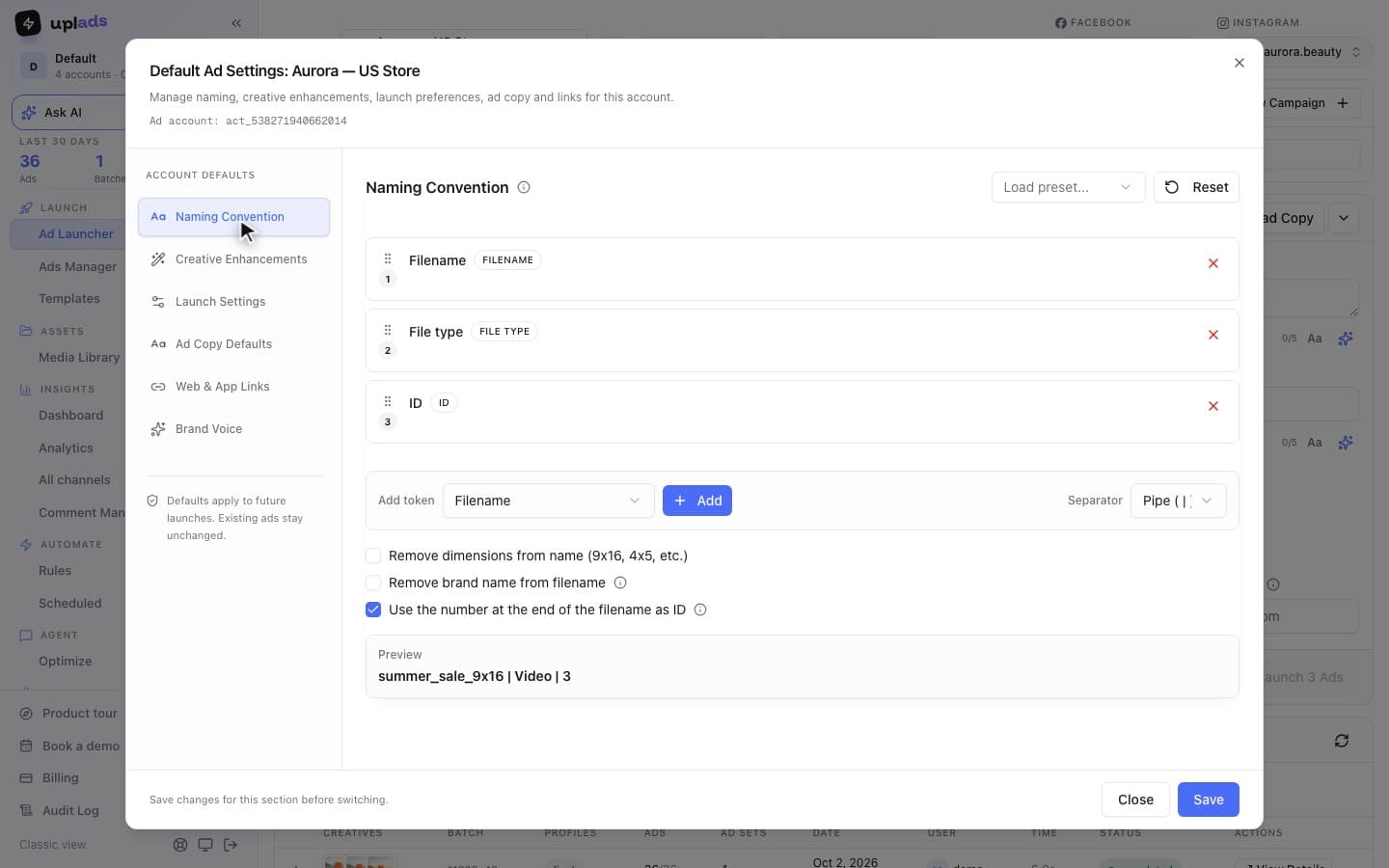
That third option is the one uplads is built around. You set a template once per ad account from a small set of building blocks: the creative's file name (cleaned automatically), the file type, an auto-incrementing number that keeps every ad in a launch distinct, the launch date in your chosen format, and a fixed label of your own text, joined by your chosen separator. Two cleanup toggles do the work humans forget: one strips aspect-ratio tags like 9x16 or 4x5 out of the name, the other drops a leading brand prefix.
The convention is not policed after the fact. Every ad in a fifty-ad launch is named from that template before it is created, and you see the resolved names in the review step before anything goes live. The business context (concept, hook, variant) lives in your filename standard; the tool does the cleaning, numbering, dating, and joining that nobody wants to do by hand. It standardizes the ad name and slots each ad into the campaign and ad sets you already picked. It does not rename your campaigns.
Stop renaming ads after every launch
uplads applies one naming template to every ad in the batch, automatically, before the ads are created.
Common Facebook ads naming convention mistakes
The mistakes are predictable, which is good news: a convention designed against them holds far longer.
- Too many qualifiers. The first version of every convention has one token too many. If you do not slice reports by it, it does not belong in the name. Cut it.
- Free-text instead of fixed vocabulary.
Lookalike,LAL,lal, andlook-alikeare four audiences to a filter and one audience to a human. Write the allowed values down and treat the list as the convention. - Mixed separators.
_at one level,-at another, a stray space somewhere. Pick one separator and never deviate. This single rule prevents more broken filters than any other. - Encoding the audience in the ad name. It belongs in the ad set. Repeating it in the ad name means it drifts in two places and your ad-level filter returns nonsense.
- No date anywhere. Without a launch date in the name, "what did we ship last week" and "archive everything older than a quarter" become impossible. Put a date in at least the ad level, always in
YYYY-MM-DDso it sorts. - A convention nobody can apply under pressure. The most common mistake of all. If applying the convention is a manual step separate from launching, it will be skipped. Design for enforcement, not for elegance.
Rolling a naming convention out across a team
Roll it out by making the convention the path of least resistance, not an extra rule layered on top of the work.
A convention adopted by memo lasts exactly until the first busy week. A convention adopted because it is the easiest way to launch lasts indefinitely. Practical sequence for a team or agency:
First, shrink it before you ship it. Take whatever your buyers propose and cut a third of the qualifiers. A convention that is slightly too sparse survives; one that is slightly too rich does not.
Second, fix the vocabulary in one place. One short reference that lists every allowed value for every qualifier. Not the format string, the values. This is the document people actually need and the one most teams never write.
Third, standardize creative filenames at the source. Whoever produces creatives names files to a fixed pattern before they ever reach the ad account. If the file name is already structured, every downstream tool, from Meta's native templates to a bulk launcher, has clean input to work from. It costs nothing to adopt and removes most of the cleanup that would otherwise come later.
Fourth, move enforcement into the launch. Whatever tool creates the ads (Meta's templates for campaign and ad set, a bulk launch workflow for the ad level) should apply the convention automatically. The goal is that a buyer who does nothing special still produces correctly named ads, because the naming is part of launching, not a chore after it. When the convention is enforced where ads are created, it stops being something a team has to remember and starts being something the account simply has.
A naming convention is one of the few pieces of ad operations that pays compounding interest. It costs a quiet afternoon to design and a small discipline at launch to maintain, and it returns clarity on every report, every creative test, and every account handoff for as long as the account runs. Design it small, fix the vocabulary, and enforce it where the ads are made. That is the entire job.