
Search "creative testing budget split" and you get a confident, contradictory answer. One ranking page says reserve 10-15%. The next says 10-20%. A third says 15-20%. The top exact-match result argues a 60/40. A Reddit thread with twenty-plus comments quietly says all of that is theory and at 100 dollars a day you can test maybe three creatives, full stop. Every page is sure, and no two pages agree.
That disagreement is the actual finding. When a question has a real answer, the top results converge. When they scatter this widely, it usually means everyone is quoting a percentage without saying what it depends on. I build the launch tooling for an Austrian performance marketing agency that runs paid ads for ecommerce brands daily, and the "what percent goes to testing" question came up in a planning call almost every Monday for years. The honest version of the answer is below, followed by the part of this problem that costs real time every week and that none of the ranking pages mention.
Creative testing budget split: the short answer
The right creative testing budget split is whatever number falls out of multiplying the minimum spend one creative needs for a readable result by the number of creatives you want live, not a percentage you pick off a blog. Express it as a percentage only after you have done that math, because the same dollar figure is 40% of a small account's budget and 8% of a large one's.
That reframing matters because it explains why the SERP cannot agree. A 10% reserve and a 60/40 split are not competing opinions. They are the same underlying logic applied to accounts at completely different stages and budget sizes. The rest of this article does the math properly, then shows why the math is the smaller of the two problems you actually have.
Budget allocation · worked example
Same €100 reserve.
Three different percentages.
- €250 total daily budget
- 40% for testing
- €500 total daily budget
- 20% for testing
- €1,000 total daily budget
- 10% for testing
Illustrative calculation: €100 ÷ total daily budget × 100. These are example inputs, not a recommended split or observed campaign results.
Why the percentage rules contradict each other
The percentage rules contradict each other because each one is a single account's correct answer being sold as everyone's rule. Strip the confidence away and the published numbers are not really in conflict, they are just unlabeled.
Here is what the ranking guides actually recommend, with the attribution attached so you can weigh them honestly rather than average them.
Look at what separates them. The 10-20% numbers describe a mature account that already has winners absorbing most of the spend. The 60/40 explicitly describes a new account with nothing proven yet, so almost everything is testing by definition. Brkfst's 15-20% is not even the same line item, it is creative production cost, not test media spend. These are four answers to four different questions wearing the same headline.
So the question is not "what percentage." It is "what does my account need," and that has a number you can derive instead of borrow.
The number that actually sets your split: minimum spend per creative
The number that sets your testing budget is the minimum daily spend one creative needs to gather a readable result, judged against your own cost per result, not a percentage and not a flat dollar figure copied from someone else's account. Everything else is downstream of this one input.
The clearest statement of the constraint in the entire SERP is not in a guide, it is in a Reddit thread: at roughly 100 dollars a day you cannot meaningfully test more than two or three creatives, because splitting 100 dollars across five ads is 20 dollars each and 20 dollars rarely gathers enough conversions to trust the read. That is the whole problem in one sentence. The binding limit is conversions per creative, not the size of the pie.
This is where Meta's learning phase sets the floor. A test cell needs enough events to move out of the noisy, unstable delivery period before its numbers mean anything. The exact spend that takes depends entirely on your cost per result: a 12 dollar lead and a 90 dollar purchase need very different daily budgets to reach the same number of conversions in the same window. So the honest sequence is:
- Take your real cost per result on this objective.
- Decide how many conversions per creative you need before you will trust the read (most teams want a test cell to clear the learning-phase region, not just touch it).
- Multiply: that is your minimum daily spend per creative.
- Decide how many creatives you want live in the test.
- Multiply again: that is your testing budget. The percentage is just that number over total spend.
If you would rather not run that arithmetic by hand every planning cycle, our free ads budget calculator turns a target cost per result and a creative count into the daily testing budget those five steps describe.
Do it in that order and the contradictory rules resolve themselves. A store with a low cost per result and a modest budget can genuinely run a healthy test on 15% of spend. A higher-ticket account testing the same number of creatives needs far more per cell, so the same test is 40% of its budget or it does not happen. Neither guide was wrong. Both were answering for their own cost per result and calling it a rule.
How to size the testing budget by account stage
Size the testing split by where the account is in its lifecycle: a new or rebuilding account is mostly testing because it has nothing proven to scale, and a mature account with durable winners can shift most spend to scaling while holding a fixed testing reserve. Account stage moves the number more than any other single factor, which is exactly why the 60/40 and the 10-20% camps both exist.
A practical way to think about the three stages:
- New or rebuilding (no proven winners). Almost everything is a test. A heavy weighting toward testing, in the region of the 60/40 the top results describe, is correct here because scaling a winner you do not have yet is not an option. The risk is not over-testing, it is under-testing and never finding the first winner.
- Growing (a few winners, still volatile). This is the genuine split decision. Enough goes to scaling the known winners to grow, while a substantial testing line keeps feeding the pipeline because one or two winners is fragile. This is the stage where a deliberate split actually earns its keep.
- Mature (several durable winners). Scaling absorbs the majority of spend, and testing settles into a fixed reserve, often the 10-20% the guides quote, sized to launch a steady cohort of new creatives every week. It never reaches zero, because every winner fatigues eventually and the reserve is what replaces it before it does.
The reserve never going to zero is the part teams get wrong most often. The day you stop testing because everything is working is the day the pipeline that keeps it working goes dry. Treat the testing budget as a permanent line item, not a discretionary one. Our guide to scaling Meta ad creatives covers why the durable growth lever is creative volume rather than budget on a single winner.
CBO vs ABO for the testing campaign, and Meta's 2026 budget controls
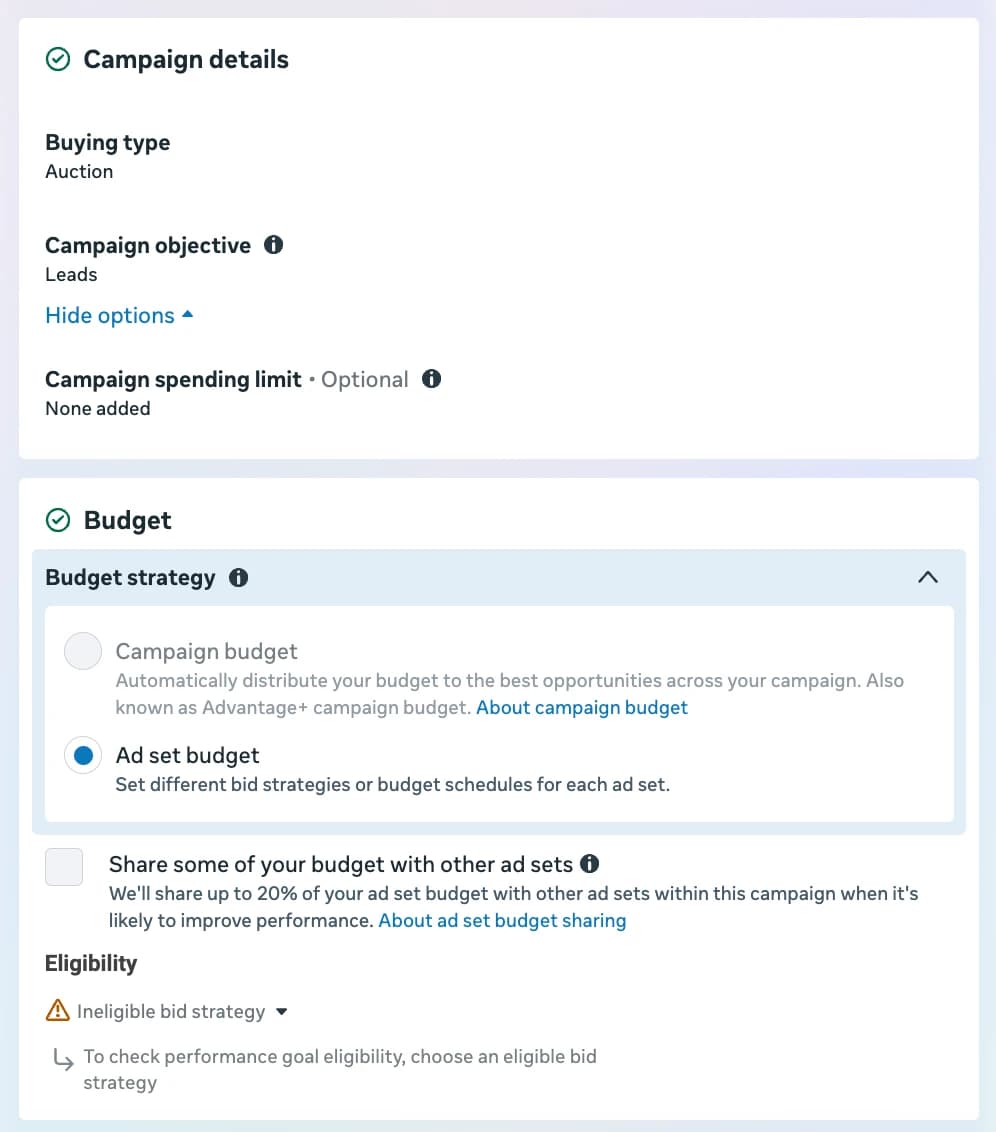
For a clean read on each creative, run the test in a separate ABO campaign with ad-set-level budgets, not a CBO or Advantage campaign budget, because CBO will starve cells it decides early are losing and you will never get a fair comparison. Use pooled CBO budgeting when efficiency matters more than an isolated read or when you are testing inside a scaling campaign rather than a dedicated lab.
This is the live debate in the video results for this query, framed as "equal budgeting: right or wrong." The answer is that it depends on what the test is for. If the point of the test is to learn which creative wins, you want controlled, roughly equal spend per cell, which is what a dedicated ABO testing campaign gives you. If the point is to grow efficiently and you accept that the system will pick fast, pooled budgeting is fine. Most teams that test seriously keep the two jobs in separate campaigns so the testing read stays clean and the scaling structure stays efficient. Meta's own creative testing guidance and its newer in-platform creative testing controls are built around exactly that separation: an isolated environment to read creatives, distinct from where you scale them.
Whatever you choose here, notice that it is still a structure decision you make once and rarely revisit. The creatives you feed that structure are a decision you make every single week. That is the bridge to the part of this problem nobody ranks for.
The launch cost the budget split debate ignores
The cost the entire creative testing budget split debate ignores is that whatever percentage you settle on, you still have to physically build and launch the agreed test cohort into ad sets every week, and that launch labor is fixed no matter what the split is. The split decides how much money moves. It does nothing about the work of moving it.
Walk through a normal week. The split says you test eight new creatives. You produce them. Now you have to get those eight into the testing campaign: the right ad sets, named to your convention so the reporting is readable later, the vertical and square versions grouped so each concept is one clean multi-placement ad rather than four duplicates fighting each other. Then you do it again next week. Then, across every client account if you are an agency. The split percentage did not change that workload by a single minute. A 10% reserve and a 40% split take exactly the same amount of hands-on launching for the same number of creatives.
That is the realization that turned a recurring Monday argument at our agency into a build decision. We spent meeting after meeting tuning the percentage, and the percentage was never what cost us the afternoon. Relaunching the agreed test cohort, by hand, across accounts, was. The number on the whiteboard was the easy half. The hands on the keyboard every week was the expensive half, and no budget rule touches it.
This is the gap creative testing as a discipline keeps running into, and it is why the weekly creative test workflow is a logistics problem more than a strategy one. It is also why how many creatives you run per ad set keeps trending up while the launch tooling most teams use stays manual.
How to run the split without losing a day to launches
To run your chosen split without the weekly launch tax, separate the two decisions cleanly: keep the budget split and the campaign structure in Meta where they belong, and remove only the mechanical step of getting each week's test cohort into the ad sets you already funded. That second part is the only thing a bulk launcher should touch.
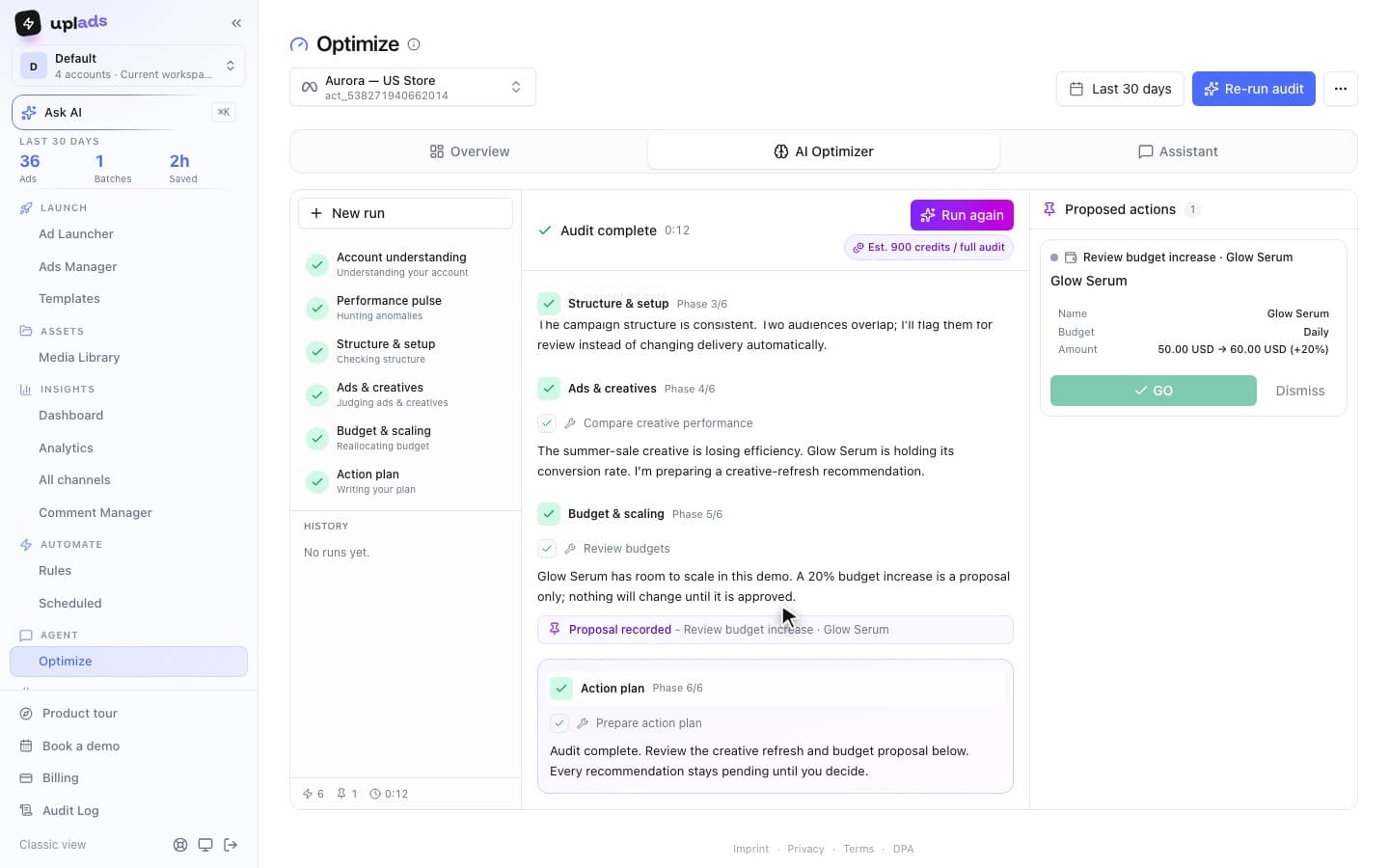
This is the scope uplads was built around, and the boundaries are the point. uplads never changes a budget or a bid on its own. You decide the testing split. You set the budgets, in Meta or in uplads when you create a campaign or ad set in the launcher, and launching into ad sets you already run leaves their budgets as they are. After launch, a budget moves only when you change it in the Ads Manager, schedule a change, or build an automated rule that does. Nothing in the launch flow invents a number or paces spend, and the spend figures you see while selecting ad sets are read-only display.
What it does remove is the repetitive launch labor: upload the test cohort once, fan every creative into every ad set you selected in a single launch, with your naming convention applied automatically from your account settings and your vertical and square files grouped into one multi-placement ad per concept. It does not design the test, choose CBO or ABO for you, set the split or generate the creative. It can draft copy variants in your brand voice and report which creatives performed, but the call on what wins and what gets more budget stays with you. Meta, TikTok, Google Ads and Snapchat all launch from the same upload. The split strategy is yours. The hour you used to lose executing it every week is the part worth automating.
Decide the split once. Stop relaunching it every week.
uplads fans your weekly test creatives into the ad sets you already funded, with naming and placements applied automatically and budgets untouched.
The creative testing budget split has a real answer, and it is not a percentage you read off a list. It is the minimum spend each creative needs for a readable signal, multiplied by how many you want live, adjusted for where your account is in its lifecycle. Derive that and the contradictory rules stop mattering. Then put the saved energy where it actually compounds: producing and launching the next cohort, every week, without the split deciding how long that takes.