
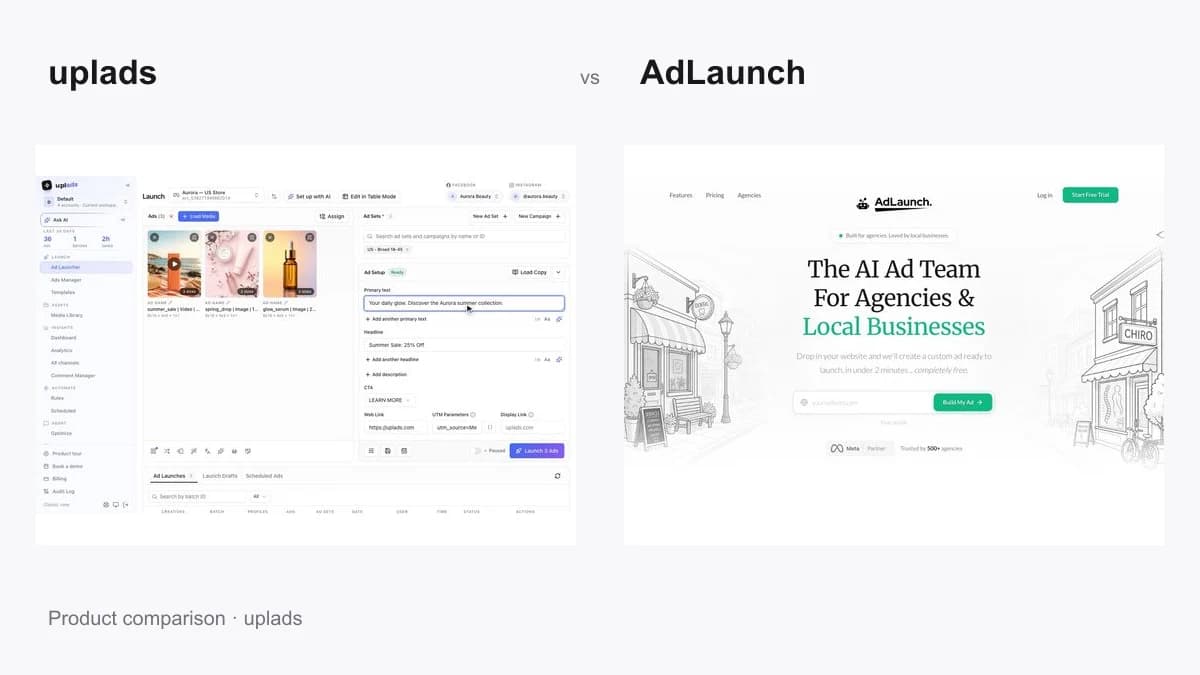
uplads and AdLaunch overlap, but they do not begin at the same point. Both can help a team reach a live Meta ad. AdLaunch puts AI creation at the center. uplads puts reliable high-volume execution and post-launch Meta operations at the center.
What each platform does
uplads is a bulk ad launch and operations platform. A user connects one ad account for a launch, uploads files or folders, maps creatives across campaigns and ad sets, adds or generates copy, applies a naming convention, and launches. Individual assets can be up to 250 MB, one launch takes up to 500 creatives into up to 50 ad sets, and duplicate files are reconciled by content hash. Meta creation requests are chunked in groups of up to 50 and each subrequest is recorded independently.
AI copy is part of the live workflow. uplads uses included AI credits or the customer's OpenAI or Anthropic API key to write up to five variants per field, shaped for each network: Meta primary texts, headlines and descriptions, TikTok captions, Snapchat headlines and the text sets of each Google channel. A per-account brand voice and saved website brief provide reusable context. Images can be analyzed visually; video copy uses the brief and filename rather than frame analysis. uplads does not generate or edit image and video assets.
After launch, uplads provides live Meta reporting, an in-app Ads Manager with bulk actions on live ads including find-and-replace text editing across a selection, approval-based optimization recommendations, scheduled launches, and automated rules on Growth and Agency. TikTok, Google Ads and Snapchat launching are live, each with its own Ads Manager, and rules also run on TikTok; the deeper post-launch surfaces are Meta-first today.
AdLaunch, according to the AdLaunch homepage (the old adlaunch.io address now redirects there), is "The AI Ad Team For Agencies & Local Businesses". Its public promise is a short path from a website to a launch-ready ad: drop in a URL and the AI creates a custom ad in under two minutes, and creating that ad costs nothing. The page carries a Meta Partner badge, says it is trusted by 500+ agencies and offers a free trial. Pricing figures were not visible when we checked in October 2026.
The cleanest distinction is visual creation versus ad operations. Both products use AI copy. Only AdLaunch publicly centers AI-generated ads built from a website; only uplads documents the detailed bulk workflow, naming, placement grouping, request status, and current Meta operating surface described above.
Pricing at a glance
Not public
Free ad from a URL; confirm plan price in the product
69€/mo
2 Meta ad accounts, 1 seat
199€/mo
5 accounts, Meta, TikTok, Google Ads and Snapchat
499€/mo
15 accounts, 15 seats
Source: adlaunch.com, checked 7 October 2026; uplads pricing page, October 2026
uplads publishes its self-serve tiers on the pricing page: Starter at 69€ a month for two ad accounts on Meta, Growth at 199€ for five accounts and five seats with TikTok, Google Ads and Snapchat, Agency at 499€ for 15 accounts, extra accounts at 39€ each and two months free on yearly billing. The 7-day trial requires no credit card and runs on Growth limits - enough to run a real batch through the whole workflow before paying anything.
AdLaunch's public site did not show a price when we checked in October 2026; the homepage links to a pricing section and a free trial. This page therefore does not guess at its monthly cost or use an older listing for a differently positioned product.
Honest pros and cons
uplads
Pros
- AI copy per platform (Meta, TikTok, Snapchat, each Google channel) with included credits or the customer's own API key
- Saved per-account brand voice and reusable website brief; AI Vision writes unique copy per creative
- Bulk file/folder upload, up to 250 MB per asset, with duplicate reconciliation
- Meta, TikTok, Google Ads and Snapchat launching; up to 500 creatives per launch
- Multi-placement grouping uses filenames and actual dimensions, with manual overrides
- In-app Meta Ads Manager with bulk actions on live ads, including find-and-replace text editing
- Naming templates, Meta reporting, scheduled launches, rules, and human-approved optimization
- Transparent EUR pricing and a 7-day no-card trial on Growth limits
- MCP connector (Beta, every plan): Claude or ChatGPT build campaigns paused and stage launch drafts a person reviews, with a daily budget ceiling on anything that raises spend
Cons
- Meta, TikTok, Google Ads and Snapchat by design; no Pinterest, no CTV
- Launches the team's own visuals - AI covers the copy, not image or video generation
- Deeper post-launch surfaces (reporting, rules, optimizer) are Meta-first today
AdLaunch
Pros
- AI builds a custom ad from a website URL in under two minutes, per its homepage
- Free ad creation from a URL, plus a free trial
- Meta Partner badge, and "trusted by 500+ agencies" on the homepage
- Strong fit for local businesses and agencies without an in-house creative function
- Meta ad creation and launch in one product story
Cons
- No pricing figures visible on the public site in October 2026
- Only Meta is named on the homepage; TikTok, Google Ads and Snapchat are not documented
- Bulk-launch internals such as placement grouping, naming behavior, and failure handling are not documented publicly
- Teams with established designers may be paying for a generation layer they do not need
Feature matrix
| Capability | uplads | AdLaunch |
|---|---|---|
| AI-generated ad copy | yes - brand voice, 5 variants, included credits or own key | |
| AI-generated ad visuals | yes (custom ad from your website) | |
| Reusable brand context | Per-account brand voice + website brief | Website input |
| Bulk file/folder upload | not the primary public workflow | |
| Maximum asset size | 250 MB per asset | not specified publicly |
| Ads per launch | up to 500 creatives, 50 ad sets, 20 campaigns | not specified publicly |
| Multi-placement grouping | yes, filename + dimensions + manual override | not specified publicly |
| Independent Meta request status | yes, batches up to 50 | not specified publicly |
| Naming template at launch | not specified publicly | |
| Bulk actions on live ads (incl. find-and-replace text edits) | not specified publicly | |
| Creative analytics (six traits, weighted by spend) | not specified publicly | |
| Facebook + Instagram launch | ||
| TikTok launch | Growth and Agency | not publicly documented |
| Google Ads (PMax, Demand Gen, YouTube, App) | Growth and Agency | not publicly documented |
| Snapchat launch | Growth and Agency | not publicly documented |
| Native reporting | Meta | Meta management claimed; detail not public |
| Automated rules | Meta and TikTok, Growth and Agency | not specified publicly |
| Scheduled launches | Meta, Growth and Agency | not specified publicly |
| AI optimizer | Meta, proposes changes for approval | AI management claimed; detail not public |
| Self-serve white-label | no; custom Enterprise listed | agency positioning; confirm white-label in the product |
| AI assistant connector (MCP) for Claude / ChatGPT | yes (Beta, every plan) | not publicly documented |
| Public pricing | 69€-499€/month + Enterprise | no price visible (October 2026) |
“Not specified publicly” is not a negative assertion. It means the public site did not provide enough detail to verify the capability.
Where uplads is stronger
The launch workflow is explicit. uplads is designed around the batch already sitting in a creative folder. Upload the files, add copy, map the targets, apply naming, review, and launch. One launch uses one ad account and can fan out across campaigns and ad sets within it. In internal timings, the batch goes live 87% faster than launching the same ads manually.
AI copy is connected to execution. The copy generator is not a separate chat window. It can use the account's brand voice and saved website brief, then place approved variants directly into the launch. The useful boundary is clear: AI helps write the text, while the team still supplies the visual asset and approves what ships.
Placement and failure handling are visible. uplads combines filename cues with actual dimensions to group matching aspect ratios and supports manual correction. For Meta, creation calls are chunked into subrequests and each result is recorded independently, so one failed ad-create request does not rewrite successful siblings as failures.
There is an operating surface after launch. Meta reporting, an in-app Ads Manager with bulk actions on live ads - including find-and-replace text editing across a whole selection - approval-based recommendations, rules with hard budget caps, and scheduling mean the product is no longer “upload and leave.” Creative analytics closes the loop: every creative that has run is classified along six traits (visual format, hook, angle, emotion, awareness stage, tone) and the report shows which traits carry the account's spend. These deeper surfaces are Meta-first today, which matches where most accounts concentrate their budget.
Test the uplads execution workflow
The 7-day trial needs no card and runs on Growth limits. Bring a real creative batch, generate or paste the copy, and compare the launch and review workflow with the one you run today.
When to choose AdLaunch
Choose AdLaunch for one profile only: the local business or small agency with no designer and no visual production at all, where AI has to create the ad itself from a website before anything can launch. When the missing designer is a genuine constraint, that value proposition is real. Every other profile is decided by the workflow that repeats weekly - launching and operating the ads - and that half belongs to uplads.
When to choose uplads
Choose uplads when image and video production is already covered and the weekly pain is moving many approved concepts into Meta, TikTok, Google Ads or Snapchat with consistent copy, names, placements, and status handling. It also fits teams that want live Meta reporting and human-controlled post-launch operations in the same system.
What uplads still does not do
- No AI image or video generation. uplads turns finished creatives into live ads; the visuals come from the team's own pipeline.
- Post-launch surfaces are Meta-first. Reporting, scheduling and the optimizer operate on Meta today and rules on Meta and TikTok; TikTok, Google Ads and Snapchat launching are live, each with a native Ads Manager.
- No self-serve white-label. Custom Enterprise lists white-label, but it is not part of Starter, Growth, or Agency.
Verdict
uplads for any team that already produces creatives - the week's real bottleneck is launching and operating the ads. AdLaunch only for the operator with no visual production at all, where AI must create the ad itself.
Both products use AI copy, but uplads owns the repeatable half of the workflow: bulk launch plus live-ad operations. AdLaunch's differentiator is visual generation.
The old framing that uplads had no AI copy or no native reporting is no longer accurate. The current decision rests on a narrower, more useful distinction. AdLaunch is the creation-led choice for one specific buyer: the business with no visual production at all. uplads is the operations-led choice for everyone else - and it does not stop at getting ads live: in-app reporting, bulk editing on live ads, automated rules and creative analytics mean the next batch gets briefed on what worked rather than generated from scratch again. Once creative production exists in any form, that is the more durable half of the workflow to own, and it is the half you can test on a free 7-day trial on Growth limits.