
Search "advantage plus vs manual campaigns" and you get a fully formed debate. One Reddit thread shares a head-to-head test. Strike Social, WordStream, Marpipe, and a dozen agency blogs argue the case with confident numbers. The whole first page is a referendum on which campaign type performs better.
The debate is real, and most of it is correct. But every page is arguing the same upstream half of the problem and skipping the half that actually costs you time every week. I build the launch tooling for an Austrian performance marketing agency that runs paid ads for ecommerce brands. Every Monday the team launches dozens of new ad variants per client. Not once in years of doing that has the Advantage+ versus manual choice changed how long the launch itself took. This piece gives you the honest decision framework and then the part the SERP leaves out.
Advantage+ vs manual campaigns: the short answer
Use Advantage+ when you want Meta's machine learning to make the targeting, placement, and budget decisions for speed and broad prospecting; use manual when you need to keep those controls for retargeting, specific inventory, or tight audience definition. For most accounts the honest answer is not "pick one" but "run both, and stop treating the choice as the thing that decides your results."
That framing matters because the campaign-type decision is a setting you choose once per campaign and rarely revisit. The creative you feed it is a decision you make every single week. The rest of this article covers the choice properly, then shows why the choice is the smaller of those two problems.
What is an Advantage+ campaign, and what counts as manual?
An Advantage+ campaign is a Meta campaign where the automation layer (audience expansion, placement selection, and budget allocation) is switched on and making delivery decisions; a manual campaign is one where you keep those controls and set them yourself. The line is about who decides delivery, not about the ad itself.
In practice, "Advantage+" is now an umbrella over several distinct tools, and it helps to keep them separate:
- Advantage+ audience. You give Meta an audience suggestion, and the system treats it as a hint rather than a hard boundary, finding buyers outside it when the math says to. Manual targeting, by contrast, holds the audience to the saved, custom, or interest-based definition you set. Meta documents the setup in its Advantage+ audience help page.
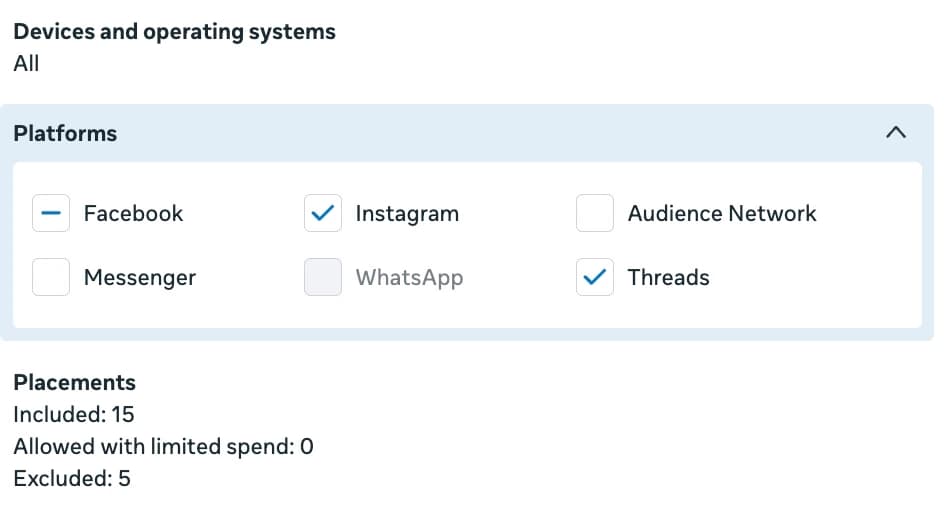
- Advantage+ placements. Your ad serves across every placement Meta thinks will perform, instead of the specific Feed, Stories, or in-stream slots you would hand-pick with manual placements.
- Advantage campaign budget. Budget is pooled at the campaign level and shifted between ad sets automatically. This is the setting many advertisers still call CBO. The manual equivalent is setting and holding the budget per ad set.
- Advantage+ Sales campaigns. This is the consolidated conversion campaign that replaced the older Advantage+ Shopping campaigns. Sales, Leads, and App Promotion objectives now turn these automation defaults on unless you opt out.
That last point answers a question the SERP keeps asking: no, Meta is not removing manual control, but it has made automation the default for the money objectives. Manual is now an opt-out path, not the front door. The controls are all still there. You just have to decline them on purpose.
Are Advantage+ campaigns more cost-effective than manual?
On Meta's own reported figures, yes, in the scenarios it measures, but the numbers compare different things and are smaller in practice than the headlines suggest. Here are the figures every ranking page cites, with the attribution attached so you can weigh them honestly.
The problem with treating these as a scoreboard is that they do not measure the same thing. Cost per result and CPM are different metrics. A 44% lower cost per result and a 47% lower CPM are not opposite ends of one comparison; they are two sides each reporting the metric that flatters them, on different objectives. That is exactly why this debate never resolves on the public web.
The practical reading: Advantage+ usually wins on top-of-funnel prospecting, speed to launch, and accounts that cannot generate enough conversion events to feed a complex manual structure. Manual usually wins on retargeting, regulated or brand-sensitive placements, and any case where a specific exclusion or inventory choice is non-negotiable. The real-world gap on a like-for-like test, the kind people share in the Reddit thread that ranks for this query, is typically far narrower than 44%, and it flips by account.
When should you use Advantage+ vs manual campaigns?
Use Advantage+ when speed and broad reach matter more than control, and manual when control protects something specific. Here is the decision compressed:
Lean Advantage+ when:
- You are prospecting cold, top of funnel, and want Meta to find buyers beyond your seed audience.
- The account is small or new and cannot feed many manual ad sets enough conversion events to exit the learning phase. Consolidating into fewer Advantage+ ad sets stabilizes delivery faster.
- You need to launch fast and do not have the hours to hand-build and babysit a granular manual structure.
- Your creative volume is high enough to keep the automation supplied with fresh inputs.
Lean manual when:
- You are retargeting, where audience precision and exclusions are the entire point.
- You operate in a regulated or brand-sensitive category and need specific placements on or off.
- You are protecting a known-good inventory pocket where manual placement has reliably driven a lower CPM for you.
- You need clean, isolated reads on a single audience or placement variable.
Most mature accounts do not choose. They run an Advantage+ campaign for prospecting and a manual campaign for retargeting and exclusions, on the same creative, and let cost per result settle the rest. That is the answer the strongest pages eventually arrive at, and it is correct.
The cost both sides of the debate ignore
Whichever campaign type you choose, the recurring weekly cost is the same: you still have to produce, name, and launch a fresh batch of creative into your ad sets, and that work does not get smaller because Meta is choosing the audience. This is the part the entire first page of search results skips.
Read the framing carefully. Advantage+ automates who sees the ad, where it serves, and how budget moves between ad sets. It does not write your hooks, cut your video variants, produce your static concepts, name your files, or push them live. Manual automates none of those either. Both models sit downstream of a creative pipeline that runs at the same cadence regardless of which one you picked. If your account needs fifteen fresh concepts a week to stay ahead of creative fatigue, it needs fifteen whether the campaign is Advantage+ or manual. The campaign-type setting changed nothing about that number.
This is why the debate feels endless: the field is optimizing the box you tick once and ignoring the work you redo every Monday. In our agency, the launch step, uploading the week's creative, applying the naming convention, fanning each file into the right ad sets, was the part that scaled linearly with client count, and it was completely indifferent to whether those campaigns were Advantage+ or manual. The macro folder we kept for "duplicate this ad set ten times and rename everything" did not care about the campaign type either. That is the tell. When a cost is the same under both options, it is not the option that is expensive. It is the workflow underneath both.
There is a useful corollary here. If the launch labor is identical either way, then the right place to invest is not in winning the campaign-type argument. It is in making the weekly creative refresh cheap enough that you can afford to run more concepts, test honestly, and let either delivery model do its job with better inputs.
The single biggest lever on Advantage+ or manual performance is not the toggle. It is how many strong creatives you can get into delivery per week without the launch grind capping you. That is the case I make in the guide to scaling Meta ad creatives, and it is the reason the how-many-creatives-per-ad-set question matters more than the campaign-type question for most accounts.
Where a bulk launcher fits, and where it does not
A bulk launcher does not pick Advantage+ or manual for you, and it should not pretend to. It removes the launch labor that is identical under both, which is exactly why it sits before the campaign-type choice rather than competing with it.
I want to be precise about scope, because the honest version of this is more useful than the marketing version. uplads is the launch layer, and it is deliberately campaign-type-agnostic:
- It does not choose your campaign type. You pick an existing campaign or create one in the launcher, with or without Advantage campaign budget, and tick the ad sets you want inside it. Whether a campaign runs on Advantage+ or manual settings is your decision, made in Meta or in that dialog.
- It does not decide budgets or bids for you. When you create structure in the launcher, you set the budget and bid strategy yourself, and the Ads Manager in uplads can change budgets and bid strategies for many campaigns or ad sets at once. The Advantage campaign budget versus ad-set budget decision is yours and stays yours.
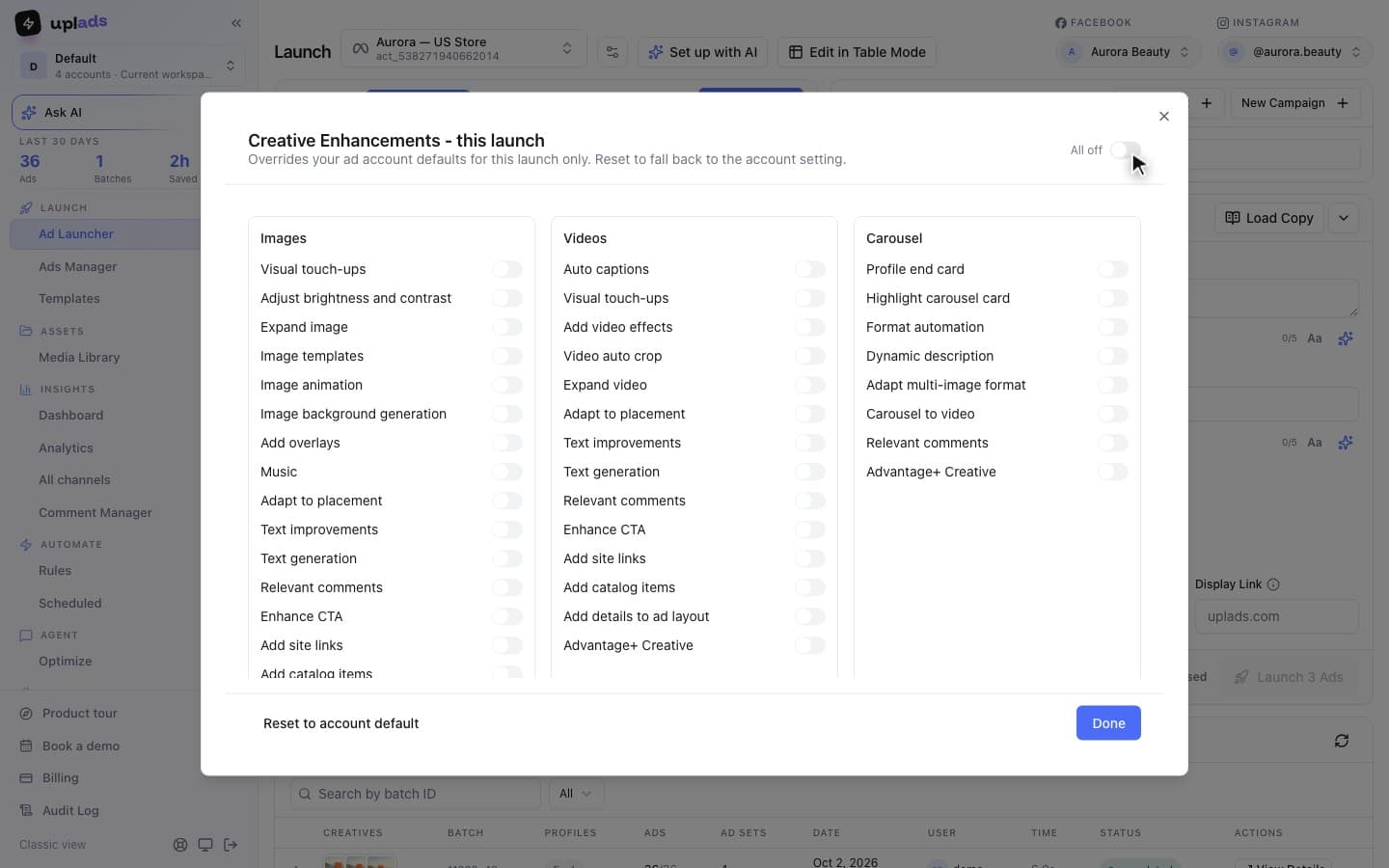
- It does not expand audiences or generate creative. Nothing in the launch path makes delivery decisions. Your files upload as they are, and the optional AI copywriter only drafts text variants that you review and edit before launch. That is the opposite of Advantage+, and on purpose: the automation you want for delivery is Meta's job; the determinism you want for launching is a different job.
- What it does do is take one upload of the week's creative and fan it into every selected ad set at once, group the aspect-ratio variants of one concept into a single ad that serves the right shape per placement, apply your account's naming convention automatically so reporting stays clean, and isolate failures so one rejected ad does not sink the batch. None of that depends on whether the destination is Advantage+ or manual.
If you run both campaign types, as the decision section recommends, this is the part that gets visibly worse without tooling: the same creative now has to be launched into an Advantage+ structure and a manual one, doubling the click-work for zero strategic reason. Removing that duplication is the whole point.
When you need a new ad set, the launcher can create one from scratch or copy an existing one with its targeting and budget. Either way the new ad set starts paused, and copying works the same whether the source was Advantage+ or manual. The settings come from you or from the ad set you copied. That is the boundary: uplads makes launching cheap; delivery decisions stay with you and Meta.
Launch 100+ ads in a single click
The campaign-type debate is the box you tick once. The creative launch is the work you redo every week. Launch a full batch of creative into your existing Advantage+ or manual ad sets in one pass with uplads, so the part that is identical either way stops costing you Mondays. See plans and what a batch launch costs.
How do you decide for your account this quarter?
Pick the campaign type on intent, not on someone else's stat, then put your energy where the recurring cost actually is. The short version:
- Prospecting and speed: start Advantage+. Let Meta find buyers and stabilize delivery, especially if the account cannot feed a granular manual structure enough events.
- Retargeting, exclusions, protected inventory: keep it manual. Control is the entire value here, and the automation has nothing to add.
- Run both on the same creative. Compare cost per result on identical inputs. This is the only honest test, and it is also a clean weekly creative-test structure if you set it up deliberately.
- Then fix the launch. Whatever you chose in steps one through three, the weekly production-and-launch workload did not change. That is where the time is. Make it cheap and you can afford to test more, which improves both models more than re-litigating the toggle ever will.
The reason "advantage plus vs manual campaigns" generates an endless debate is that it is a genuine trade-off with no universal winner, and the gap is smaller than the headlines. The reason it is also slightly the wrong question is that the cost it argues over is fixed once, while the cost it ignores recurs every week. Decide the campaign type in an afternoon. Spend the rest of the quarter making your creative launch fast enough that either model has better inputs to work with. That is the version of this answer almost nobody publishes, and it is the one that actually moves an account.