
Search "facebook ads frequency cap" and the results split into two unhelpful piles. One pile is Meta's own help docs, four separate pages for reservation, auction, reservation again, and an effective-frequency study, that never sit next to each other so you can compare them. The other pile is generic cross-platform guides telling you to keep frequency between one and three per week. Neither answers the question the Reddit threads on that same results page are actually asking: I went to set a frequency cap on my Sales campaign and there is no setting. Where is it?
I build the launch tooling for an Austrian performance marketing agency that runs paid ads for ecommerce brands. The recurring moment that made me want to write this down was watching a junior buyer hunt through a conversion campaign's settings for a frequency cap that does not exist on that campaign, then quote the "one to three per week" rule from a blog as if it were a dial they could turn. It is not a dial there. This piece is the version of the answer I wish those docs gave in one place: where the cap exists, where it does not, why the number everyone repeats is a brand metric, and what the lever actually is when you cannot set a cap at all.
What is a frequency cap in Facebook ads?
A frequency cap is a limit on the maximum number of times, on average, one person is shown your ad within a set period of time.
It is a delivery control, not a performance metric. Frequency is the number Ads Manager reports: average impressions per person. The cap is the ceiling you ask Meta's delivery system to respect. The two are easy to conflate because guides discuss them together, but you measure the first and request the second, and requesting it is only possible in specific places. That last point is the one the entire first page of results manages to skip, so it is where this guide starts.
Can you set a frequency cap on every Facebook campaign?
No. Whether a frequency cap setting even appears depends on two things: your buying type and your objective. On most performance campaigns, it is not exposed at all.
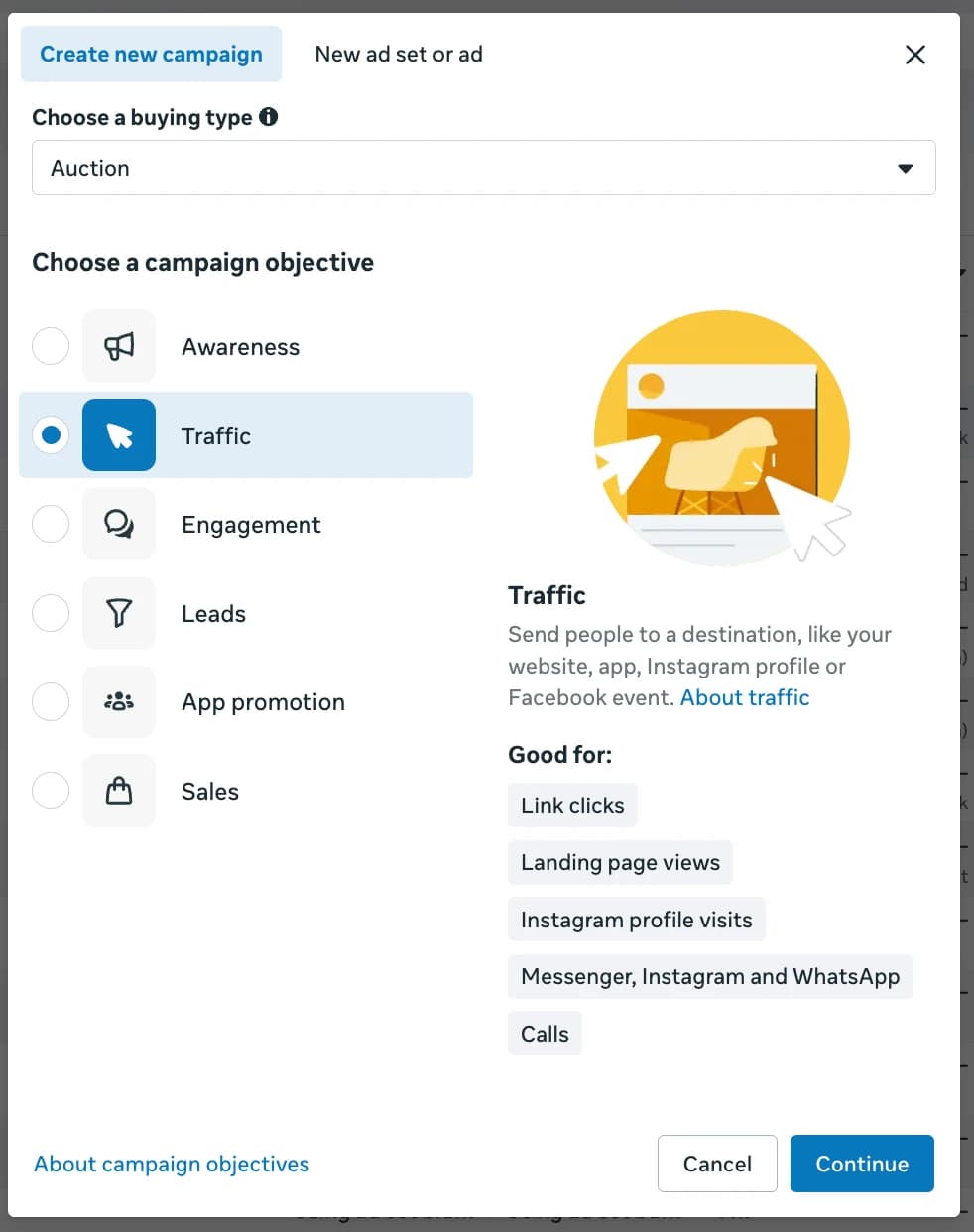
Here is the part no single page on the results page states plainly. Facebook has two buying types. Reservation is the guaranteed-delivery, fixed-CPM brand buy: you book reach in advance, and you get a true hard frequency cap plus a target frequency. Auction is the everyday performance buy, the real-time bidding system almost every direct-response advertiser uses. In auction, a frequency cap is exposed only for the Awareness and Engagement objectives. For auction Sales, Leads, and Traffic, the objectives that cover the vast majority of performance spend, there is no hard frequency cap setting. Meta minimizes repeat exposure on its own, but you cannot hand it a number.
Read the chart as one sentence: the campaigns where you can set a hard cap are the ones built for brand reach, and the campaign type carrying most performance budget is the one where you cannot. That mismatch is the whole reason this keyword exists and the reason the search results are so confusing.
Frequency cap in reservation vs auction campaigns
In reservation, the frequency cap is a guaranteed contract; in auction, it is a constrained option that exists for some objectives and not others.
Reservation campaigns are bought like traditional media: a fixed CPM, a guaranteed delivery, and frequency controls that behave like a real contract. You set a maximum number of impressions per person over a chosen number of days, for example two impressions every seven days, and Meta holds to it because it has booked the inventory in advance. Per Meta's documentation on reservation frequency controls, this is the buying type built for predictable reach and frequency, which is why the cap is firm there.
Auction is different by design. Delivery is decided impression by impression in a live auction, so a hard cap is a constraint on an optimizer rather than a booked guarantee. Meta exposes that constraint for Awareness and Engagement, where controlling exposure is the point of the campaign, and per Meta's documentation on auction frequency controls it does not expose it for the conversion objectives, where the optimizer is told to chase results and is trusted to manage exposure as a side effect. Neither approach is wrong. The problem is only that nobody tells you which one you are in before you go looking for the setting.
Frequency cap vs target frequency
A frequency cap is a ceiling that only ever holds delivery back. Target frequency is a goal that actively shapes pacing toward a chosen weekly average.
The cap says "never more than X." Target frequency says "aim for X per week and optimize toward it," which can mean pushing delivery up as well as holding it down. Target frequency carries stricter conditions: typically a campaign running seven days or more on a lifetime budget, with Advantage campaign budget and manual bid controls turned off, because Meta needs room and time to pace toward an average. If you have ever set a target frequency and watched the option vanish when you switched to a daily budget, that is the requirement, not a bug. For most advertisers the practical takeaway is simpler: a cap is the brake, a target is the cruise control, and on a standard auction conversion campaign you get neither.
Why your conversion campaign frequency keeps climbing
On a conversion campaign with no cap available, frequency climbs for a simple structural reason: a finite audience, a fixed budget, and too few fresh creatives to spread the impressions across.
Frequency is impressions divided by reach. If reach is bounded by a narrow audience and the budget keeps buying impressions, the average person necessarily sees your ads more often. There are only four ways that math changes. Widen the audience so reach grows - our free audience size estimator shows how much headroom a target actually has before frequency is forced up. Lower spend so fewer impressions are bought. Exclude people who already converted or recently engaged. Or put more distinct creatives into rotation so the impressions a person receives are spread across different ads instead of pounding the same one. The first three slow the climb. Only the last one resets what the person actually experiences, because seeing five different ads is a fundamentally different experience than seeing the same ad five times, even at identical frequency.
This is also why frequency is the earliest warning in the fatigue chain. Rising frequency is the leading signal that creative fatigue is coming, well before click-through rate, CPM, or cost per result move. If you want the full order those signals fire in, that is its own topic, covered in the order Facebook ad fatigue signals appear. The relevant point here is that on the campaigns where you cannot set a cap, watching frequency and refreshing creative is the cap. There is no other control.
A frequency cap is symptom management, not the cure
Even where a cap is available, it limits exposure to a creative the audience may already be tired of. It does not make the creative fresh. The cure for climbing frequency is creative-refresh velocity: enough new concepts entering rotation, often enough, that no single ad has to carry the audience long enough to fatigue it.
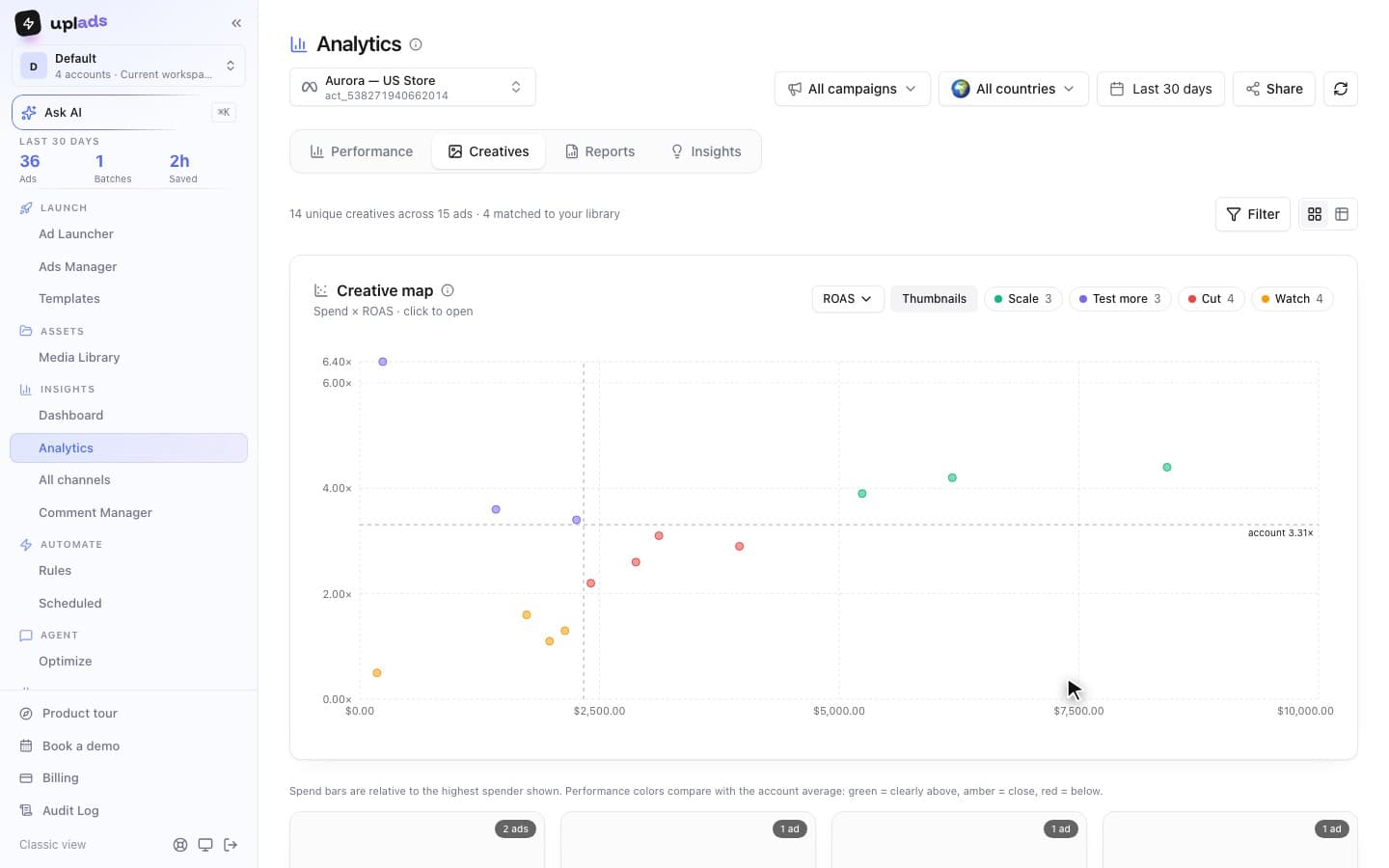
That is the part the whole results page underweights. uplads covers the detection side too, but it does not pretend that detection is the fix. Its Ads Manager shows frequency next to spend, CTR, CPM and ROAS for every Meta ad, a rule you build can pause an ad or notify you once frequency passes a threshold, and where Meta allows a cap on the ad set you can set it there. None of that makes a tired creative fresh: a rule that pauses an ad at frequency 4 still leaves the ad set with nothing new to show, and it never decides on its own which concept wins.
What uplads removes is the reason refresh is slow. You upload a week of new concepts once, and they fan out across every ad set you select in a single launch, with your naming convention applied automatically and aspect-ratio variants, 4×5 for Feed and 9×16 for Stories and Reels, grouped into one ad per concept rather than launched as separate ads. If one ad fails, that ad is isolated and the rest of the launch still ships. The frequency math does not change because of a setting. It changes because the audience is now seeing this week's five concepts instead of last month's one, and that swap stopped taking half a day.
Refresh creative faster than frequency climbs
A weekly routine that keeps frequency in check The routine that actually controls frequency on conversion campaigns is not a setting you flip once. It is a cadence you run every week. Each week, read frequency at the ad level on a seven-day trailing window, not at the campaign level where a fresh ad set hides a tired one. Where a cap is available, set it deliberately for that objective rather than leaving it default. Where it is not, treat the four structural levers as your control panel: audience width, spend level, exclusions, and above all the number of fresh creatives entering rotation. Then launch the new batch into your existing ad sets in one pass so the refresh is not the step that slips. For the structure side of that cadence, how many creatives per ad set in 2026 covers how wide to go, and the creative testing guide covers how to decide which concepts earn the next slot. The frequency cap is a useful brake on the campaigns that have one. On the campaigns that do not, your launch cadence is the brake, and scaling Meta ad creatives is the part of this that compounds: the teams that keep frequency healthy are simply the ones that can ship fresh creative faster than the audience tires of the old. uplads is built for exactly that cadence, on flat pricing that does not throttle how many ads you launch.